

Writer and Director: Jay Yu-Chieh Chiu
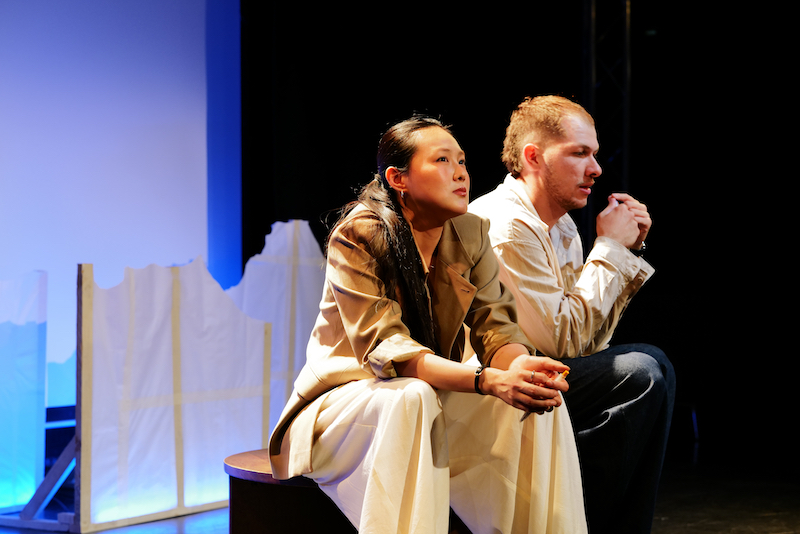
The stage is set out like a TV studio with two chairs and a projected backdrop. Scenographer Tzung-Hui Lauren Lee has created a low jagged landscape of torn paper, which changes colour with the sunset-vibrant lighting design by Felix Weis. Island Tides, staged as a reality show where the audience can vote on whether a married couple should stay together, involves a cast of five, a dozen creatives, and a whole other team to produce the film that forms part of the show. There’s plenty of skill here, but the resulting play is less than the sum of its parts.
Chia-Yi Chan plays Divorce Lawyer June (aka “Queen of Divorce”) with commitment and focus. Dressed in a stylish wide-legged ensemble, designed by Diana Dublewicz, she gives a spirited performance, sparring with “Intimacy Consultant” Ian, who is warmly conveyed by Daniel Popescu.
The two professionals are set up to argue before a “studio” audience over whether Mr and Mrs Smith should stay married. Ian seems actually to be a relationship counsellor, helping couples resolve their differences through therapy. It’s one of many confusing elements in Jay Yu-Chieh Chiu’s script, which involves elements of rhyme, rap-battle, and Socratic-style philosophical dialogues. Several sections use the language of psychological self-help guides, creating a wordy and sometimes static staging, interrupted at one point by a strange moment of expressive dance.
The show could be seen as an indictment of reality TV shows in which relationships are packaged as entertainment. Ian and June later discuss the dynamics of Love Island. Pedro Monteiro plays an irrepressible TV host, who bounds on stage to ask the audience to vote (via a QR code handed out on the way in) on whether or not Mr and Mrs Smith should stay married and have therapy or, in language reminiscent of TV show Love is Blind, “walk away” forever.
Pauline Chabosseau and Iacopo Farusi play Mr and Mrs Smith, who we only see in a filmed section, set in a real suburban home. Chabosseau is emotionally engaging as an individual actor, but their marriage seems so terminally and painfully loveless that the question of whether to stay in it feels like a no-brainer. They both assert “I still love him/her”, but it’s hard to believe them, and they spend half their time hiding in cupboards filming vlogs. At the root of their doomed malaise, there is some kind of mysterious tragedy involving a son called Henry, but this storyline is not developed.
Near the start of the show, Ian and June repeat: “We are not communicating”. It becomes a kind of refrain or mantra. In theory, this is resolved during the almost-hour-long discussion so that the characters feel communication is happening and compromise is possible, moving beyond the binary TV-studio question into the more nuanced world of real-life choices.
The title refers, at least in part, to 17th-century poet John Donne’s lines “No man is an island entire of itself; every man is a … part of the main.” There’s an interesting hint here of a metaphorical aspect to the show, a search for social connection. This is an intriguing experimental piece of theatre, involving several competing ideas. It doesn’t really work, but several elements show promise.
Runs until 30 August 2026
Camden Fringe 2026 runs until 30 August
