

Writer: Nina-Lou Bricard
Director: Daisy Roe
In this underdeveloped, but promising piece of new writing, writer and performer Nina-Lou Bricard treats us to a taster of Maeva, a young French twenty-something, whose perfect looks hide a troubled past. This short half-hour monologue, messy at times, still manages to hold our interest in the moments where Bricard fully commits to both her character and the material. The meaningful elements of this brutal story hold an immediate contemporary resonance. There is work to do, but The Waiting is an early comment on women, sex, and power.
We hear Maeva before we see her. Thumping down backstage stairs before hurtling into view from the wings. She is dressed for her wedding day and out of breath. We learn that she has run away from her groom and the party. Beyond that, in the opening moments of this show, it is initially unclear why Maeva is here. Other than the odd glib remark, Bricard doesn’t give her a reason to talk to us.
There is a bit too much bluster from Bricard, with Maeva affecting disgust with the space. We must watch her, unnecessarily, establish the world in which this character has arrived. A café, perhaps? Likely similar to the one we are all in. Instead of using the actual space in front of her, Maeva peeks into non-existent rooms, demands drinks from imaginary waiters, and shouts too often at fictional customers. She clumps about in very loud shoes. Mobile phones are tossed over her shoulder, which in this instance leads to a stage mishap, although Bricard quickly recovers.
The narrative wanders, and it’s really not until she talks to her past that this show falls into place. In fashionably black sunglasses, which she pushes down her nose with disdain, Maeva doesn’t like us, eventually confessing that she “much prefers her own company”. In an erratic outpouring of words, we come to realise why.
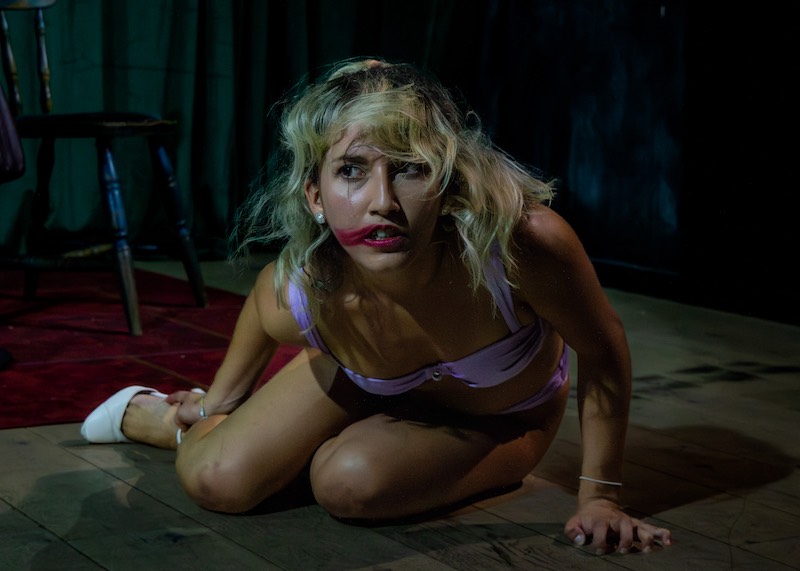
This excessive stage business is distracting, but more to the point, it undercuts the powerful events that follow. In between Maeva’s outbursts, there are refrains to something crawling on her back. This is unsettling and hints at something darker. Maeva then suddenly and violently hurls herself with force against a table. This seems unhinged at first. We are uncertain as to what’s going on. Eventually, though, it becomes clear that a past event is forcing itself into the present moment. When Maeva removes her dress and reveals what’s underneath, both literally and metaphorically, her story takes on a sharper edge.
Here, Bricard trusts her material, and this is when she holds an audience. Maeva is compelled to physically relive the horrific events that have come to define her. Both director Daisy Mae and Bricard are better with the staging in these moments. Every choreographed movement and line of dialogue, precise. It is upsetting to watch, and effective.
The comedic elements are often a distraction from the poignant material. Simone de Beauvoir’s writing is a prop that hints at deeper themes, but for now, adds little to the present action. The runaway bride is not a fully formed premise, and who is Maeva waiting for, or why? This engaging character study has yet to land in a distinct and richer context. There’s more here to find, but it’s worth seeking. When Bricard allows herself to be vulnerable in telling this disturbing story, she’s watchable, and it’s a compelling performance.
Reviewed on 23 August 2025
