

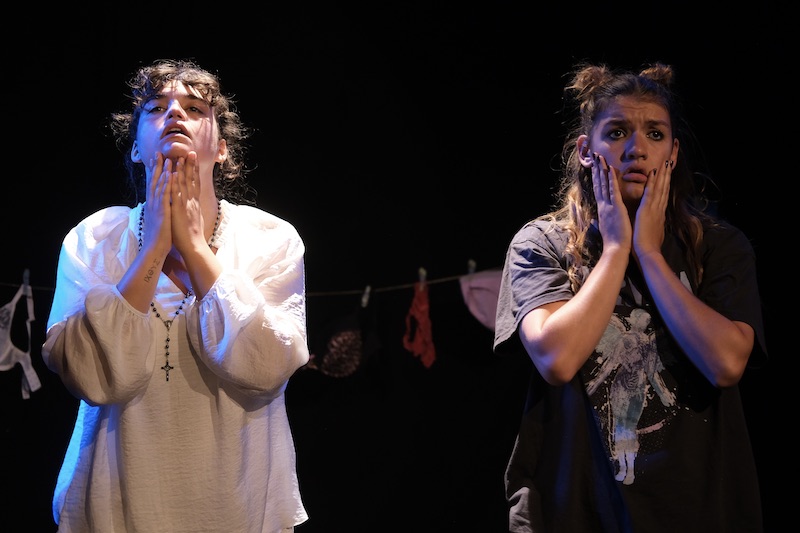
Writer and Director: Guilia Cestaro
It’s Cora’s first day at the laundrette. Set in the present day, the laundrette is like the one on EastEnders in that the staff have lots to do despite the fact that most people have washing machines at home now. But Dirty Laundry’s laundrette appears to specialise in delicates; mostly women’s underwear, and there’s plenty of Vanish to remove the stains.
With a nod to the infamous laundries in Ireland, this laundrette is a Catholic one too, although strangely, the workers, all except Mal, attend mass on Saturday instead of the usual Sunday. Head honcho at the laundrette, Sephie (Giulia Cestaro), is also the preacher at the church. Cleanliness is next to godliness, after all.
Cora (Elise Barrett) is religious, but soon develops a crush on Sephie, who wafts about, dressed in white, like an angel. Meanwhile, Mal (Tilly Hansen-Hamilton) and Edith (Mariia Zyhar) carry on a sexual affair, which is nicely represented by the swapping of clothes. Every now and then, the four stop to pray; Sephie looks serene with her hands together, Cora earnest, Edith dutiful, while Mal, eyes open, wrings her hands in doubt.
In these quiet moments, we discover more about these young women than we do in their dialogue, which is mainly about sex and masturbation. While it’s heartening to see women openly discussing sex, some of their conversations seem juvenile, almost puerile at times. Cora’s crush on Sephie is sublimated into lust for the Virgin Mary.
It’s unclear what message the play is trying to relay. Of course, women should be in control of their own bodies, but why place these four women in this odd location where religion dictates morals like a Victorian England? The laundrette is a metaphor that doesn’t quite work, especially as the play is set in our current age.
Each character has her own monologue, with Mal’s demand for equality being the most successful. Sephie’s sweary speech is so at odds with her prim and proper character on the laundrette floor that it’s doubtful if Cestaro is even playing the same person.
Dirty Laundry, as suggested on the publicity, may be fearless, but there’s a sense that the cast is out to shock rather than have nuanced discussions on women’s sexuality and the confines that religion puts on it. The stage lights seem to have a mind of their own, but they still manage to capture the spiritual scenes in holy shadows. However, when it comes to the secular, Dirty Laundry needs to go through the wash one more time.
Reviewed on 18 August 2025
Camden Fringe runs until 24 August 2025
