

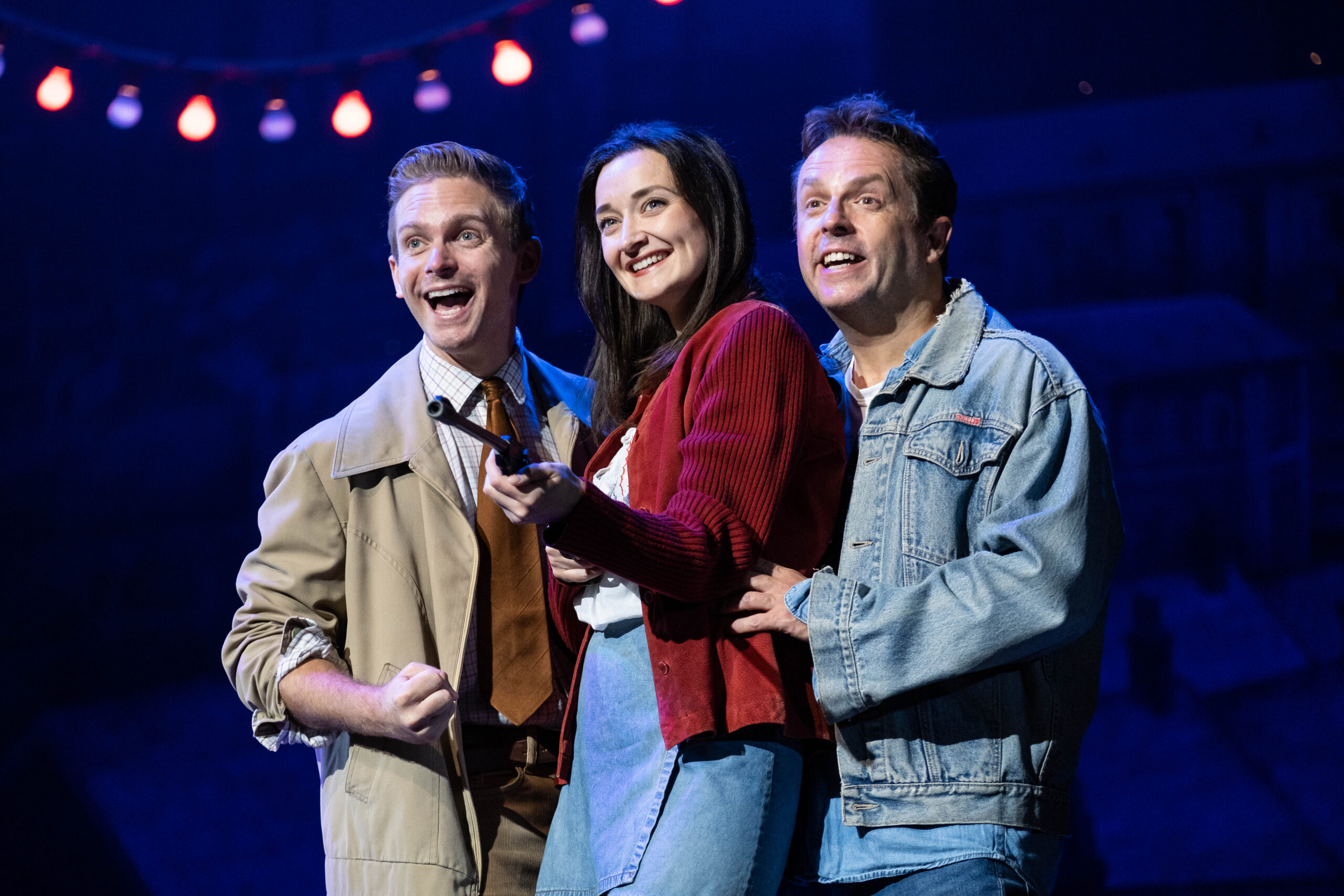
Book, Music and Lyrics: Willy Russell
Directors: Bob Tomson and Bill Kenwright
What more can possibly be said in praise of Blood Brothers? Willy Russell’s musical magnum opus has toured nationally and internationally for almost forty years and, helmed as always by director Bob Tomson, Bill Kenwright’s classic production is the epitome of the phrase ‘if it ain’t broke, don’t fix it’.
The story follows fraternal twins Mickey (Sean Jones) and Eddie (Joe Sleight), separated at birth, brought together by apparent coincidence (or possibly fate), and doomed to die if they ever know the truth. This vividly theatrical premise provides the dramatic structure for the piece – complete with ominous references to superstition and a moody, suit-clad Narrator (Kristofer Harding) who constantly reminds us that the lives of these boys, whose destinies would always be shaped by their divergent social class, are edging ever closer to disaster – yet it is the show’s emotional depth that really seals the deal. Russell’s wit and humour, deeply sympathetic and well-drawn characters, and retro (at least to contemporary audiences) musical flair, all come together to make this a British musical theatre classic.
Though Mickey and Eddie are the blood brothers of the title, the starring role is arguably that of their mother, Mrs Johnstone. Vivienne Carlyle brings a slightly bizarre operatic melodrama to the part which can be jarring when compared to the more grounded (if still characteristically big) performances happening around her. Coupled with odd vocal choices and one of the shakiest Merseyside accents in the cast, Carlyle’s performance is distracting at the best of times, meaning a lot of the major emotional beats miss the mark. This is especially a shame when we reach the climactic emotional number that rounds off the play.
The production is rescued, however, by the brothers themselves. Sean Jones is already most audiences’ Mickey, having played the role on and off since the 90s, and it is no surprise that he once again excels in the role. He strikes the balance of raucousness and sensitivity so perfectly that the case for letting someone else have a go is a genuinely hard sell. Joe Sleight’s Eddie ticks all the boxes, while Gemma Brodrick’s Linda is a joy to watch. A special mention is due for Alex Harland, who stands out from the ensemble with his comedic multiroling; he is clearly having a lot of fun.
There is an unusually comic element to Kristofer Harding’s puckish performance as the Narrator, a role that is often played with a more intimidating, sinister energy. This occasionally serves to defang an otherwise impactful moment, but his very strong vocal performance means he is always welcome onstage. The same can be said of Laura Harrison, whose minimal solos are sung with a wonderfully crisp and pure tone suitable for her role as the well-to-do Mrs Lyons, Eddie’s adoptive mother.
The magic of Willy Russell’s writing lies in the balance of a grand ‘folk opera’ tone set by the Narrator and the everyday authenticity of its mostly working-class Merseysider characters. Andy Walmsley’s set, with its council estate red bricks and grandiose backdrops, puts us in the mind of the similarly tragic West Side Story, and captures well the emotional and contextual scale of a story ostensibly about the lives of just a few people. That said, the painted backcloths and boards are palpably fake to a modern eye, though this is not without its charm. The production proudly wears its age on its sleeve and one senses that something special would be lost in updating the set for modern sensibilities.
It is easy, particularly for an audience in Sunderland, to see the influence of Blood Brothers on comparable musicals such as Billy Elliot. Despite the more sweeping chronology of the story, though, Blood Brothers is relatively intimate in scale. Billy Elliot, another working-class coming-of-age story that confronts the realities of class and opportunity in the industrial North, is as ambitious in its message about class struggle as the titular Billy’s dreams of ballet school. The Johnstones, meanwhile, are ultimately trapped by the realities of their class and Russell grants their story the same cathartic grandeur formerly reserved for the kings and queens of Greek and Shakespearean tragedy. The central superstition that claims the twins will die if they ever know their true connection is, rather fittingly, a fabrication of the upper-middle-class Mrs Lyons, who seizes on Mrs Johnstone’s working-class folk beliefs to seal their contract of adoption. Nevertheless, the pièce de résistance of the tragedy is that the twins really are doomed, and with as much fatalistic certainty, by something real: the British class system.
It feels important to acknowledge, finally, the play’s ongoing effect on young theatre makers. The text of this ‘Liverpudlian folk opera’ remains a core text for GCSE Drama classes across the country, which is apt given that the show was originally conceived for a Liverpool secondary school in 1981. Though the apparently perpetual professional life of the musical is a constant sore spot for hungry community theatre groups, it is undoubtedly a gift that students experiencing the play for the first time at school are still able to see this absolute classic on the big stage in all its glory.
Runs until 26th March 2026 and touring nationally
The Reviews Hub Star Rating
-
9
