

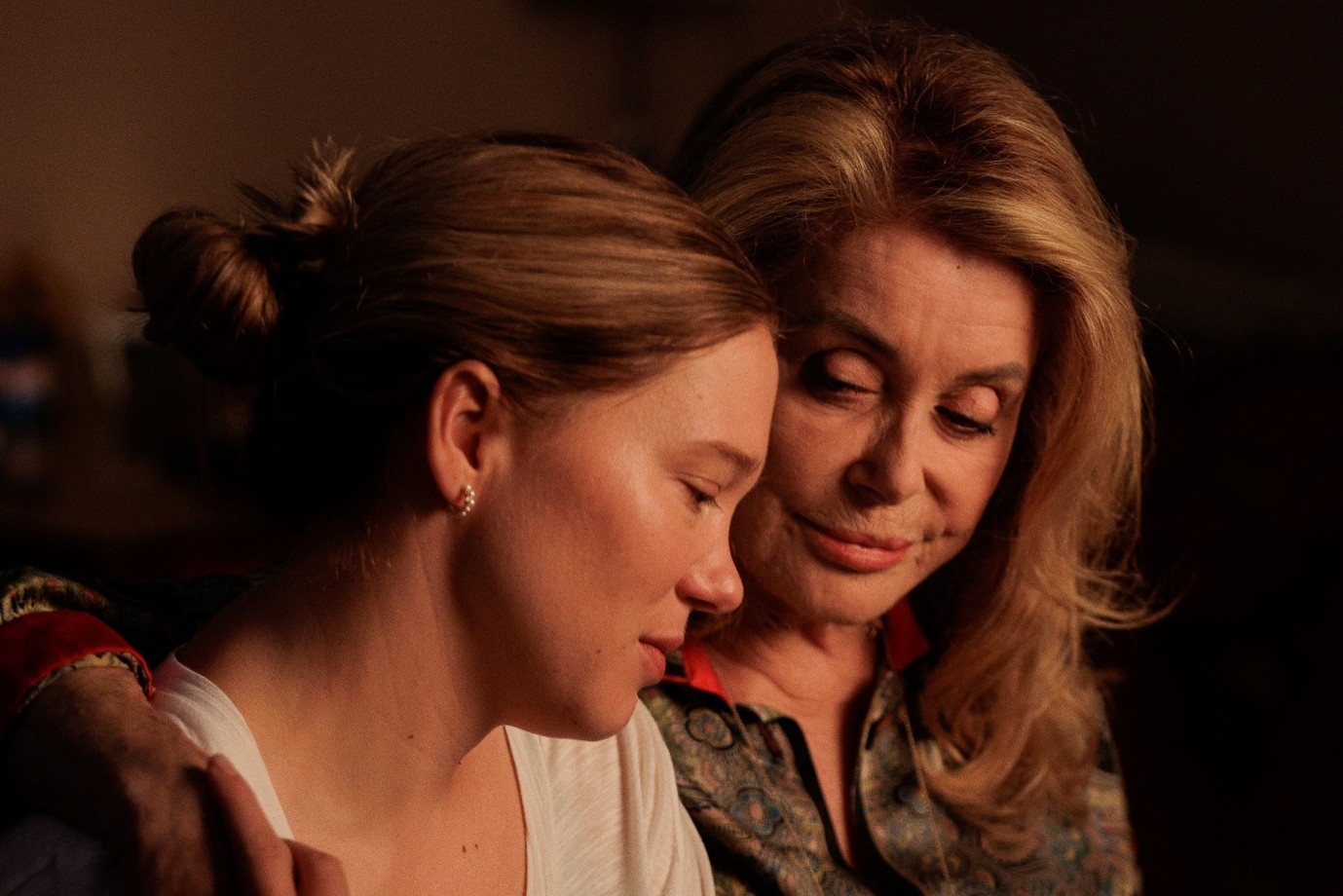
Writer and Director: Marie Kreutzer
It is a guarantee you will never hear Charles & Eddie’s 90s pop-soul anthem Would I Lie to You? the same way again after watching Marie Kreutzer’s Gentle Monster. Kreutzer has crafted a chilly, insular domestic drama that deliberately conceals more than it reveals, allowing details to surface gradually, recede, and reappear. A distinct shift from her playful period piece Corsage, this is a murkier, more complex exploration of unchecked masculinity and power dynamics – a resolutely uneasy watch, but an unnervingly bold one.
Léa Seydoux gives another finely tuned performance as Lucy Weiss, an experimental concert musician forced to confront a terrifying new reality following a shocking revelation about her husband. At its heart is a troubling question that could confront any of us: do we really know the people we love?
Lucy, her husband Philip (Laurence Rupp) and their young son Johnny (Malo Blanchet) have just moved to the countryside. So far, so idyllic and European – except that we have already witnessed Philip’s sudden panic attack back in their Munich apartment, a hint of his ongoing struggles with burnout. Then, one otherwise unremarkable morning, the police arrive at their country home to seize his hard drives, and he resignedly agrees to be questioned.
In these early scenes, Seydoux masterfully captures Lucy’s dazed bewilderment as she tries to make sense of the unravelling crisis, initially asking her husband whether he has hacked a bank. She attempts to cling to routine – dropping her son at school, performing in concert, and visiting her mother, Eloise (a quietly imperious Catherine Deneuve). A former pianist herself, Eloise is initially oblivious to Philip’s alleged crimes, but their comfortable existence soon begins to rupture and crack.
A parallel storyline follows special investigator Elsa (an excellent Jella Haase), who is caring for her father as he struggles with progressive Alzheimer’s – and who soon faces disturbing allegations of inappropriate behaviour from his live-in carer. The two storylines subtly echo one another to create a disturbing examination of how accusations, power, and patriarchal behaviour are understood and confronted. The patriarchal forces surrounding Lucy – including Philip’s lawyer – constantly reassure her that the illicit material on his computer is not what it seems, insisting that the images require “contextualising” and were strictly for research related to his vaguely hinted-at filmmaking career. Yet, as another character later hauntingly remarks, not all crimes leave physical marks.
Earlier moments, sometimes shown in flashback, take on new significance: Philip’s phone pinging with a message or his slipping away to check his laptop under the guise of work becomes a chilling exercise in concealment. Music provides another unsettling counterpoint throughout the film. French singer-songwriter and composer Camille, who previously scored Corsage, crafts a twinkly, melancholy score, while renditions of Coldplay’s Yellow and Phil Collins’s A Groovy Kind of Love are used to ironic, unsettling, but sometimes overly obvious effect. Lucy’s habit of reinterpreting famous pop songs written by men—whether onstage in concert or privately at home—becomes especially jarring as she struggles to interpret the words and actions of the man she loves.
Gentle Monster is an emotionally bruising and often difficult film, demanding that we sit with uncertainty rather than offering easy answers. Yet Seydoux delivers a remarkably unsparing, deeply sympathetic performance as a woman whose world collapses as she tries to comprehend just how little she truly knows about the person closest to her.
Gentle Monster is screening at the BFI London Film Festival 2026 from 7-18 October.
