

Writers: Jacopo Del Giudice, Paolo Strippoli and Milo Tissone
Director: Paolo Strippoli
The best horrors manage to extend the terrors of their first halves deep into their second parts. For example, Ari Aster’s Hereditary and this year’s criminally overlooked Bring Her Back maintain their initial creepiness until the final frame. However, some horrors, like Aster’s Midsommar, just end up looking silly, undermining their initial atmosphere and replacing it with gory shocks. The Holy Boy is one of the latter films, and for all its early considerations on sexuality, adolescence and grief, it fails to live up to the promises made in the first half.
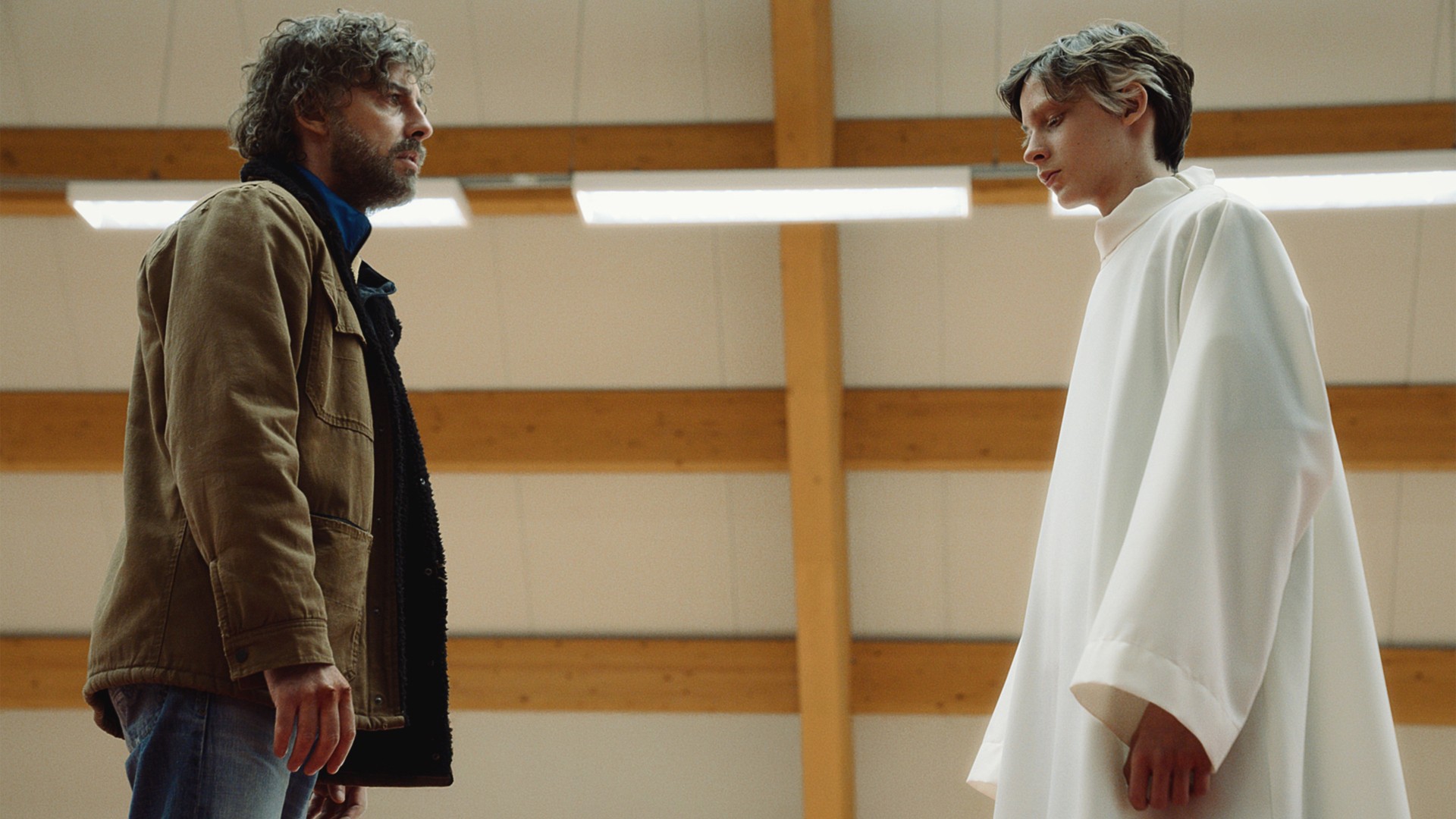
Ex-judo champion Sergio has arrived in Remis, advertised as the Valley of Smiles (indeed, La Valle dei Sorrisi is the film’s Italian title), to teach PE at the town’s school. He’s not the most enthusiastic of teachers and stands around smoking while his students jog lethargically around the gymnasium. Each evening, he drinks in the local bar, not understanding why the townspeople are so happy. They seem to have got over the train crash that devastated the town 15 years earlier.
But one night after drinking too much whiskey and smashing one of the quaint plates that adorn the bar’s walls, he finds out the town’s secret. He’s taken to a secret church by the barmaid to meet The Holy Boy. In fact, it’s Matteo, one of Sergio’s pupils, who, as he’s excused from gym, listens to tacky pop while his classmates exercise. Venerated as a saint in the town, Matteo can take away people’s pain. And Sergio has bags of it as he’s grieving the loss of his son. However, when he’s enveloped in Matteo’s embrace, the hurt Sergio’s been carrying disappears. He can now smile along with the rest of the town.
Matteo’s father runs his son’s life as if he were the manager of a 1950s rock ‘n’ roll star. Matteo must perform every night, and his father books 15-minute slots for each anguished townsperson. Women come to pray outside his window, while another mother has a painting of him, reminiscent of the Sacred Heart image of Jesus. She tracks her own tears onto his face.
There’s only one person in the town who fails to be convinced of Matteo’s gifts: the school bully, Lorenzo. Unfortunately, Lorenzo is the one person Matteo wants to impress. Matteo is in love with the boy who throws him to the ground. Not quite seeing the full picture, Sergio suggests to Matteo that judo may help him stand up for himself.
With the whole town keeping a secret, there are, of course, hints of The Wicker Man in Paolo Strippoli’s film, a kind of folk horror, but where the landscape is never a character. While the Swiss chalet-like houses are lovely to look at, there’s a sense that this story could take place anywhere. The church in Remis, with a shiny wooden floor, appears more like a room in a conference centre and the old train station where Matteo and Sergio like to meet lacks the looming atmosphere it needs.
Later, when the townspeople stand on street corners as if they are in the 1978 remake of Invasion of the Body Snatchers, everything is too choreographed, too deliberate. And the odd balletic finale comes out of nowhere, and its graceful flourish sits uncomfortably with the rest of the film.
However, newcomer Giulio Feltri is excellent as the eponymous character. He clearly portrays a boy caught up in hormones and expectations. There’s great pleasure to be had in watching him show the white of his eyes when he powers up his psychokinetic trances. As Sergio, the rugged Michele Riondino brings a kind of action-hero vibe to proceedings, but he plays the ex-judo champ’s languor well.
While The Holy Boy loses its eeriness in the last hour, the homoerotic charge between, variously, the three male characters ( Sergio, Matteo and Lorenzo) gives the film an interesting angle. As to the rest of the townspeople, they are just looking for salve rather than salvation.
The Holy Boy is screening at the BFI London Film Festival 2025 from 8-19 October.
