

Writer: Rajiv Joseph
Director: Omar Elerian
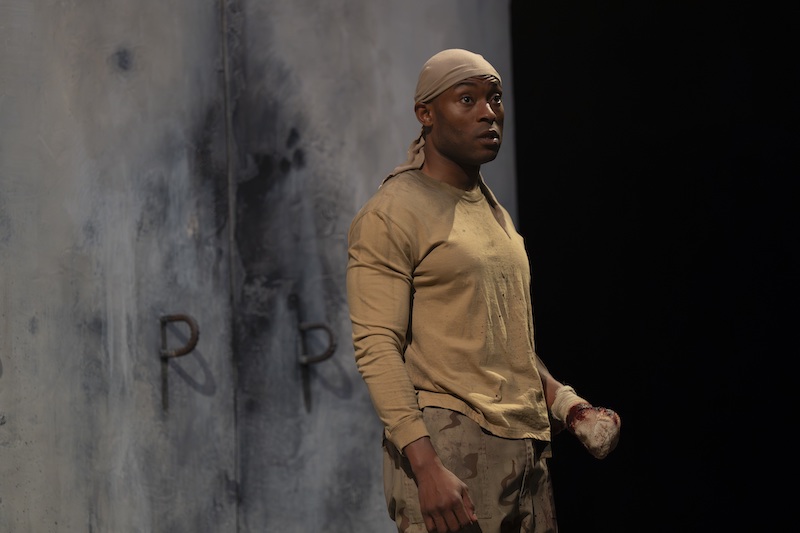
Rajiv Joseph’s play Bengal Tiger at the Baghdad Zoo, directed by Omar Elerian, is a darkly comic meditation on war. It’s set in 2003, following the US invasion of Iraq and the capture of Saddam Hussein. A bizarre real-life event forms the imaginative core of the play: a Bengal tiger, starving in captivity, is shot dead, having bitten off the hand of a US Marine. In the drama, ghosts of tiger and murdered people alike roam the smoking ruins of Baghdad searching for meaning.
First performed in 2009, how well does the play stand up? An obvious difficulty is the lapse of time since 9/11 and its consequences. The play’s programme works hard to fill us in on a quarter-century of events, but with its complex timeline and serious articles, it may make us feel overwhelmed by our own ignorance. The play itself aims to simplify causes and effects by focusing on two marines, Kev (Arinzé Kene) and Tom (Patrick Gibson), patrolling the ruined zoo. It is here they encounter the eponymous tiger. Powerful sound and visual effects (Elena Peña and Jackie Shemesh) are suitably disorientating, but make it hard to catch much of the shouted dialogue. Much is made of Tom’s severed hand, as later, in a blackly comic echo, a severed human head is light-heartedly used by Uday (Sayyid Aki), the murderous son of Saddam Hussein.
The tiger returns as a ghost, engagingly performed by Kathryn Hunter. She roams the stage, commenting with gravelly voice and dry humour on the existential ironies of war. The lions, she tells us, managed to escape from captivity, only to meet their deaths outside. What sort of God, she wonders, creates a world and then allows it to self-destruct?
The tiger is a fabulous character in all senses. Her ghost haunts Kev, the remaining marine, who is consequently deemed to be insane. Tom, returning from surgery in the US with a bionic hand, is motivated less by a desire to reunite with his erstwhile buddy, Kev, than to retrieve two treasured possessions. There’s a lot of laughter at the notion of the gold-plated revolver, looted from Hussein’s presidential palace as there is for the equally absurd notion of Hussein’s gold-plated toilet seat. But they are devices which are in danger of being overworked in the play, used increasingly for easy laughs.
Indeed, much of the humour in the play comes from obvious targets – the tiger’s droll reflections and the clearly signalled shifts of tone. Most egregious is the introduction of Uday. In real life, Uday was indeed a monstrous character, known for his love of extreme cruelty. Sharp-suited and moustached, Aki plays him very much in the style of Borat. Yes, it’s a funny performance, but Uday is a pantomime villain whose presence adds no subtlety to Joseph’s themes.
The female characters are also simplifications. Sara Masry is Hadia, sister of the translator Musa, who is threatened with sexual assault and later plays a similarly vulnerable Iraqi teenager. Then, in a bizarre scene in the desert, where Tom has insisted his translator Musa (Ammar Haj Ahmad) takes him to retrieve his looted gold, a striking woman in black (Hala Omran) – we’re told she’s a leper – appears to deliver a powerful sung lament. It feels a strange shift in tone – as she moves with slow grace, and it’s as if we are suddenly watching a Greek tragedy. This might, we feel, be where the play comes to rest. But no, there’s more absurdity to come, as the play wanders on for its full two-and-a-half-hour playing time.
There are interesting themes here – Musa, for example, in his role as translator, embodies the difficulties of communicating in intense moments of war. But there’s a lot of dialogue in Arabic without surtitles, which only serves to emphasise the otherness of the Iraqis.
As a play about underlying emptiness, Bengal Tiger at the Baghdad Zoo lacks clear focus and depends too heavily on easy laughter for its effects.
Runs until 31 January 2026
The Reviews Hub Star Rating
-
5
