

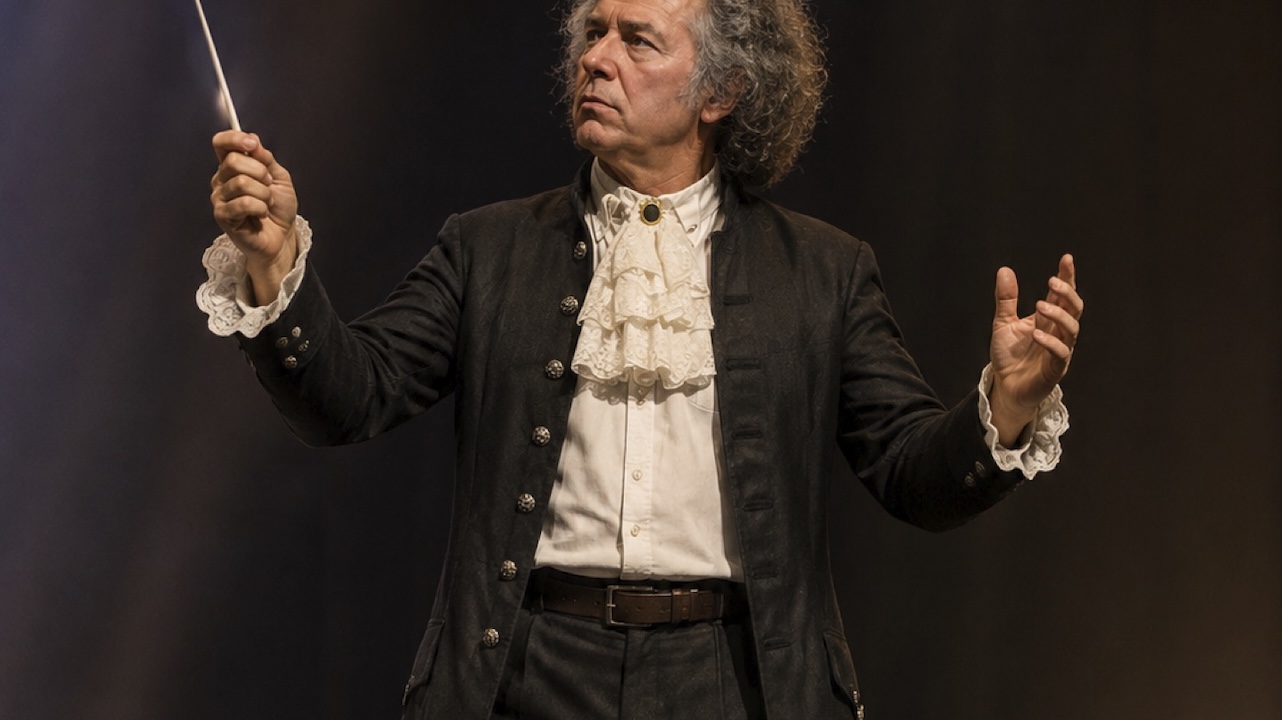
Writer and Director: Mike Venables
In this entertaining and passionately performed one-man show, Birmingham-based writer and actor Mike Venables presents us with a conundrum – who was the ‘Immortal Beloved’ Beethoven addressed in the three letters found, unsent, in his private papers after his death. It is a question that has entertained music scholars and historians for nearly two hundred years without consensus. A quick search discovers that at least 10 names have been put forward over the two centuries, including the three that Venables chooses to focus on.
The play takes us chronologically through Beethoven’s life, from early battles with his tyrannical, alcoholic father, through the devastating death of his mother, when Beethoven had to essentially become the father to his two younger brothers, to the start of his working life as both teacher and composer. Along the way, we briefly meet Haydn, who became Beethoven’s mentor for a short time, and Mozart, a meeting that is now disputed by some scholars, but certainly makes for a good story. And as brought to life by Venables, who has an excellent capacity for vocal characterisation, all these characters are vividly in the room with us.
The main part of the narrative details Beethoven’s relationships with three of the women who could be the subject of the letters, and Venables chooses to focus on Josephine Brunswick as the most likely object of the composer’s affection. And it is a very compelling narrative he gives us. Forbidden love, secretive meetings, a disapproving maid, and a near-death experience with a carriage all make for an excellent story.
Alongside this, we get the second strand of the narrative, and the one that gives the show its title, Beethoven’s well-documented battle with hearing loss and the suicidal depression it gave him. Venable’s script gives us less of this part of the story, but enough to show the impact on his health. One dialogue directly demonstrates when Beethoven realised he was losing his hearing very effectively, but later scenes appear to show him having conversations without referencing the hearing loss, which is a little confusing. But it is clear that Venables’ choice is to focus on the letter and the relationship, the deafness being a supporting part of the narrative, so this is a minor quibble.
The third strand of the evening’s storytelling comes with the second performer in this one-man show! Throughout the play, the narrative is very well supported by the pianist Rebecca Weston playing a series of well-chosen and well-known Beethoven melodies, with a delicacy that perfectly supports the storytelling. Indeed, there are a couple of moments when the timing of music and text is perfectly in sync, demonstrating how closely Venables and Weston have collaborated and rehearsed to hone their story. From Minuet in G for the early years, through the Moonlight and Pathetique sonatas underpinning the love story, to the Allegretto from the Symphony No 7 and, of course, Ode to Joy, the instrumental underscore is not simply an added luxury, but an essential ingredient in making this play work.
While not shying away from a couple of darker moments in the story, this performance, mainly by virtue of Venables’ very winning, characterful delivery, is very definitely in the “cosy biopic” genre (if there is such a thing), and that is not a criticism. The audience at the Thimblemill Library was very responsive, and the style of Venables’ natural storytelling fits this venue and its supportive local audience perfectly. And with the able support of Weston’s delicate accompaniment (and maybe a different moment of participation I shall not spoil here) this makes for a very enjoyable evening’s entertainment.
Reviewed on 9 October 2026
The Reviews Hub Star Rating
-
7
