

Writer: Luke Adamson
Director: Matthew Parker
If anywhere can show you that you need neither a huge stage nor a huge cast to deliver an enjoyable panto, it’s Penge’s Bridge House Theatre.
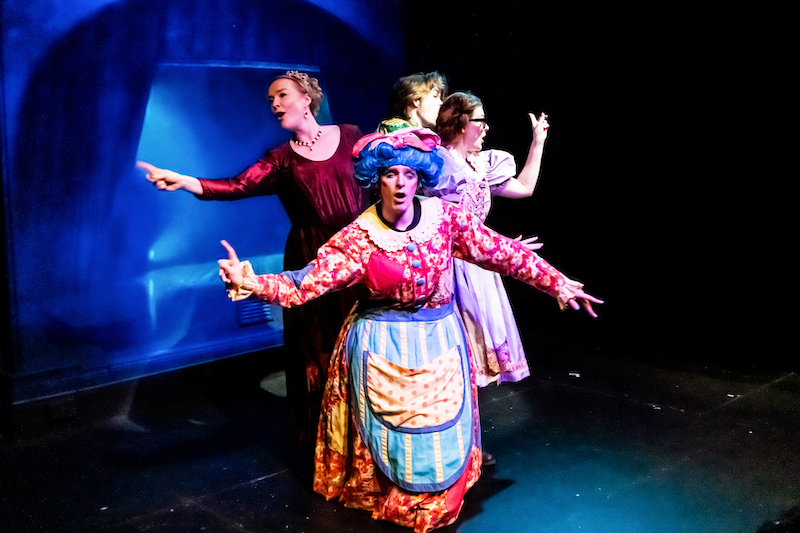
Beauty and the Beast, written by the venue’s artistic director, Luke Adamson, features a billed cast of just four characters: the prince/beast, the beauty, the dame, and the villain. From that, a tale is spun that is rooted in familiarity but with plenty of whimsical humour.
Theo Bracey’s Prince Philipe is a vain recluse who has already sequestered Cameron Griffiths’s Dame Fifi Frimousse into servitude after she trespassed in the castle grounds. When the prince breaks his beloved mirror, Fifi must travel to the local town of Penge-sur-la-mer to order a replacement. There she encounters both the evil Lady Amere (Cassandra Hodges), who claims to be a sorceress but performs magic tricks so inept they’d make Tommy Cooper wince, and Georgina May Haley’s booksmart young woman, Belle.
As Act I progresses, we get the usual adaptations of pop songs, although the Bridge House team cast their net wider than most – there aren’t many pantos that would cover a Victoria Wood song (Andrea, also known as A Better Day). Vocally, the cast all have opportunities to demonstrate their strengths. However, Griffiths is the most consistent in their delivery, alternating between a high tenor and a deep tone for both comedic and dramatic effect. Throughout the show, musical director Zara Harris’s arrangements help accentuate the show’s already heightened mood.
As the story progresses, Haley charms as the no-nonsense young woman who’s every bit the prince’s equal, unafraid to show her knowledge. There aren’t many pantos that’d have the heroine embark on an aside about Jane Eyre and how its titular heroine also falls in love with a crotchety and rude employer. But that is one of the charms of Adamson’s script – every time panto convention suggests the play should zig, we’ll instead see the characters zag.
Indeed, there are plenty of meta gags about how the characters know they are in a pantomime in a small theatre. Stage manager Tom Thornhill is even dragooned into becoming a fifth character, frequently turning up on stage to extricate the characters from whatever muddle they’ve created.
There are occasional missteps – Dame Fifi’s obsession with a candlestick combines allusions to Disney’s version of the tale with rather more adult tastes, for example. But it is the moments that truly work that dominate, distilling everything great about panto into a pint-sized experience.
It all adds up to a small but mighty production that is perhaps closer to the music hall origins of modern pantomime than many of the larger, slicker shows that dominate the genre. Beauty and the Beast demonstrates that, whatever the size of the theatre, there is a type of panto that suits.
Continues until 30 December 2025
