

Music and Lyrics: Hannah Corneau
Book: Mona Mansour
Director: Michael Greif
The chaotic, passionate marriage of F. Scott and Zelda Fitzgerald has continued to spark intrigue over 100 years since the pair tied the knot. It is this incredible union that forms the focus of the new musical, Beautiful Little Fool.
Penned by Mona Mansour and Hannah Corneau, the musical is told through the eyes of the Fitzgeralds’ daughter, Scottie (performed by a powerful Lauren Ward), who guides us through her parents’ turbulent, terrific partnership. It is a rapid 90 minutes that is compelling, sweeping the audience along with a romance that feels taken straight out of The Great Gatsby, before personal and professional jealousies and tragedies tear the two apart.
Corneau’s songs are more rock-based than anything representing the Jazz Age time the Fitzgeralds meet in. This is not particularly problematic here, using the raucous sounds to reflect the sensuality and chaos of the marriage, though some of the song choices are a little too similar, particularly by the end, where more time could have been given to tidying up some of the two-dimensional dialogue that hinders in places.
David Hunter, as F. Scott, and a tremendous Amy Parker, standing in for an indisposed Corneau as Zelda, work hard to bring to the fore the attraction the pair has for each other, before it so brutally erodes. Hunter’s portrayal of one of America’s greatest writers is at full throttle, spotlighting not just his infatuation with Zelda, but the vulnerabilities and insecurities about his own writing that render him paralysed with artistic fear. That said, the script’s exploration of F. Scott’s complexities is problematic. It asks us to feel sympathy for a man lacking in direction one moment, and disgust for the same man, abusive and controlling towards his wife, the next. This could do with some development, especially as it is clear that this piece is pushing us towards learning more about Zelda and her marginalisation, perhaps biting off a little more than it can handle, to an extent, by looking at both parties.
F. Scott’s vulnerabilities and abuses, in a relationship, are toxic enough, yet this is compounded by Zelda’s own artistic desires, cruelly kept out of the limelight by her husband; the musical is as much about bringing to the fore Zelda’s forgotten talent as it is their frenetic marriage. Parker excels in their delivery of Corneau’s songs, injecting each number with a level of energy and fury that gives much more developed focus on Zelda’s character, clearly the piece’s aim.
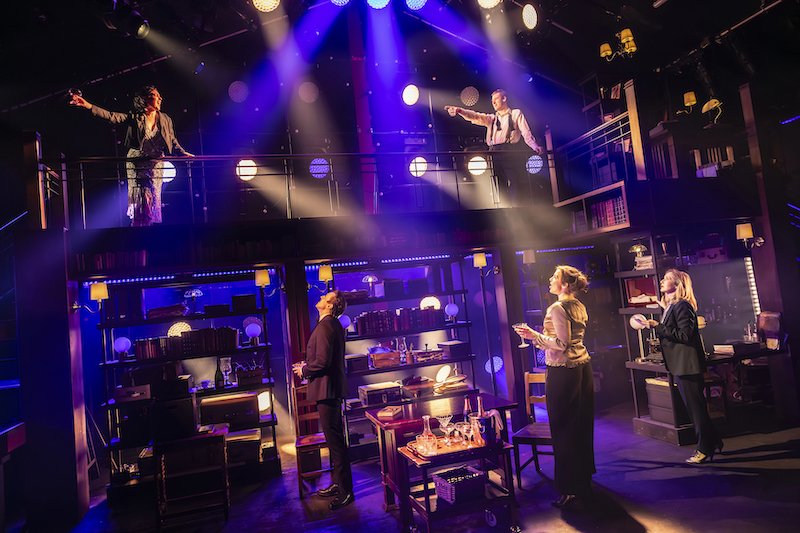
Yet it is Ward who threatens to steal the show and the attention away from her onstage parents. It is a deft touch to present us this relationship through the eyes of their suffering daughter, Scottie. The musical starts bittersweetly as Scottie, sitting in a gorgeously designed archive room, reflects on having outlived both her parents. The sense of tragedy is palpable, and this heads to a moving, poignant finale that both captures the gutting demises of both F. Scott and Zelda, while also honing in on their endless love. The decision to include a narrator smooths over any gaps for audiences unaware of the Fitzgeralds’ lives, and does help to sort out some awkward dialogue, which is not as memorable as the show’s songs.
Shankho Chaudhuri’s design is one of the production’s impressive aspects. The monochrome multi-level design works well to allow Scottie, in particular, to cast an eye over the parents, while centring the play in the archive room, surrounded by books, artwork and writing equipment, which are neat reminders of what made, and broke, the Fitzgeralds.
Just like F. Scott and Zelda, this musical has a great deal of potential, but unlike the pair, Beautiful Little Fool does not squander it. Despite some clumsy dialogue, which is used mostly to fill in the time between songs, and there are quite a few in just 90 minutes, the final result lands a moving ending.
Runs until 28 February 2026
