

Writer and Director: Clara Kraft Isono
Presented as part of this year’s Raindance Film Festival, Bawa’s Garden is Clara Kraft Isono’s beautifully made documentary about foremost Sri Lankan architect, Geoffrey Bawa (1919-2003). It is a simply mesmerising film in which Kraft Isono rejects most of the conventions of documentary in order to achieve a poetic meditation both on Bawa himself and the lost places of a growing, changing Sri Lanka.
Although the film uses talking heads – former colleagues and friends of Bawa, in particular – they too are caught up in the legend of Bawa. Kraft allows their words space to breathe, using extended sequences of slow shots, uninterrupted by restless editorialising. Sometimes there is silence; sometimes a tranquil soundscape of calling birds and melancholic music. Inspired by Bawa’s vision, Kraft Isono tell us at the start “This is a fim about architecture, but it all started with a garden,” and the film circles around this vision, until finally arriving at Bawa’s beloved home and now-wild garden at Lunganga.
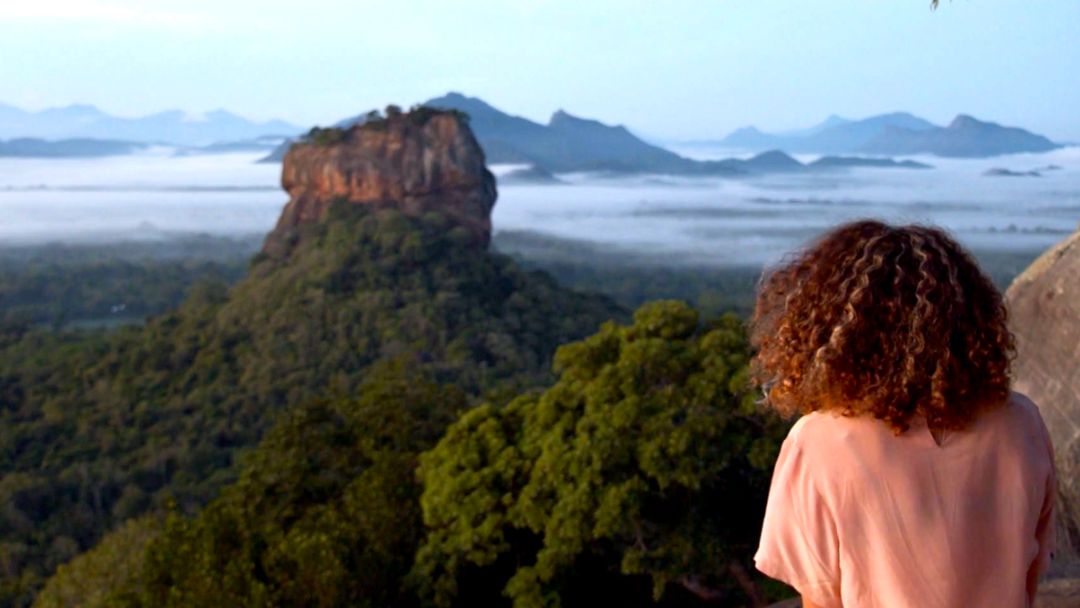
Kraft Isono shows us Bawa’s world through the eyes of the director’s proxy, French-speaking actor, Lea D’Allbronn Alexandre. It is an effective device: she who is supposedly making the journey in search of Bawa’s influence and it is her voice we hear in the voiceovers. She never speaks of herself, however, or directly to camera. Rather the camera simply watches her. We see her writing in her journal in various hotel rooms, staring into space or even languorously asleep. Her journey is a pilgrimage in search of Bawa the man and the influence of his vision, the final destination of which is Lunganga, his beloved house and garden.
The film touches lightly on Bawa himself. He had a privileged upbringing in Sri Lanka, before studying law at Cambridge. Before settling in Sri Lanka for the rest of his life, he seems to have done a sort of Grand Tour of England and Italy together with a lover – the sole reference to Bawa’s personal life. The two gardens that particulary influenced him are Stourhead in Wiltshire and the strange Garden of Bomarzo, or the Park of the Monsters, in northern Lazio. We might wish for a more detailed meditation on what particularly caught Bawa’s imagination about these gardens – the English one a monument to the new awareness of classical design, the Italian one a sixteenth-century anomaly. Stourhead, perhaps, suggested to him the idea of a garden designed to gives startling vistas. Or was it more to do with the eighteenth-century love of ruins? Possiby Bomarzo’s strange mannerist statuary spoke to Bawa’s love of the grotesque. A chapter of the film is devoted to his friend the sculptor Laki Senanayake who created the vast statues for a particular building in Galle. But on the whole, the film prefers us to experience something of Bawa’s response to Sri Lanka’s ancient beauty rather than analyse it.
Another deliberate omission is any engagement with Sri Lanka’s complex colonial past. Bawa, Kraft Isono argues, has been unfairly side-lined as an elitist eccentric and it is understandable that in the interests of maintaining her dream-like vision of Bawa’s relationship to the country’s haunting landscapes, that the film stays silent on this. But nonetheless, it is uncomfortable to hear that on political issues Bawa ‘avoided taking sides’. Kraft Isono’s sequence about the chapel he built for the impoverished nuns at Bandawalela in which little girls are shown solemnly intoning Hail Marys, does little to banish the spectre of elitism.
Of the other twelve or so chapters of the film, Kraft Isono considers Bawa’s design of the monumental hotel at Dambula; others are simply titled ‘the rain’ or ‘secrets’. The former demonstrates the excellence of Daniel Chaytor’s cinematography, splendid throughout the film as is the sensitive original music by Jasmin Kent Rodgman and the exquisite sound design by Lars Knudson and Sunjna Mullik. In one glorious sequence, we watch a magnificent rain storm deep in the woods, as water pours off buildings and drops bounce off old stone stairs.
Overall, the meditative quality of Bawa’s Garden is hard to resist.
Bawa’s Garden is screening at the Raindance Film Festival 2022.

1 Comment
Thank you Jane for such a thoughtful and sensitive review!