

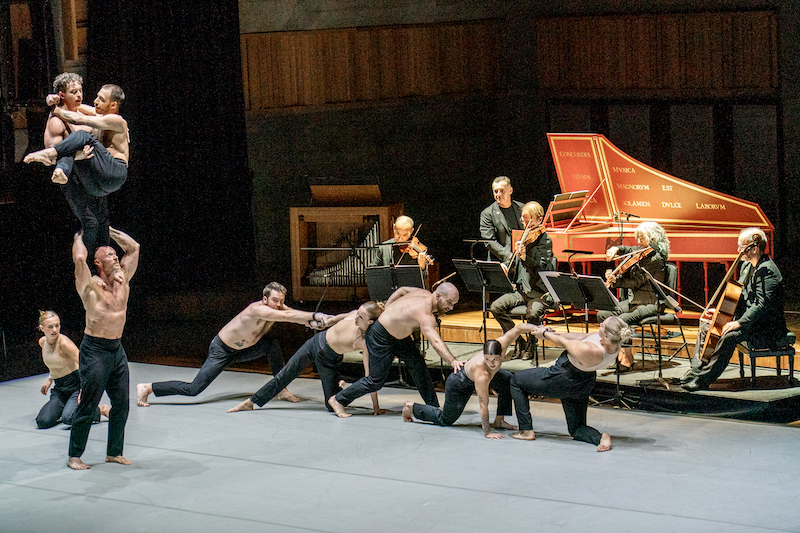
The Art of Fugue, performed by Circa and the Australian Brandenberg Orchestra, is a particularly imaginative pairing of art forms at Southbank Centre’s exciting Multitudes festival. Johann Sebastian Bach’s final composition, his intricate The Art of Fugue, BWV 1080, is here illustrated by the renowned Australian circus arts company, Circa, who have created a quite extraordinary physical interpretation of the music.
In The Art of Fugue’s 14 fugues and four canons, Bach offers a wealth of variations on a single principal subject. Circa’s nine-strong ensemble of acrobats, under the direction of Yaron Lifschitz, responds to these with an equal wealth of dazzlingly inventive movements. The number nine is revealed as particularly rich in potential. The acrobats sometimes perform alone, often in pairs, but also in threes or sixes, and in fact any number of combinations. At moments, the whole ensemble comes together for some gravity-defying building of towering pyramids. But these are not the usual gymnastics-display fare. It’s Circa’s deconstruction of these various pyramids that is as intriguing as their construction, with acrobats on the top peeling off down the backs of others, or leaping effortlessly into back flips.
The choreography defies gender. Men and women work together, or in same-sex groups, and it’s some of these that offer really tender moments, as couples embrace, lean supportively on each other, or stretch away, using tension to maintain balance. Pleasingly, Circa don’t use the traditional binary, where men literally do the heavy lifting. Here, the women are as powerful as their male counterparts, astonishingly so in some cases. They perform the whole range of movements and lifts, including individual women raising into the air a man who is standing on her outstretched hands.
A fundamental move that the acrobats return to is when one dancer remains rigidly unmoving, while the other lifts and holds them in a horizontal line across themselves. And just as Bach returns to the same theme, but always with a new variation, so the performers here offer a myriad of different movements that stem from this first one. The rigid body is playfully thrown or spun, or sometimes is first hoisted over the other’s shoulders, only to swivel and reverse the dynamic, and in a seamless move, end up standing on their partner’s shoulders. It’s not just brilliant and fascinating, it’s often moving. The still bodies confidently held look for seconds like so many tragic Pietàs.
In fact, the extraordinary shapes that are constantly presented might remind us of images from classical art. For moments, it is as if the dancers have become the warriors and centaurs in the Elgin Marbles, or those lively groups of revellers in a Poussin painting briefly frozen in time.
The whole piece is suffused in melancholy, the often stately choreography responding to the solemn D minor of Bach’s music. Death is always present: indeed, the work begins with a single acrobat, who appears to fall down dead on the stage. Later, others go limp, seeming to collapse forwards or backwards, but are always caught and tenderly restored by others. There’s a strangely effective small movement between the male dancers, as one lowers an outstretched body carefully to the ground, using one foot to gently support his head. And as the piece comes to its enigmatic ending, a brilliant piece of interpretation takes us straight back to the end of Bach’s life.
The musicians themselves, it goes without saying, are uniformly superb. Paul Dyer is artistic director and performs on the harpsichord and organ. Lee-Chen and Ben Dollman play baroque violins, with Monique O’Dea on baroque viola and Jamie Hey on baroque cello. And the acrobats deserve to be individually named: Jon Bonaventura, Holly-Rose Boyer, Helga Ehrenbusch, Scott Grove, Chelsea Hall, Sam Letch, Daniel O’Brien, Darby Sullivan, Christina Zauner.
Simply stunning
Reviewed on 25 April 2026 and continues to tour.
Multitudes runs until 30 April 2026
The Reviews Hub Star Rating
-
10
