

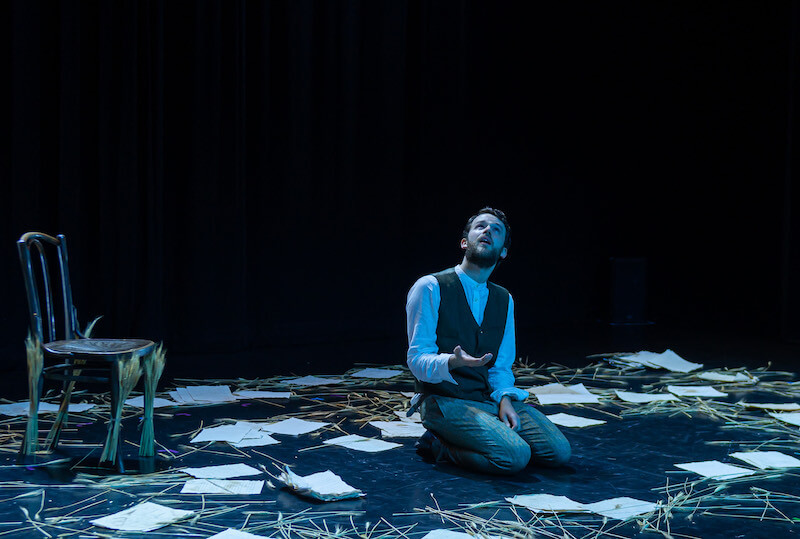
Writer and Director: Joseph Winder
Like the old man with his head in his hands who is featured in his brother’s painting, At Eternity’s Gate, Theo van Gogh is worn out. Vincent has shot himself in the chest and now Theo rages at everything. This bitter fury is the basis of Joseph Winder’s 40-minute play.
We learn that even though Vincent was the eldest son, it was Theo’s job to look after the family and organise the funeral after their father’s death. Because of his artistic proclivities, Vincent was excused from familial responsibilities, something that Theo is still resentful of, despite his admiration for his brother’s, yet undiscovered, genius. Art Dealer doesn’t have the same ring to it as Artist, even though Theo believes it’s the dealer’s job to turn a good artist into a great one.
Theo was a prominent art dealer in his time introducing the Impressionists to a wider audience, but here Winder downplays Theo’s influence and suggests that Theo was a lowly subordinate who wasn’t listened to by his employers. In fact in real life, Theo seemed to know every artist of any importance who lived in Paris in the late 1880s.
Vincent’s life was full of drama but Winder’s play lacks that drama. Too much of Theo’s monologue comes across as a rant and only his recollection of how he and his brother used to mockingly imitate their preacher father shaking hands with his congregation offers respite from the anger. Winder is solid as Theo, but the script leaves little room for nuance.
It’s also not clear why Winder is telling this story. It’s hardly as if Theo’s role in his brother’s life has been forgotten. Every biopic has focussed on their relationship from 1956’s Lust for Life to the more recent film, sharing the same name as Winder’s play, At Eternity’s Gate, for which Willem Defoe received an Academy Award nomination for his role as Vincent. Is Winder suggesting that Theo’s support – both moral and financial – wasn’t as unwavering as previously believed?
However, the simple set of a circle of wheat and sheets of paper is evocative of van Gogh’s paintings and also of the 600+ letters that he wrote to his brother. Unfortunately, very few of Theo’s letters to Vincent remain so perhaps there is scope to rethink Theo’s place in Vincent’s story. But Winder’s play needs a shot of something new if it is to stand out from other stories about the great Dutch artist.
Reviewed on 10 September 2023
