

Book: Thomas Meehan
Music: Charles Strouse
Lyrics: Martin Charnin
Director: Nikolai Foster
It certainly feels different now, in the economic context of 2026, to see Nikolai Foster’s Annie, the production that premiered in 2017. The changing circumstances in this country can easily evoke different feelings towards a musical about remaining optimistic during the Great Depression.
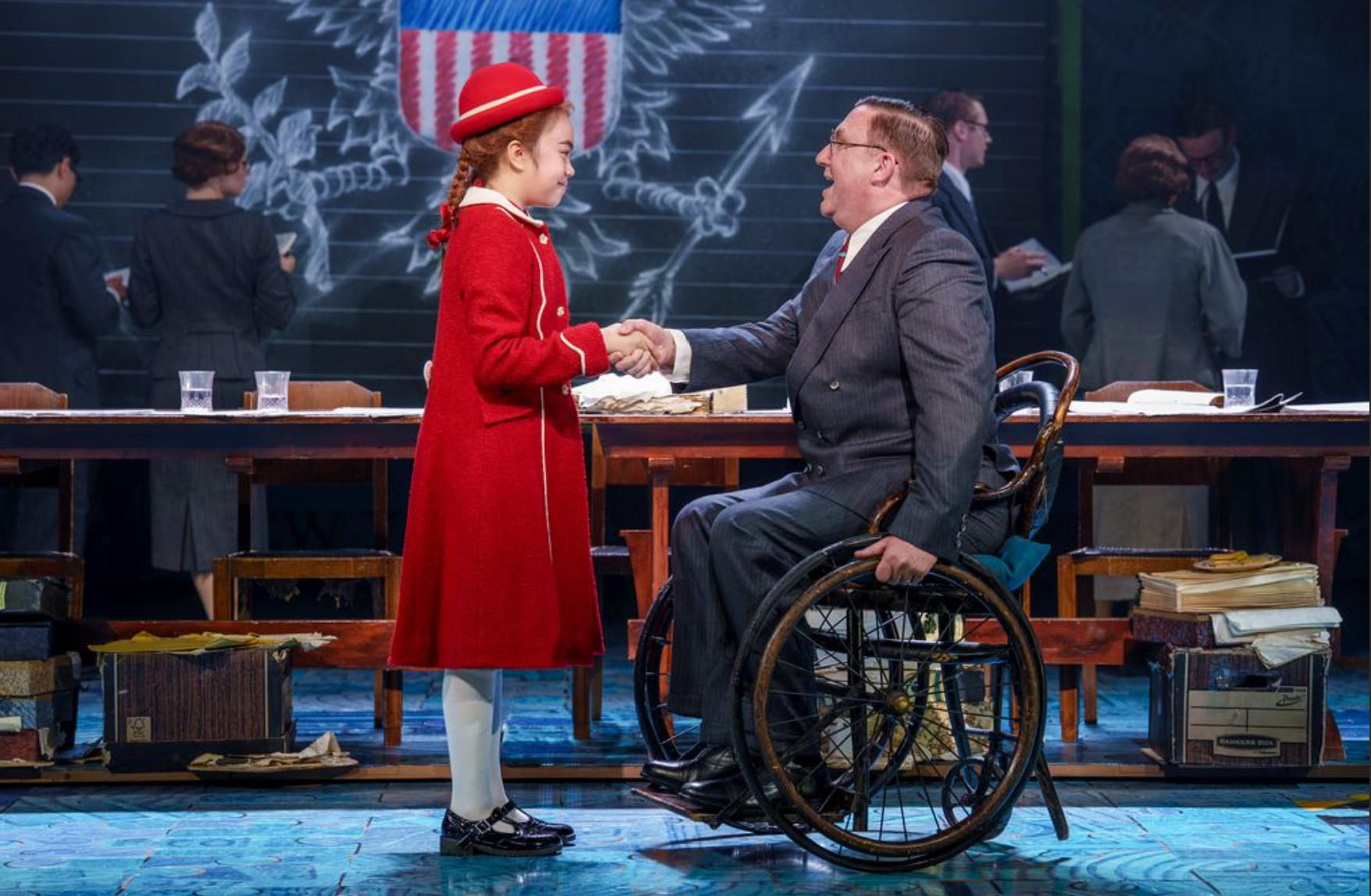
With a set using puzzle pieces to evoke the streets of New York City, Foster’s Annie is a mixture of a childlike, colourful dream and the cruelty of adult life. Although there is a lot that can be said about the story itself from a 2026 point of view, particularly when its optimism is viewed against the circumstances of today, the production, which maintains the tradition of using a real puppy for the role of Sandy, still wins plenty of love from the audience.
Claire Sweeney’s Miss Hannigan is particularly funny in one scene where one of her shoes falls off. She tries to carry on with the scene wearing only one shoe, before eventually giving up. There is also a hint of sadness in this role, giving this villainous character more humanity as a drunk who has to run an orphanage. Her behaviour on paper could recall the more modern villainous headmistress Dolores Umbridge. Yet there are also some overly sexualised moments. Although these moments may be an easy way to convey the character’s loneliness, or perhaps her insecurity during the Great Depression, as well as to get a laugh from more mature members of the audience, their necessity is still questionable in a production attended by many children.
June Young, who shares the titular role with Sophia Saravanan, Victoria Alsina and Bibi Blossom Stockley-Webster, plays a lively girl. Her interactions, especially with Alex Bourne, who plays Oliver Warbucks, feel warm and beautiful. This helps make up for the original story, in which the development of their relationship is too brief to fully resonate.
Foster also tries to bring more social critique and class dynamics to this production, particularly through some witty design during the live TV show moments and in “N.Y.C.” These moments begin to expose the class dynamics underlying a story about a little girl whose fairytale-like adventure allows her to influence people with immense power, including a man wealthy enough to call upon FBI resources at will and the president. Yet the story also overlooks the structural inequality that it implicitly accepts. Perhaps a 2026 revival should confront and address this more directly, rather than leaving it hidden in the details.
Runs until 20 September 2026 and on tour | Image: Contributed
The Reviews Hub Star Rating
-
6
