

Choreographer: Amina Khayyam
Think of Kathak, the Indian classical dance, and ancient stories of mythology spring to mind, but in this intriguing double-bill, Amina Khayyam Dance Company demonstrates that current stories can be told, too, through the signature hand movements and thumping feet. In light of these new narratives, the Indian tradition is merged with aspects of the West.
The first dance, You&Me, follows a man harbouring queer desire. With Ghungroo, the Kathak bells, attached to his ankles, Shyam Dattani effortlessly portrays a man caught within heterosexual expectations, although at night he dreams of the touch of a man. One day, this dream is realised when he bumps into Giacomo Pini’s character in a public space.
Their meet-cute is awkward at first as they are from different cultures and to prove that, Pini’s choreography has its basis in contemporary dance. They teach their steps to the other, but it must be said that Dattani’s Kathak is more exciting than Pini’s sunny contemporary. However, as their relationship blooms, Dattani’s character has to try and unify the two parts of his identity.
The storytelling in You&Me is very clear, but not all of the scenes are convincing. For instance, the part when Dattani’s character flirts by bending over to show off his buttocks brings laughs but feels incongruous with the rest of the piece. It feels as if the dance has been composed by straight people, but if this is how straight people imagine how gay men flirt in public then we haven’t come far in the last few decades.
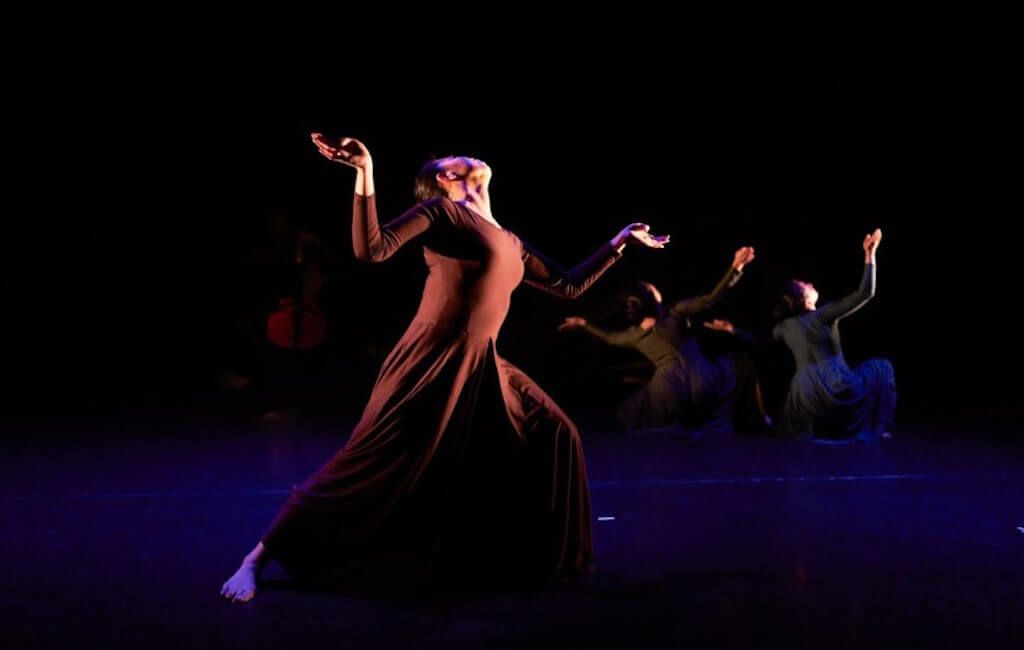
Better, is the second dance Bird which reveals the loneliness of Asian women, especially within marriage. The dance opens with a silent scream and this motif of suffering alone appears throughout most of the performance. Six female dancers, including Amina Khayyam herself, illustrate, with Kathak moves, scenes of isolation. One woman contemplates suicide, one is the victim of domestic abuse while another is reprimanded for being too Western as she hikes up the hem of her dress from her ankles.
It’s powerful stuff, especially when the other women laugh at a character’s predicament displaying that there is not always a sense of female community within Asian cultures. However, as the dance continues, a sisterhood eventually appears. The women shield each other from an assailant’s blows and finally come together, their hands entwined, proving that there is strength when women unite.
Jonathan Mayer’s incredible score, played live by three performers, weaves Kathak beats and more European sounds, the latter coming mainly from Iain McHugh’s cello. This mixture of musical traditions localises the action to Britain, revealing how Indian women in this country are caught between two worlds, both of which demand their silence. Bird suggests that one day these screams will be heard aloud and even a future where these screams won’t need to exist at all.
Reviewed on 4 June 2024 and continues to tour
