

Choreographers: Medhi Walerski, Jamar Roberts, Lar Lubovitch, Judith Jamison and Alvin Ailey
In New Works, five pieces pull together with a mixture of solos, duos, quintets and full ensemble pieces. Heterogeneous yet each with a strong underlying narrative, this is a showcase of Alvin Ailey’s American Dance Theater’s versatility and passion.
Starting with Blink of an Eye, choreographed by Medhi Walerski (premiered in 2025), eight dancers come together for group breaths before dashing off to leave space for Itzhak Perlman’s recording of the solo violin partitas and sonatas. In the first movement, the Allemande from Partita No.2, pairs of dancers weave in and out of the cyclical motifs that is Bach, following the general musical structure with visceral and sometimes almost sporadic gestures before disappearing to leave space for another performer.
Two more movements follow suit. Picked from Sonata No.1 in G minor, they feature the same lively exchange and thoughtfully held pauses. Using Bach as source material for choreography is not unusual, yet in contrast to other versions (such as Mitten wir im Leben sind by Anne Teresa De Keersmaeker, where the choreography follows all six cello suites in order), here picking and choosing movements seems almost nonsensical, taking away from a pre-existing natural construction of the dances. Additionally, it seems slightly ironic to see so many dancers interpret a solo violin work. However, the depth and complexity of the pieces quickly justify the contradiction as we are transported by a flurry of movement.
Jamar Robert’s Song of the Anchorite (2025) is based on Avishai Cohen, Yonathan Avishai, Barak Mori and Ziv Ravitz’s recording of Maurice Ravel. In it, Yannick Lebrun takes us on a slower-paced, contemplative narration beneath a dying tree. The beauty of the music and the strong bass remind us of the dancer’s heartbeat, as this meditative and passionate storytelling embarks us on a journey of reflection. Lebrun’s stretches inwards and outwards are entrancing, yet perhaps the grandeur of the stage and the quality of the background take away from this internal reverie.
In the second half, Many Angels (2024), choreographed by Lar Lubovitch, features five dancers in ethereal and almost genderless costumes, dancing to Adagietto from Symphony no. 5 by Gustav Mahler. The fairy-like quality is real, set against a backdrop of pink clouds, and the asymmetry of the dancers creates a mixture of beautiful parallel lines and imbalance. Mesmerising and celestial, Samantha Figgins’ gorgeous lifts transport us to a beautiful other world, one that ends too early to fully touch.
Ailey’s company follows this with A Case of You (2004; 2025), choreographed by Judith Jamison and featuring Caroline T. Dartey and Christopher Taylor in a beautiful duet. Starting before the entrance of the music, the dancers create both dissonance and connection with the strong lyrics. As such, though dancing to Joni Mitchel teeters on the edge of cheesy, we are regaled with romance, storytelling, and a few laughs: both Dartey and Taylor overflow with character, giving genuine life to their piece.
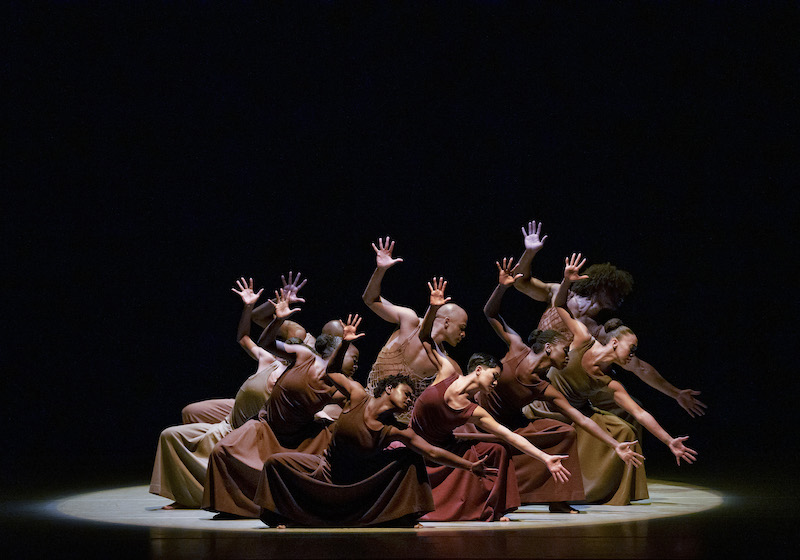
Finally, Revelations, a medley of short pieces and songs that closes each performance, reminds us of Alvin Ailey’s American Dance Theater’s origins: recognising and preserving the African American cultural experience. The collection of folk songs presented here seeps with tradition, as we recognise the pain and joy from Black American history. Some moments are incredibly touching (Sarah Daley-Perdomo’s heart-wrenching yearning in Fix Me Jesus and Xavier Mack’s slow search for equilibrium in I Wanna be Ready), while others are powerful (Sinner Man) or comical (Rocka My Soul in the Bosom of Abraham), reminding us of all the emotions that still come with dance.
New Works is playful and explorative, bringing out all of the different layers that make up our human qualities. In it, we enjoy the beauty, the skill and the narratives that shape all of our own stories in their own way.
Runs until 19 September 2026
