

Writer: Peter Quilter
Director: Stephen Mear
It’s been quite a year for playwright Peter Quilter’s stage plays about singing women. Glorious!, about New York socialite and legendarily bad singer Florence Foster Jenkins, has completed a UK tour, while Judy Garland drama End of the Rainbow is enjoying critical and commercial success at Soho Theatre Walthamstow.
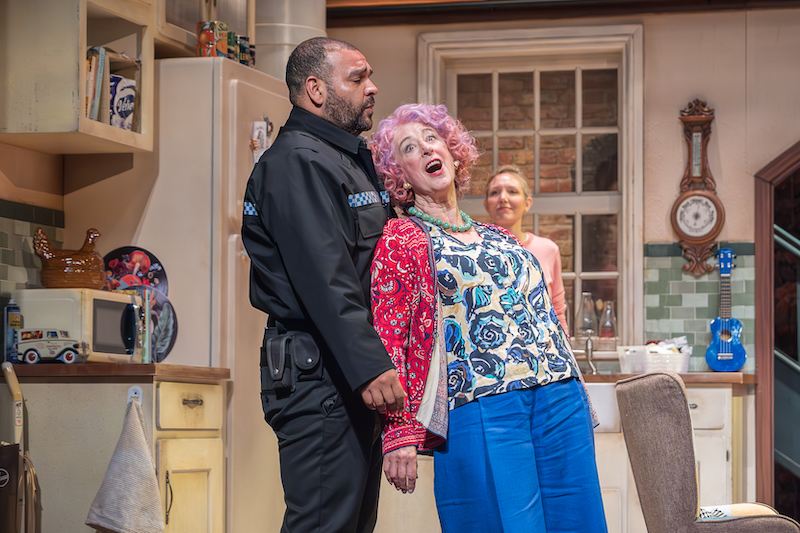
But those two revivals feature real women. Quilter’s latest, Allegra, deals with a completely fictional scenario. Maureen Lipman’s titular character, an older woman who lives alone, is prone to bursting into song at inopportune moments. Not necessarily a problem when at home – unless it’s 3 am and you wake the neighbours – but more of an issue when she is out and about in her local village, annoying and perplexing restaurant staff and shop workers.
We first meet Allegra during a welfare check by her brother, Ronen (John Middleton). Allegra’s overall demeanour is bubbly and outgoing, a sharp contrast to her blander, meeker accountant brother. But there are signs that self-care is not top of Allegra’s priorities, so Ronen introduces his sister to Anna (Elizabeth Bower) to act as a cleaner-cum-carer for the older woman.
Quilter gains much comedy from Allegra’s powerful personality and the way in which she delights in perplexing and infuriating Ronen and Anna. Lipman is in her element in this role, prancing and singing around the set with the full use of her physical comedy skills. Longtime fans will spot many mannerisms in Allegra that Lipman put to good use in Re: Joyce, her show about Joyce Grenfell. Indeed, there is the sense that Allegra could quite easily have been a Grenfell character.
Director Stephen Mear leans heavily on his choreographic background in the sequences where Allegra’s obsession with singing takes over, and she recedes into a fantasy world in which she is performing to an audience. Flowers spring up out of walls as Lipman embarks on a full rendition of Tip Toe Through the Tulips, and Act I culminates in a full-scale rendition of Singin’ in the Rain. In Allegra’s head, Ronen and Anna join in this dream sequence, as does Bailey Patrick as the local police officer who is tasked with trying to temper Allegra’s impact on the local community.
There is a more sombre edge to Quilter’s scenario, though. Quilter is uncharacteristically heavy-handed when he compares the brightness and sunshine of Allegra’s behaviour with the state of the world. It transpires that the woman has been prescribed various medications for her condition, including ADHD medication Ritalin, which she has not been taking. And when her unseen public outbursts get too much for the local community, she is court-ordered to go onto a stricter drug regimen that subdues her to the point of soporific.
This all points to Allegra’s condition being a mental health condition rather than pure eccentricity. Her periods of extreme mania certainly will strike a chord with anyone who’s dealt with someone with bipolar disorder. At the start of the play, it also feels as if Allegra might be dealing with dementia onset, too.
Yet while the sensations of Allegra’s high moments are mined for entertainment value, using song, dance and comedy to spread joy to theatre audiences the way Allegra professes to do the same for her village, it feels as if the other elements of her mental health are neglected. It would be great if people like Allegra were nothing but up all the time; if they were, it would indeed be a shame if their spirit were to be medicated away. In reality, though, the highs can come between terrible low periods, and that aspect is completely glossed over.
Instead, we get a charming, if one-sided, depiction of a woman for whom poor mental health manifests through song. It would be possible for the comedy to still exist with a slightly more realistic approach to Allegra’s life – one that, one would hope, would not play Ronen taking his sister’s meds for laughs, as he does during one of the play’s wilder choices.
One expects a new play to have a slightly more knowledgeable and aware take on mental health, while still finding the comedy in situations that many audience members will have had firsthand experience with in their own families. Instead, Allegra feels like a revival from an older, less aware age: still incredibly funny, but simultaneously out of step with the world.
Runs until 13 June 2026 and continues to tour before going to London’s Harold Pinter Theatre 8 July -8 August 2026
