

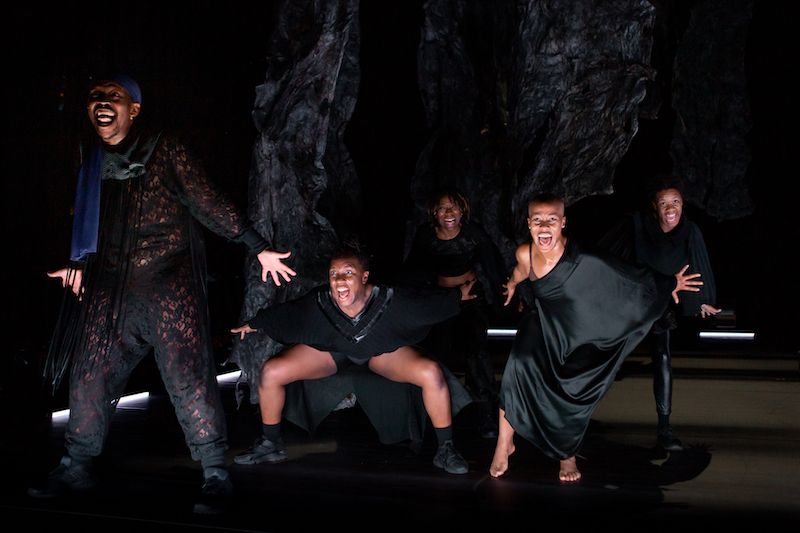
Choreographer: Alesandre Seutin
A shebeen is a name for an illicit, underground, probably illegal, drinking den. The name originates from Ireland, but the term took particular hold in apartheid-era South Africa. Forbidden to drink or talk about politics, Black people created their own speakeasies, often run by women who became known as “shebeen queens”.
Artist and activist Miriam Makeba was the daughter of a shebeen queen. It is her life, and the place of shebeens in the struggle to dismantle apartheid, that inspires Alesane Seutin’s work Mimi’s Shebeen. Staged initially by Belgian theatre company KVS in 2023, this is not a biography of the woman who came to be known as Mama Africa. Instead, it uses songs, archival sound recordings and Seutin’s use of Afrocentric dance theatre to explore some of the themes that threaded Makeba’s life and so many others: exile, migration and collective identity.
The show is dominated by singer Tutu Puoane, who, on curtain up, is atop a scaffolding crinoline, her skirt ballooning out to the stage several feet below her, and from under which the company of dancers slowly emerges.
Stef Stessel’s stage design involves large piles of plastic sheeting. They slowly rise to form grey columns around (and occasionally behind) which the dancers move and sing. With vocals that blend English, French, Xhosa and others, we get a sense of resilience and determination throughout. Alongside renditions of some of Makeba’s songs, poems from Lebogang Mashile and Lisette Maneza pepper the work’s 12 movements. Seutin’s choreography draws upon many styles of dance that emerged from club culture, underground dance movements and raves, all imbued with an Afrocentric sense of urgency, pain and joy.
Live music, mostly percussive, from the onstage band accompanies both Puoane and archival audio material. We hear a South African politician talk openly and unashamedly about how Europeans – by which he means white Europeans – are more evolved peoples. But we also hear Makeba herself, with audio from an address to the United Nations.
The show also cries out against colonialism in general, and not just apartheid, and how indigenous cultures were subjugated. “New gods were forced into the skies of our minds,” we are told. Songs are dedicated not just to the townships of apartheid-era South Africa, but to favelas, projects, the ends, around the world – all names of areas where poverty and race go hand-in-hand to enforce segregation.
The dancers initially start in all black, which, combined with the atmospheric lighting, conveys a sense of funereal reverence. Gradually, that is broken down, moments of elation and amusement coming through the dance. As the piece progresses, each performer undergoes outfit tweaks until the predominant colour shifts from black to purple, symbolising remembrance and hope. It denotes royalty, too: a further tribute to the shebeen queens around the world, and to Makeba in particular.
Runs until 24 October 2025
