

Writer and Director: Andy Sandberg
As assets concentrate in fewer hands at unprecedented pace, Andy Sandberg’s darkly comedic Affluenza offers pointed insight into the perils of ultra-wealth – especially among those born unwittingly into it – and the increasing 21st-century acceptance of the casual disregard and callousness it can bring.
Based on the real-life 2013 trial of Texan rich kid Ethan Crouch, who killed four people in a drunk driving spree, the play’s title refers to his lawyers’ defence: that isolating ‘affluenza’ – privileged cocooning – was to blame for his deficit in morality and social empathy.
Sandberg has relocated the action to New York state’s elite beachside The Hamptons, where distraught parents Ellen and Dennis are wringing their hands at their 16-year-old son Dylan’s ‘plight’: twice over the alcohol limit he’s crashed into two cars, slaying a father and daughter and seriously injuring two others. “We know it was an accident,” bleats his mother, “and accidents happen.”
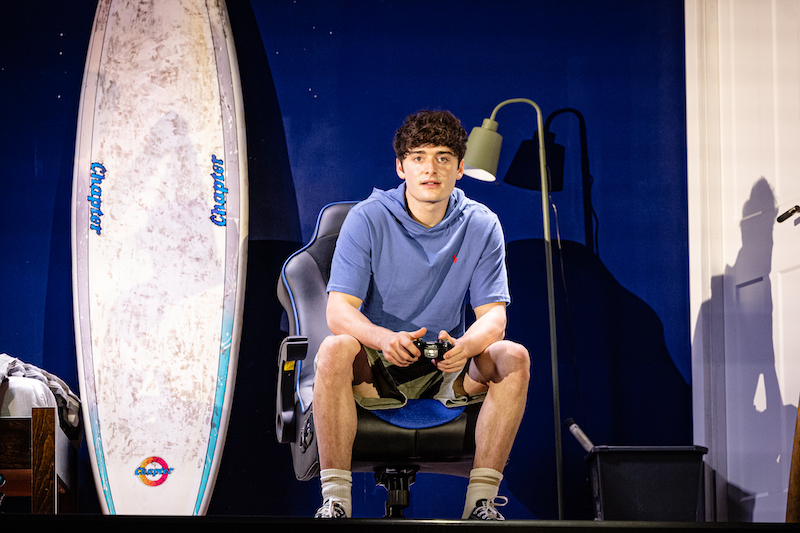
Having forked out 12 grand for lawyer Brad to fly out and “win” the situation for them, they’re horrified at his conscience: “The only criminal defence lawyer in NY who cares about right and wrong!” Talking with Dylan, who’s been playing Grand Theft Auto XL Miami (“F-ing Puerto Ricans… not you, Rosa”; “I’m Mexican!” his maid shouts back), and swigging wine from a bottle his mother opened, Brad sees the teen’s murderous vacuity in full flow.
But Brad’s looking to have children with psychiatrist partner Anna, requiring extra funds, so he takes a term she’d coined for a spoilt patient – affluenza – to use as Dylan’s defence: “His actions weren’t the result of his own choices.” Initially shocked, Anna benefits financially from Brad winning the case and happily becomes pregnant.
The victims’ families also cash in, deciding to settle, with only one, Charles, a white academic whose daughter was disabled in the crash, choosing to hold out for justice: “Rich kids living in their own messed up reality just can’t get away with it.” His Hispanic lawyer Angela advises settling too: his white daughter can’t be seen as a worthier cause than the other, racially diverse victims.
Anna bumps into bitter, bereaved mother Beverley, who lost her daughter to the crash: “You can’t imagine this level of hurt til you have it.” Charles, having settled for $4.6 million, speaks to the press, trying to subdue his sentiments but helplessly blurting them out: “Inequality in this case is not the real story: it’s all about what you’re prepared to sell your misery for.”
Act Two sees Dylan in his early 40s, post-divorce, still in his inherited parents’ now decaying beach home, trying to placate his trashy, grasping girlfriend, Crystal. She’s invigorated their finances by locking Dylan and wayward 17-year-old son Todd into a reality TV contract, overseen by Brit producer Liz and motley film crew Ron, a Boomer stoner, and well-meaning sound engineer Debbie. Chaos inevitably ensues.
Affluenza is a complex piece, with an incredibly lavish set – like a split-level Pottery Barn – which may have left only enough money for six actors, who must play 15 characters. There’s irony – intentional? – at paying fewer actors in a piece about wealth inequality.
Credit to casting director Nicholas Hockaday for finding his very versatile half dozen players. Donald Sage Mackay anchors both acts as testy rich dad Dennis, righteous, dishevelled English teacher Charles and hilarious, shambolic Ron in his Spinal Tap-style wig, belting out to Joan Osborne: ‘What if God was one of us, just a slob like one of us?”
Juliet Cowan, while convincing as ditzy, forgiving trophy wife Ellen, and angry but compensated ex-mum Beverly, doesn’t quite have the heft or volume to play pushy reality TV producer Liz. Strictly star Janette Manrara, playing to her heritage, brings Hispanic authenticity and much-needed decency to the parts of housemaid Rosa and lawyer Angela, as well as good-natured energy to the role of sound recordist Debbie.
As variably pregnant psychologist Anna, Juliet Cowan is credibly indignant at Brad’s immorality, then cowed – like everyone else – at the prospect of money if he wins. She really excels, however, as brash, money-grubbing girlfriend Crystal. Rupert Young impresses as lean, hungry, corruptible lawyer Brad, hand-waving away his wife’s moral qualms, and manages the physical transformation to downbeat, tousled Dylan-in-old-age as best he can.
Hiring Noah Schnapp, Stranger Things’ tormented Will Byers, with his 4.2 million YouTube followers and Ivy League degree in entrepreneurship, to play wealth-affected, time-shifted teens Dylan and Todd is astute. Fans are flocking to see him live, with the added frisson of screen-to-stage transition in discerning London. As the show’s poster boy, he hasn’t much stage time but uses it effectively to convey Dylan’s sweary brattishness, and Todd’s vehemence and soulful depth.
Slick and fast-paced, Affluenza feels Netflix-perfect: an American production for an American audience, with surging music, US references, bright lights (to the extent of retinal burn as Charles faces the press) and freezing aircon. But it’s all slightly baffling for older English viewers, some of whom can be heard trying to explain the plot to each other.
Part of the problem is the multiple casting, which holds up in the first half, but falls down slightly in the ‘20 years later’ scenes, with lawyer Brad becoming grown-up Dylan without enough differentiation. And the gleaming beach house, which looks current at its first showing, isn’t aged sufficiently.
Despite offering an amusing and accurate reflection of declining 21st-century morals – just how low can we go? – Affluenza might leave viewers dispirited. And it’s not wholly novel. Like Stranger Things, it covers a lot of ground that other productions have already trodden, such as The Dinner and Gods of Carnage. The new angle here is redemption, financial at least, via reality TV, which, while amusing and satirical, doesn’t quite do justice to the serious dilemmas being raised.
It’s clever, but cold. And sadly, that’s the way everything’s headed.
Runs until 28 November 2026
