

Writer: Claire Dowie
Director: Colin Whatkeys
Adult Child/Dead Child was first performed at the Finborough in the late 1980s, winning the Time Out Theatre Award in 1988. Now at 68, Claire Dowie is back for one last time, where it all began, the venue of her first gig. One of four plays spanning four decades: the others are Why is John Lennon Wearing a Skirt? H to He (I’m Turning into a Man) and See Primark and Die, The Finborough presents a rotating series of solo performances; an In Yer Face box set, billed as Claire Dowie’s swansong.
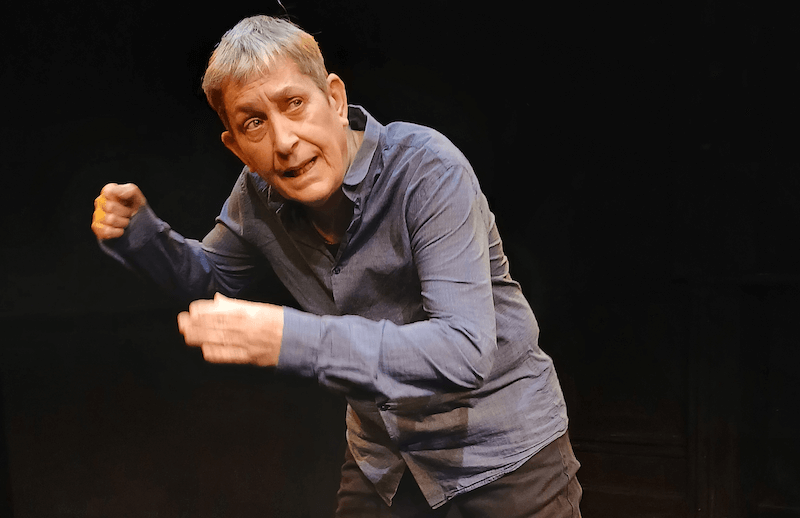
A poet and key fixture on the 1980s cabaret circuit with an alternative comedy background, Dowie has furrowed her own path. Stand-up theatre – a fusion of stand-up comedy, storytelling, and spoken word –involves no props or tricksy lights, just an ordinary-looking woman in a grey man’s shirt and jeans, short hair, no makeup, and a Brummie accent. Technically, it’s a monologue, with none of the gravitas or pomp this suggests, Adult Child/Dead Child is more like a 70-minute natter with a loquacious neighbour.
The performance is so naturalistic and conversational, it’s impossible to believe what we’re hearing isn’t true, that it isn’t the actual experience of Nora from down the road. There are elements of Victoria Wood in Dowie’s humorous, observational delivery, which moves in pitch and pace from second to fifth gear and back again. As we witness a child’s experience recalled through adult memory, we move chronologically through a series of emotional states and perceptions which start from the baseline: how does it feel to be unloved as a child?
The Adult Child/Dead Child does not have a happy childhood. It’s “a hole in your stomach, an empty feeling.” She has parents: an orderly home and a perfect, impossible-to-match-up-to sister. She’s not abused, she insists, but nor is there any evidence of familial love or connection. Isolated, misunderstood, emotionally marooned, she invents an imaginary friend. Benjie is her opposite. Brave, wild, strong, protective, Benjie becomes more dominant and starts to incite all kinds of transgressions. She encourages the child to lie, swear, steal, disrupt, commit acts of vandalism and violence. Withered by a lack of parental warmth, frustrated by not being heard, and angry at the harsh punishments she must endure, the child starts to splinter in order to survive.
This story of a disturbed childhood, “a monster, a horror, a terror,” is interspersed with sections of verse, which serve to break and structure the narrative. The sections of poetry are incantation-like, repeated and layered, oppressive as an internal negative voice, insistent as questions with no answers, bewildered as a lost child. Mentally, on a downward slope, Benjie is nothing but an opportunist, and when the stun comes, it’s a series of rapid blows, low-level Lizzie Borden, but shocking, nonetheless.
Adult Child/Dead Child starts somewhere indefinable. There is no inciting incident, but more the drip, drip of damaging neglect and indifference. Despite the fact that the child is examined by child psychologists and physiatrists, we never have the benefit of their insights, and there is no diagnosis. When independent life in a bunker-like bedsit leads to her being sectioned, it’s no surprise. But her final descent ironically represents a hopeful beginning, the light at the end of the tunnel.
Contemporary theatre is awash with plays that examine mental health. As we have become more aware and articulate a catalogue of mental health maladies, Adult Child/Dead Child may not have the originality or shock it once did. However, what remains is the vivid characterisation of how adults carry their childhoods and the salutary reminder that all humans need love and that demons can be spawned in its absence. Catch this trailblazer before Dowie disappears into the peace of her garden for good.
Runs in rep until 3 July 2025
