

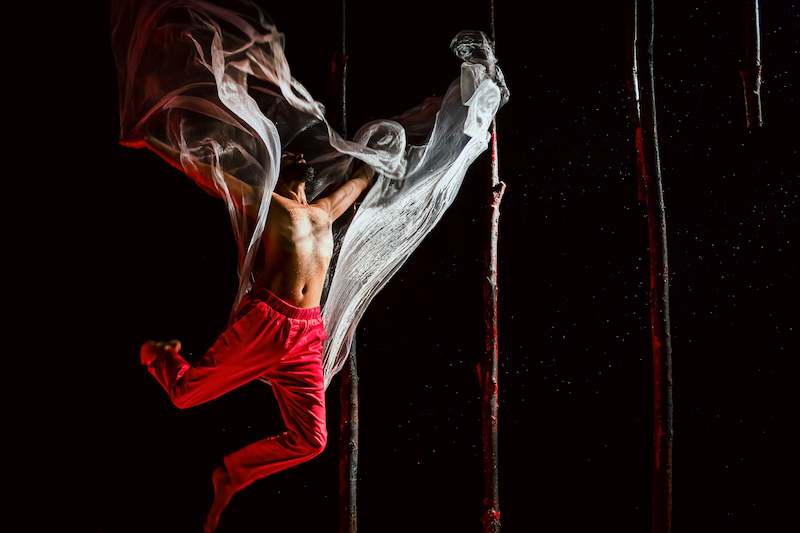
Songs of the Bulbul – Sadler’s Wells East, London
Choreographer: Rani Khanam
In 1899, Paul Laurence Dunbar, the son of formerly enslaved parents, published a poem called *Sympathy*, and its final line, “I know why the caged bird sings”, became one of the most resonant images in American literature; resonant enough that 70 years later Maya Angelou borrowed it for the title of her first book. But the image is older than either of them. In Persian Sufi tradition, the bulbul, the nightingale, has sung of captivity and yearning for centuries, its song directed always towards the rose, its longing a symbol of the soul reaching for the divine. It is from this deep well that Aakash Odedra draws Songs of the Bulbul, now at Sadler’s Wells East, and the result is one of the most beautiful hours you will spend in a theatre this year.
The story is simply told. A bulbul flies free, without care or worry. It is captured and caged. Stripped of light and of the sky it once owned, its despair deepens, and yet, as its end approaches, it sings more sweetly than it ever has, delivering one final, heartbreaking song before its soul departs. Freedom, the piece suggests, is found only in the ultimate release.
Odedra dances it alone, to choreography by Rani Khanam, and what he does over the course of the evening is quietly extraordinary. His movement reads as free and expressive, birdlike in its flurries and sudden stillnesses, yet you can sense the fierce control underneath every gesture, and it is that balance that makes him so intoxicating to watch. Dressed in a white billowing tunic that recalls a whirling dervish, he spins and spins until the dance tips into something meditative, hypnotic, closer to prayer than performance. The Kathak technique is immaculate; more importantly, it is in service of something.
The emotional arc is superbly judged. The opening stretches, with the bird swooping and darting through its unbounded world, are wonderfully uplifting, and the evening darkens by degrees as capture and captivity close in. Nothing is rushed. The despair creeps rather than crashes, which makes the final song, when it comes, land with real force.
And then there is the stagecraft, which is breathtaking. Fabiana Piccioli’s lighting sculpts the stage into shade and brightness, side light and single spots carving out the bird’s shrinking world, and at the heart of Emanuele Salamanca’s design sits a huge semicircular arc of around 100 candles. As the caged bird begins to lose its sight, it is this candlelight that takes over, and the interplay between the dancer and those small, stubborn flames, the last embers of the daylight it yearns for, is as eloquent as anything the choreography has to say.
The floor is littered with rose petals, a nod to the nightingale’s strange devotion to the rose, and the symbolism sharpens as the bird’s journey turns: beauty scattered everywhere, and the creature that sang for it caged. Rushil Ranjan’s recorded score, performed by Manchester Camerata, binds it all together, moving between classical Indian music, sweeping Western orchestration, Sufi poetry and Islamic devotional stillness without a seam showing.
The programme notes that the work is dedicated to Odedra’s mother, who took her own life in 2020, and once you know this, the piece deepens further. This is not a work about a bird. It is about what happens when a soul becomes so removed from the freedom the rest of us take for granted that its sweetest song becomes its last, and Odedra has transformed that most private of griefs into something universal, compassionate and consoling. It is referenced with a feather-light touch, and it is all the more affecting for it.
Dunbar knew why the caged bird sings. Angelou knew. The Sufis knew centuries before either. Odedra knows too, and for one transporting hour, he makes sure that we do as well.
Runs until 11 July 2026
