

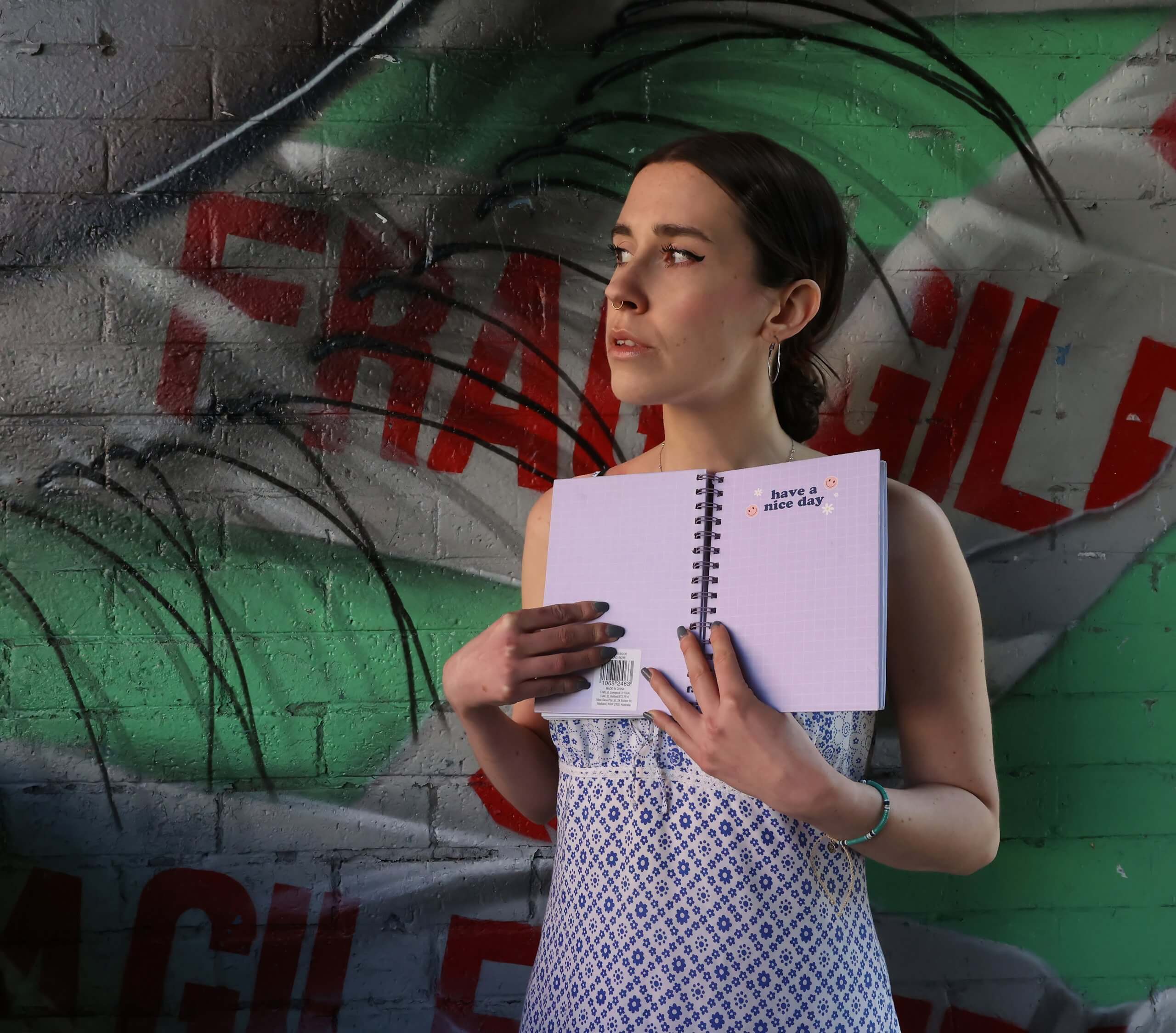
Writer: Eleanor May Blackburn
Director: Emily Browning
This is a sparkly new show (with a great title) written, created and performed by the writer herself in a bravura solo performance that is heading to the Edinburgh Fringe and should do very well there.
Blackburn describes herself as a disabled, neurodivergent, queer, working-class actor/writer/poet/theatre-maker from Sheffield and her show does address some mental health issues. Blackburn’s character is Phoebe who is 28, a journalist and has Obsessive Compulsive Disorder (OCD). In her case this mainly takes the form of keeping endless lists which can basically be about anything and everything. These are so time consuming and all encompassing that they are literally everywhere – on her fridge, on her whiteboard in her room, and even physically on her – all over her hands and anywhere else that might occur to her. They have taken over her life and cover every aspect of it in an endless cycle of repetition and what she sees as failure if she doesn’t accomplish everything on the list – which she rarely, if ever, does. She is like Sisyphus in Greek mythology who was condemned to the eternal, futile task of rolling a boulder up a hill, only to have it roll back down each time he nears the top. This punishment was inflicted by the gods for his deceitfulness and for cheating death and the myth of Sisyphus has become a powerful symbol of the human struggle, particularly in Existentialist philosophy. It speaks of the absurdity of life and the struggle against seemingly endless and futile tasks.
Phoebe’s life is one long struggle that she does her best to make sense of and to control but her attempts only lead to more disappointment. Her whole world is in danger of being confined to one room, her “kingdom”, and her endless lists dictate her every action. She engages our sympathy in her plight and we long for someone to help her. In this regard she is not, seemingly, without people she can turn to for she gets a number of telephone calls from her family and her best friend, all wanting to know how she is and to make contact with her. But these calls go unanswered and are just left on answerphone. Are they part of her imagination and a sign of her need for communication or does she actually deliberately ignore them because she just wants to be left alone to inhabit her own [fantasy] world? Will her mental health issues finally get on top of her to take her own life or will she continue to exist in a world of her own, with it’s giant fluffy monster appearing under her duvet and spooning her while she sleeps? Are we witnessing a young girl slowly but surely disintegrating before our very eyes or is there something more heroic going on – a lonely person coping with life in the best way she knows how?
The performance space is basically just a carpet-like floor covering with a few props around – a duvet and pillow and cuddly toy; a notepad and pen (of course); one or two clothes; a handbag; a tube of toothpaste; a few other bits and pieces. The window, mirror and drawers are clearly marked on the floor. This is a very practical way of setting the scene for the audience of a person’s flat in a simple but effective manner that lends itself easily to being adapted for a variety of spaces and venues. This, of course, is very important with the Edinburgh Fringe in mind.
It is a hallmark of the skill of Blackburn’s writing and her moving performance that we leave the theatre with more questions than answers. And the dramatic experience is all the more powerful for that.
Reviewed on 31st July 2025. At Edinburgh Fringe 1-25 August 2025.
