

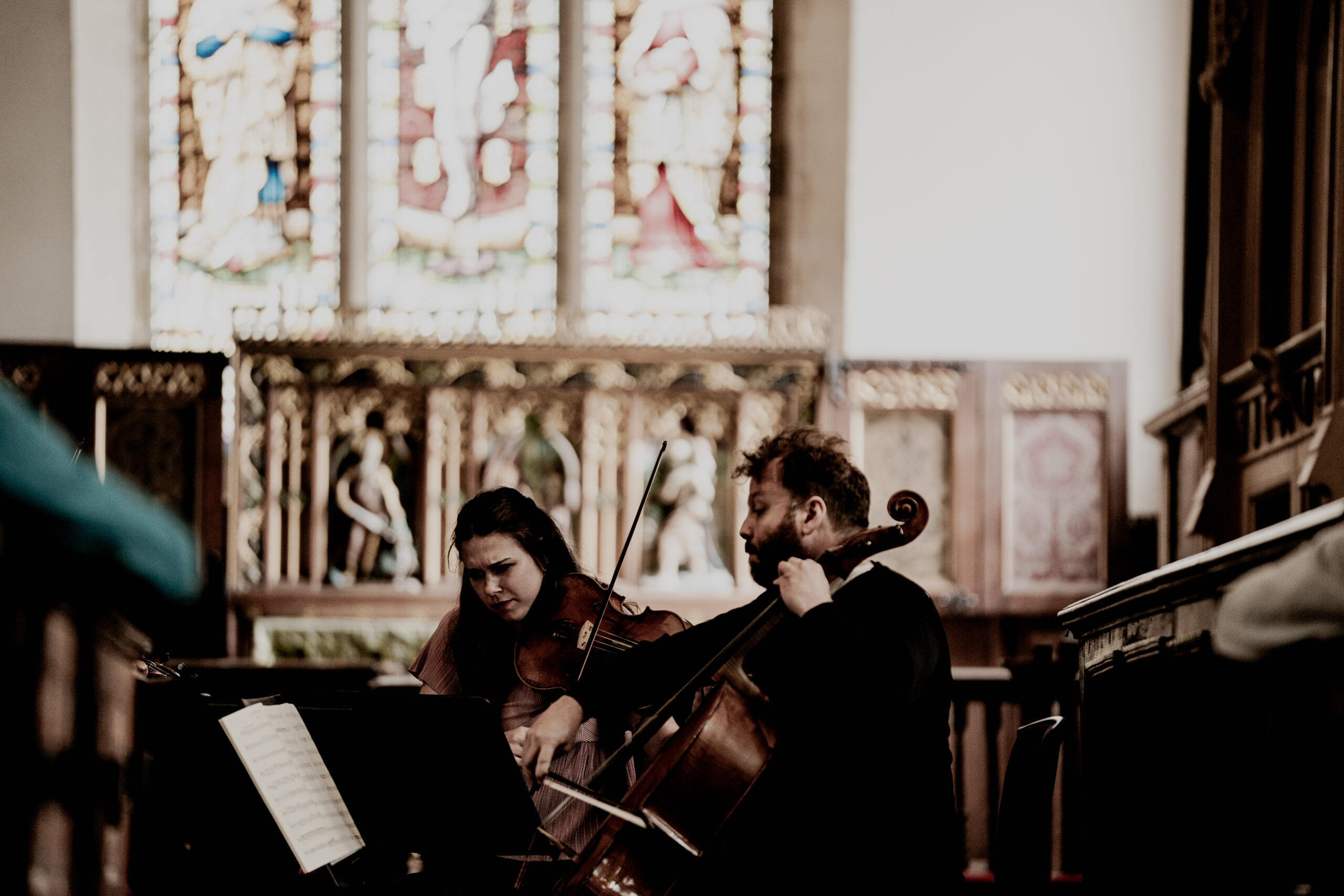
A New Dawn was the last but one concert in cellist Jamie Walton’s remarkable North York Moors Chamber Music Festival which has run for two weeks under the general title Creation. All of the concerts bar four take place in the marquee at Welburn Manor; the remaining four are afternoon concerts in churches in the area. St Michael’s, Coxwold, with its monumental tombs and dramatic coats of arms, provided a spectacular background for a concert of two contrasted works for string quartet. The works were played by two different quartets from the 30-ish musicians involved in the festival, performing a wide range of works including no fewer than six premieres.
Joseph Haydn is renowned as the Father of the String Quartet, as much as the Father of the Symphony, while Thomas Ades is a vibrant contemporary composer appearing at the festival as pianist as well as composer of six works including one premiere.
Here his early work, Arcadiana, in seven movements, followed Haydn’s String Quartet opus 76 No. 4 (the “Sunrise”), each of them lasting approximately 30 minutes. At first hearing the two works could not be more different. Haydn’s opening movement magically suggests the dawn of a new day in recurring patterns from all four instruments, while its second movement is a solemn hymn tune. Then, in the third and fourth movements, Haydn’s well-known sense of humour asserts itself after the gravity of the second movement. The music stops and starts, twists and turns, until a hectic coda brings the piece to an almost manic conclusion, with the members of the quartet ratcheting up the tempo in contrast to the gentler beauties of the first two movements.
A change of instrumentalists and the opening of Arcadiana brought dissonances, vivid pizzicato and echoes of water. The odd numbered movements (all the movements have names in an assortment of languages) relate to water, the even numbers to land. Gradually Ades’ sense of melody asserts itself in movements that often conjure up the spirit of paintings or other musical works. After playing of remarkable intensity early on, the final movement, Lethe, fades into a sort of serene melancholy.
The restraint of the late stages of Arcadiana suggested a link to the Haydn: a movement from aggression to calm whereas Haydn took the reverse course, from serenity to boisterousness. And both pieces were immaculately performed – and received with equal delight.
Reviewed on 21st August 2026.
The Reviews Hub Star Rating
-
9
