

Writer: Matthew Minnicino
Director: Marc Atkinson Borrull
“Toxic masculinity, sweaty affairs, and a flawed humanity.”
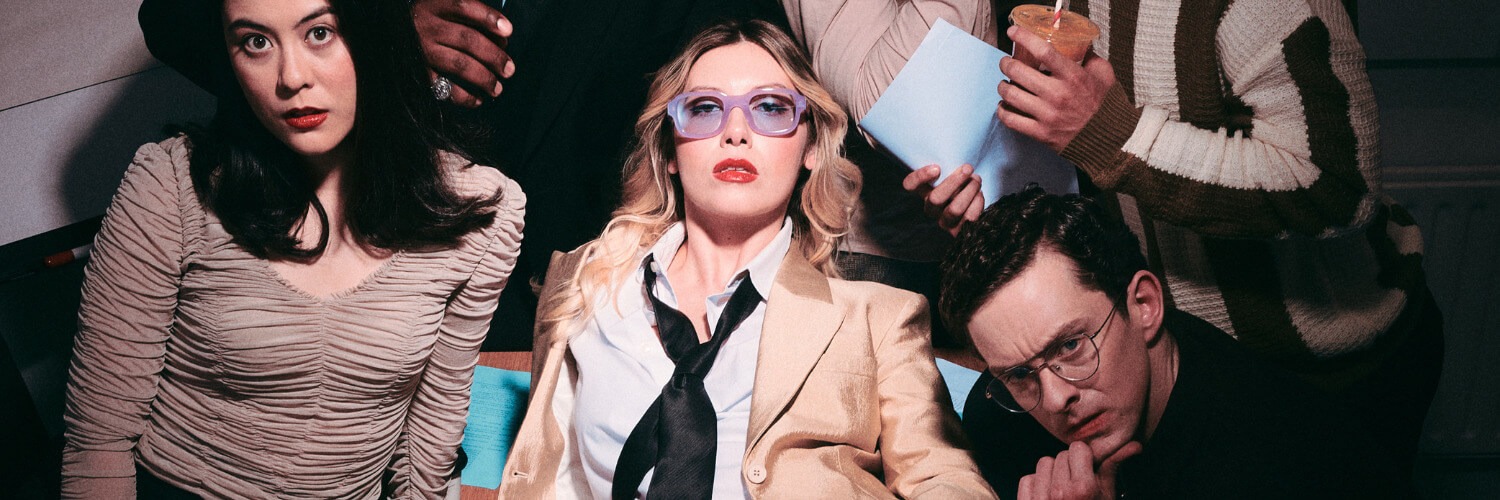
Sugarglass, in collaboration with Smock Alley Theatre and Once Off Productions, presents a clever rebranding of Molière’s The Misanthrope, dismantling the outdated notion that pessimism lies in one man alone. Matthew Minnicino’s adaptation challenges us to broaden our understanding of misanthropy—not as a singular character flaw, but as a cultural epidemic choking under the weight of narcissism, iced matcha lattes and performative virtue. Minnicino doesn’t just modernise Molière’s world, he surgically replaces its aristocracy with a Dublin-based corporate elite, in the world of FRANS.
Minnicino’s Dublin is as morally bankrupt and culturally desolate as Molière’s 17th-century salons. This production thrusts us into a day in the life of FRANS, with its LED lights and translucent glass offices. From its first moments—a slick, fast-paced opening montage—A Misanthrope positions itself as a vibrant satire of contemporary culture. Each performer dives headlong into their satirical archetype, their exaggerated movements and poetic dialogue embracing the absurdity of contemporary corporate life.
The ensemble cast were an energetic unit, stoking the furnace of this theatrical locomotive with strong performances across the board. Matthew Malone’s energy as the initially vilified misanthrope, Alceste, encourages his scene colleagues to carry the same. The comedic power duo of Adrian Muykanovich (Clitandre) and Naoise Dunbar (Acaste) deliver standout performances, especially in a brilliantly executed scene in the office gym that doubles as a battleground of insecurity and male vanity. They strike a perfect chord between toxicity, and ridiculousness when expressing how nepotism comes with its faults. Darragh Feehely’s Philinte, the voice of reason, deserved more stage time with his presence offering a grounded alternative to the chaos, and his more restrained satire is a welcome shift in tone.
Emer Dineen shines as the deceitful bombshell Celimene commanding the stage with charm and wit. Dineen finds complexity and a clear arc in the role, drawing us into her steady unravelling. Her looming business launch—pitched as a kind of personal salvation—grounds the satire in a recognisable ambition: survival in a world where your worth is your brand. While the societal pressures and expectations of women in the workplace is a valid narrative, the drawn out and overemphasis of the notion becomes heavy-handed through repetition, culminating in an unnecessary slow-motion sequence that undercuts emotional depth and highlights the notion as simply performative.
Molly O’Cathain’s design work deserves high praise. Her use of space is clever and effective, and the bold, vibrant set enhances the high-energy pacing of the piece. However, this sharp vision doesn’t entirely extend to costume. Despite flourishes of makeup and accessories, some visual choices fall flat. The integration of actors and set, however, fuels a forward momentum and fluidity that keeps the world of the play alive.
Sugarglass strives to produce radical adaptations of classics and their ambition is evident here. In the end, A Misanthrope is a production full of potential and moments of brilliance—but it occasionally loses its footing in its eagerness to be satirical. A tighter runtime and more structural comedic matter, might have better allowed these moments of tension and breath to land. Sugarglass’s mission is exciting, and their talent undeniable. But sometimes, the fit between material and message matters just as much as the style of delivery. Molière’s original was a satire of an already exaggerated society; layering modern satire over classical satire creates a double distortion that can cloud the target rather than sharpen it. As a comedy of manners handling sensitive topics one can only question which side of society the production was vouching for.
Runs Until 2nd August 2025.
