

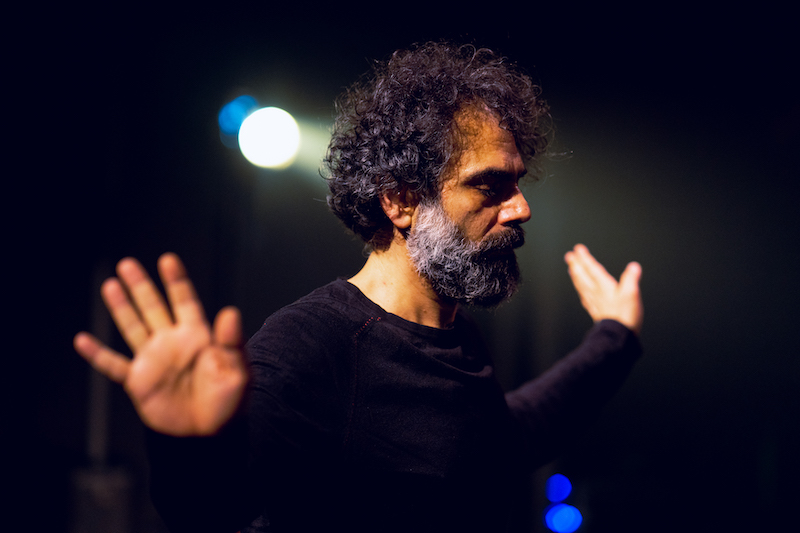
Choreographer: Omar Rajeh
Omar Rajeh, founder of the Beirut International Platform of Dance, bases his choreography in the practice of maqam, a technique that plans each piece’s narrative but does not prescribe individual movement. Rather than treating the body as having a single centre of gravity, each component has its own centre, and Rajeh considers the dance to be a conversation between body parts.
In Dance is Not For Us, playing in this year’s Dance Umbrella Festival, Rajeh starts out holding a potted fern, its fronds quivering in response to his hand movements. The fern keeps moving throughout, even when set down, thanks to a small fan on the same desk. Rajeh, too, is always moving in some way.
Yet the first ten minutes of this 75-minute performance feel like the least dancey show. Rajeh, accompanied by voiceovers and projected captions, spreads pots of fresh basil across the stage, reminding him of the plants around his grandmother’s Lebanese home. He also works at a laptop, musing on ideas for the dance performance we are about to see. Good-natured humour runs through it all, and it carries into the opening moments of the dance proper as Joss Turnbull and Charbel Haber’s pulsating, repeating rhythms take hold.
The projected captions return from time, Arabic and English phrases that speak to difficult times, protest, and pressure on artistic endeavours, alongside happier memories. Rajeh’s movements mirror this, often joyous while combining elements of rage and oppression.
His maqam style also allows for periods where his body becomes a pure machine. At times, he stands still, his arms and hands working with hyperactive precision, as if furiously scrawling equations. Then seconds later, a pointing hand becomes the only static element of his body as every other part gains a manic momentum.
While captions and voiceovers remind us that Lebanon has faced civil war, death, and loss, Rajeh’s work symbolises that dance and life win in the end. As the work draws to a close, he gives the audience the small potted basil plants that have shared the stage with him. They may not have come from his grandmother’s garden – Lebanese basil is denser and more pungent than the gentle aromas of these samples – but they feel significant.
As Rajeh celebrates the confluence of fates that bring him to dance here, and bring us to be in the same room as him, the evening would normally be reduced to a memory as soon as the house lights come up. As we leave, basil in hand, the reminder of the performance feels physically manifested in those aromatic herbs.
Runs until 17 October 2026
Dance Umbrella continues until 27 October 2026
