

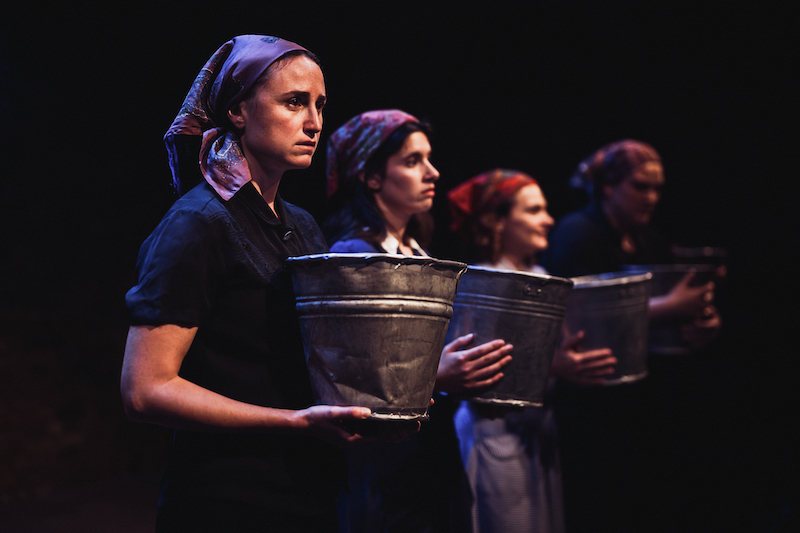
Writer and Director: Julia Pascal
The Banality of Evil: Hannah Arendt, France, 1940 lives up to its lengthy title with hefty subject matter and challenging detail. Hannah Arendt (Mai Weisz), German Jewish philosopher, finds herself in France being rounded up and being sent to Camp Gurs with other Jewish women. It is there that the play spends the vast majority of its time, a hellish, muddy place that reflects the welcome muddiness of the script’s philosophy.
Julia Pascal’s script is evidently heavily researched, with a breadth of interest in the lives of the women of Camp Gurs and a depth of understanding about the details of their suffering. In addition to the pain that dominates the story, there is uncanny humour sprinkled throughout. Humour in the face of suffering incites breaths of relief from the audience while adding complexity to the characters.
Pascal achieves nuance for the most part, allowing space for contradictions to be true at the same time without lecturing. Pascal is even brave enough to tackle Arendt’s complex relationship with Zionism. The sole exception to this nuance is in its eventual depiction of Eva (Ariella Barnett), who begins the play as an avowed communist. Communism is treated with nuance throughout the main body of the play: the strength of the International Brigades and their fight against Franco’s fascist regime is lauded while at the same time Stalin’s forced relocation of Jewish citizens of the USSR is condemned. Nevertheless, by the end of the piece, Eva has cast off her communist ideology as if it were daft all along. This choice is peculiar in a text so intent on reflecting the moral complexity of the various philosophies contained therein.
Pascal’s direction intends us to read The Banality of Evil as a political piece. It is upfront with its Brechtian influence, and we are persistently reminded through song, non-naturalistic prose, and the announcement of the beginning of each scene, that this is a work of theatre. This is a smart choice. Given the horrors of internment, there would be a risk that this play could become torturous if the audience were left to engross themselves in a naturalistic version of this story.
While the standard of the singing performances is exceptionally high, especially from Anja Fahlenkamp, Ariella Barnett, and Anna Eckhard, the songs themselves vary greatly in quality. Oftentimes, the musical interludes, much like the wandering prose, become too much like free jazz for a narrative medium. It is true that for the most part, Pascal’s text delivers implicit meaning well, allowing the audience to draw their own conclusions, but when Pascal indulges too much in free-association interruptions, there is little joy to be found, and the end result is a bitter taste of pretentiousness.
It is some task to write about Arendt, and some task to play her. Nevertheless, Pascal and Weisz should be proud of their work in bringing her to the stage. The Banality of Evil is a firmly political piece; despite rarely picking a direct political stance, it is fearlessly feminist, and it does not flinch from those painful, shameful years.
Runs until 7 November 2026
The Reviews Hub Star Rating
-
6
