

Writer: Helen Goodman and Joseph Dewey
Director: Helen Goodman
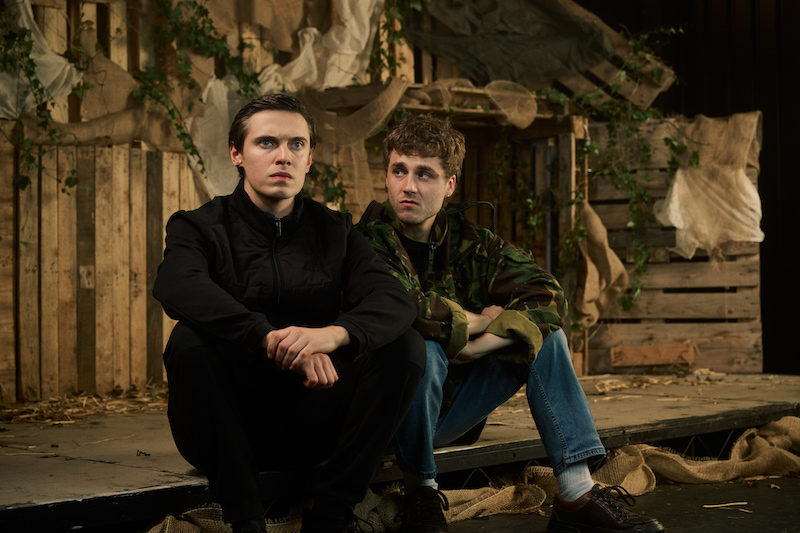
It is 1982. Jane’s alcoholic dad has just died. Mum, presumably in mourning and traumatised by the presence of invading Argentine troops on their Falklands Islands farm, will not leave her bedroom. Weak-willed, suggestible younger brother Billy is too busy playing with toy soldiers, hanging out with his dodgy mate Mark, and dreaming of fighting Argies to be much use around the home, so Jane is left to do all the heavy lifting. A complication arises when a wounded, traumatised Argentine soldier, Alejo, seeks shelter in the family’s rickety barn, impressively rendered by set designer Hannah Calarco.
Though the writers have something to say about how war traumatises everyone it touches, victor and vanquished alike, Helen Goodman and Joseph Dewey’s 70-minute drama Toy Soldier never quite gets beyond some basic questions. Why, for example, does Jane (Faye Bennett) not simply report the injured Alejo’s (Nico Conde impresses but has precious little to do) presence to the authorities, either his occupying comrades or, later, the British liberators? Is it warped romance, saviour syndrome, or loneliness? The narrative gives little hint, and Bennett, whose voice struggles against the Union Theatre’s ferociously noisy air conditioning, gives no obvious clue.
Before that can settle, further implausibility enters. How do you expunge all evidence of a brutal war crime without anyone in a close-knit island community noticing? Would 17-year-old apprentice car mechanic Billy (Matthew Edgar), however troubled, really be using his sister’s nail varnish to paint his toy soldiers with fake blood or quoting Henry V? How did islander Mark (Paul Gorman in sneering, black-shirted Hitler youth mode) get quite so well versed in the jingoistic rantings of some parts of the British tabloid press many thousands of miles away?
The storyline flashes forward to Britain in 2002. Billy is a thug enforcer for his BNP boss Mark, who spouts racist claptrap, disingenuously comparing the Argentine invasion two decades earlier to the arrival of immigrants now. One supposes this is in some way connected to 1982’s events, but it is not clear how, or indeed why Billy returns to the Islands in the wake of his mother’s death. There is no reckoning with Jane or the past, which would at least give some dramatic resolution.
Dewey’s atmospheric video back projections can be hard to make out against Calarco’s set but are instantly recognisable to anyone who remembers the Falklands War: Thatcher’s speeches, Exocet missiles destroying ships, and long lines of bedraggled surrendering Argentine conscripts. How much they will communicate to a generation unfamiliar with the war, and how Britain felt during those 10 weeks, is less obvious. Aside from reminding us that war is hell and has consequences, Goodman and Dewey come up with plenty of moving parts but little by way of dramatic traction.
Runs until 18 October 2026
