

Seven Deadly Sins
Music: Kurt Weill
Libretto: Bertolt Brecht
English translation: W.H. Auden and Chester Kallman
Director: Alejandro Bonatto
Musical Director: Adrian Salinero
The Human Voice
Music: Francis Poulenc
Libretto: Jean Cocteau
English language translation: Joseph Machlis
Director: Alejandro Bonatto
Musical Director: Elspeth Wilkes
Brecht and Weill’s Seven Deadly Sins is rather less fun than it sounds. The sins are more against the Great American Dream of getting rich quick than the Ten Commandments. There’s a strong whiff of grim earnestness and the desire to ensure the bourgeoisie doesn’t have a good time that gives Brechtian alienation a bad name. The show also lacks a big showstopper along the lines of The Threepenny Opera’s Mack the Knife, although Weill’s music is agreeable enough to listen to and sugars the Brechtian pill.
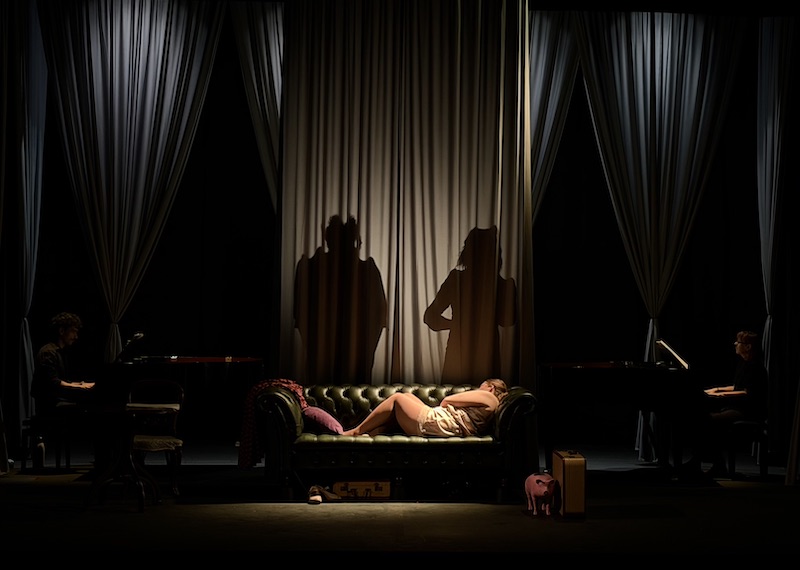
The English translation by W. H. Auden and Chester Kallman is audible without subtitles. Adrian Salinero and Elspeth Wilkes facing each other on grand pianos at the back of the stage keep things trundling along nicely, as Anna works her way through several American cities. The role of Anna is normally split in two (a singer and a dancer). Here there is just one, although she often converses with her reflection in a mirror. The cast – Katherine McIndoe, Harry Grigg, and Phil Wilcox – all provide some fine singing, although the characterisation is quite restrained in Alejandro Bonatto’s production.
Bonatto argues eloquently in the programme that Elle in Poulenc’s The Human Voice can be presented as the same woman as Anna, and he aims to present them as ‘a continuous psychological portrait of a woman pushed to her limits – by the world around her and then by the world within’. He acknowledges that they come from very different contexts and theatrical traditions, but their worlds are so different that it is difficult for an audience to join them up. But Poulenc’s piece – one side of an intense and desperate telephone conversation between Elle and her lover – is very well worth hearing.
It receives a knock-out performance from Katherine McIndoe. She is accompanied this time by just one pianist (Elspeth Wilkes), although Adrian Salinero makes a brief appearance on stage as a flautist for reasons that aren’t entirely clear, though it sort of works.
We are back in the era of pre-mobile telephones that require the use of fingers, when you depend on the operator to connect you, and regular redialling is required, as well as dealing with crossed lines. This is a lot worse than bad Wi-Fi. The struggles with telephonic connection are a metaphor for the lack of communication between Elle and her lover, as she moves from revealing her insecurity and jealousy to realising that he is lying to her and calling from a restaurant and is not at home. She mentions her recent suicide attempt, and it gradually becomes clear that her mental health is disintegrating as she keeps drinking and – unusual for an opera singer on stage – smoking.
The translation of Cocteau’s libretto by Joseph Machlis is outstanding in its ability to retain the rhythm of the French words while rendering them into clear English in a piece that could not be more Gallic if it tried. It probably helps that we are generally dealing with recitative in ordinary language, albeit of a very high order of expressiveness and intensity. The result is riveting, even if at 45 minutes it’s almost too long. But not quite.
This is an imaginative piece of programming in an intimate theatre and deserves a larger audience.
Runs until 19 September 2026
