

Writer: Charlotte Brontë
Book & Lyrics: John Caird
Music & Lyrics: Paul Gordon
Directors: John Caird & Megan McGinnis
A Victorian-era, feminist, romantic, and gothic musical set in the moors of Yorkshire. How haunting and intriguing! But… can gothic romance and feminism really coexist in that era? And then, how do you sing about it?
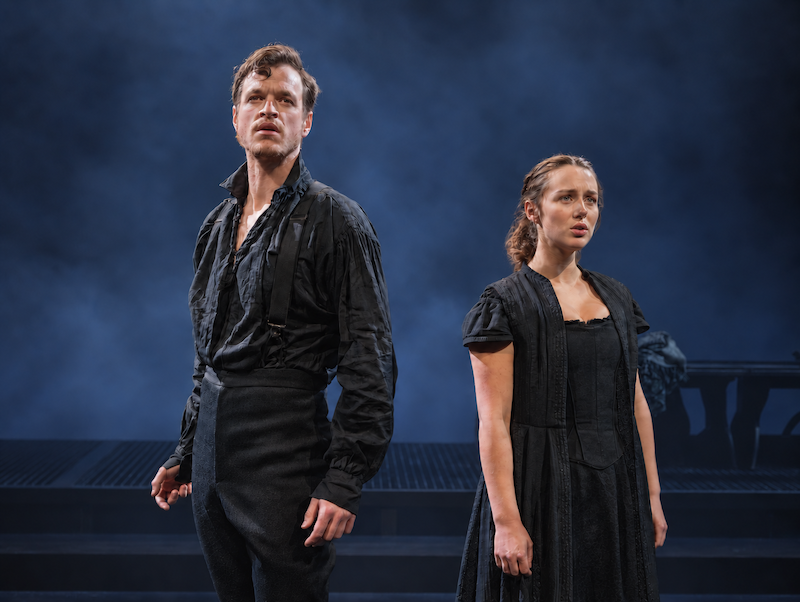
Jane Eyre, the musical written by John Caird and Paul Gordon, is based on Charlotte Brontë’s well-known novel, published in 1847. This groundbreaking work, which follows Jane’s life, was at the time one of the first novels to feature a first-person narration, told from a woman’s perspective. In this adaptation, directed by Caird and Megan McGinnis, Jane Eyre’s life story is told with the help of a cast of 12. In it, 10 ensemble members take on various roles throughout the performance to embody over 20 characters, all while sharing the first-person narration and speaking from Jane’s perspective, thus carrying the two leads, Jane (Charlie Burn) and Mr Rochester (Ashley Gilmour), through their romance.
Act 1 is a fast-paced medley of short ballads, alternating between full choir formation and short solos. This follows Jane from her childhood (with young Jane played by the brilliantly captivating Emily-Rose Samuel) through a whirlwind of events: losing her parents, being mistreated by her aunt, and being forced to attend an impoverished girls’ school. There, she meets Helen (played with beautiful purity by Isabelle Methven), whose untimely death is a harsh lesson, before she takes on her role as governess at Thornfield Hall for a young Adèle (again played with sassy joy by Samuel) and meets her romantic interest Edward Rochester – a strange, brooding and secretive man.
The speed is constant, songs are wordy, and, though the orchestration (Larry Hochman and Brad Haak) is wonderfully nuanced. It leaves little space for spoken text and for full musical numbers, with only Gilmour and Burn’s duet Sirens standing out from the rest.
In contrast, Act 2 changes pace completely, and the audience is regaled with a number of fully developed songs, as well as musical reprises from the first act which give the piece more unity. We finally get a chance to savour Burn’s beautiful voice, notably in Painting her Portrait, and enjoy Gilmour’s comically masterful rendition of Dear Sister. Heartfelt scenes of pain and reconciliation between Jane’s family members and Rochester are poignant, yet the contrast in storytelling is almost a disappointment as we lose the narration so present in Act 1.
The lack of emphasis on this first-person narration, so key to Brontë’s implicit act of feminism, is unfortunate, and the piece lacks an obvious female voice, making some of the social commentary shallow rather than timeless. This is not helped by the embodiment of the gothic horror through various lacy black costumes, which limit character differentiation, and the use of a background screen, whose images clash with the sombre tone of the piece.
Yet, Jane Eyre remains a beautifully poignant and entertaining story with fitting musicality and a playful gothic sobriety reminiscent of other well-loved musicals. It is enjoyable, though not quite yet on par with the greats.
Runs until 24 October 2026
