

Writer and Director: Yanis Koussim
Horror films go for emotions. They excite , disturb and terrify. What Roqia mainly does is frustrate and annoy.
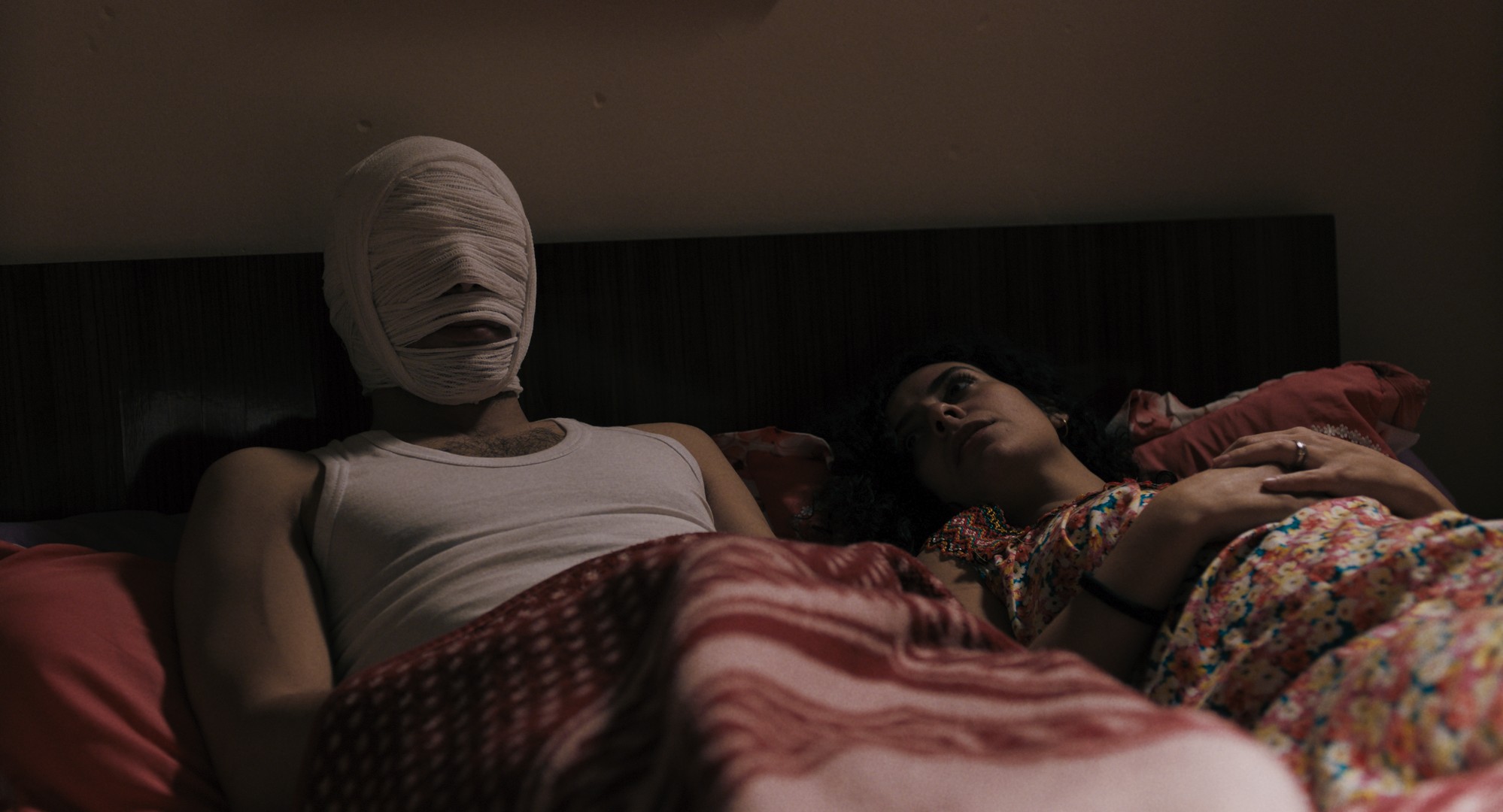
The setting is Algiers. It’s a not unintriguing story, about two neurologically damaged characters whose lives eventually converge. One has Alzheimer’s, the other amnesia, so both are navigating the hideous shadowlands of dementia. The older man, in the present day, is an exorcist. Most occupations come with hazards; you don’t spend years in exorcism without absorbing some of the evil you’ve expelled. The other character is a young father in 1992, the year the ten-year-long Civil War broke out. Horribly injured in a mysterious car crash, apparently with no evidence of a car, he is brought home with his face tightly bandaged like that other stalwart of horror, a mummy. When the bandages come off he looks fine, but he can remember nothing. His valiant wife takes the opportunity to do some personality remodelling, reminding him only of happy things, not, for instance, of the time he spent fighting Russians in Afghanistan. Something terrible in his past leads to an encounter with the exorcist. Then we are back in the present where a gruesome mess is survived only by an uncannily hefty and smiley newborn.
Afghanistan was where young men were drawn into to the Islamic Salvation Front, the fundamentalist movement that became one side of the Civil War. Perhaps to illustrate the perils of this kind of dogmatism, Koussim subjects Ahmed to something worse – possession by devils.
Unfortunately it’s frustratingly difficult to tell what’s happening . If the intention is to describe the confusion and disorientation of dementia, (and in Ahmed’s case impaired vision), the film is doing a first-class job. After an ominous quotation about Satan running ‘through men’s blood’, the film opens in almost total darkness, with spots of light that seem to be torches. Sometimes there are alarming glimpses of cowering children. There are noises, some vaguely identifiable, which culminate in terrified screaming. Admittedly the hand-held camera creates a vivid impression of close-up violence. This scene is probably linked to one later in the film, but you don’t see enough to be certain. While horror often depends on the unknown or not fully understood, the viewer does need a few more clues than Koussim is prepared to give. Often the screen is completely black, and all we have are ambiguous sounds . Dripping blood or a dripping tap? Hard to know. Chanting voices in the dark are undeniably eerie. The problem with exorcism is that involves chanting the same words many times over, perhaps on the very plausible basis that the devil will eventually get bored and go away. There are at least three exorcisms in Roqia. Then there are the dreadful words in an ‘alien tongue’, also often repeated but in a sort of whispered growl, which some viewers may find more annoying than alarming.
Lighting is an issue. Some scenes are so dark that you really cannot see the faces or the action. There may be a flash of metal, but, rather crucially, you can’t see whose flesh it’s slicing into. On the other hand , some well-lit scenes are strikingly composed. There is a shot of a pizza counter, full of verticals, with sauce bottles spaced out like tall buildings. Another shows the exorcist’s devoted assistant Slimane and the flirty housekeeper Waffa on a roof, separated by a washing-line full of white cloths. As she takes the cloths away, two horizontal lines of red rope remain. Ahmed’s modest home is made poignantly pleasant by vases of bright flowers against bare walls.
The acting is uniformly good. Mostefa Djadjam changes all too credibly from eminent sage in the nineties to rheumy old man in the present. Mohmed Medjani , as Ahmed’s youngest son, has few words but his solemn face is painfully unforgettable.
Roqia is screening at the Muslim International Film Festival 2026 from 2-5 July.
