

Writer: Noël Coward
Director: Philip Wilson
In the first major presentation of Coward’s The Marquise for over two decades, Philip Watson brings the show into the 20th century – setting it some 200 years after Coward had originally set it – putting onto the stage a piece of theatre so quintessentially Coward while remaining fresh and new.
The cast is led by Simon Shepherd (as Raoul de Vriaac) and Tristan Gemmill (as Esteban el Duco de Santaguano), playing the fathers of two people set to be married. Between them they provide stability to the events of the play and, vital for the successful production of Coward, an innate understanding of their roles in the show.
It is Shepherd who, perhaps more than any other, invites the audience to experience the highs and lows of life in the Parisian countryside. As de Vriaac he his deliberate and considered, and it is through his reactions to the events on stage that the show is kept moving at pace. Gemmill for his part is a master of Coward’s brand of wit and humour, delivering each line and moment to maximum effect and graciously allowing his fellow performers to take the success of each moment of humour he establishes.
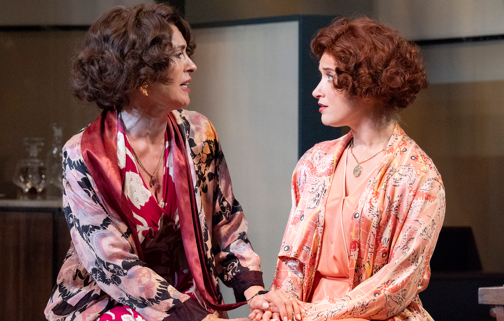
The two set to be married at Adrienne de Vriaac and Miguel el Duco, played by Eva O’Hara and Barnaby Tobias respectively. O’Hara plays well the beautiful innocence her character needs until it is her turn to create the tension, most notably in a short section alongside Shepherd talking about the love she received from her father and her late mother; she is a talent worthy of a Coward show. Tobias’s role is smaller, but each moment on stage is used skilfully.
In the title role is Juliet Aubrey as The Marquise Eloise de Kestournel. Aubrey brings sophistication to the role which brings the show together. Coward originally wrote the show for actress Marie Tempest, and Aubrey is a worthy successor to that legacy. She commands the stage from her first entrance through to the climax of the show. As with any good piece of theatre, The Marquise has many unexpected turns and almost all of them fall at the feet of Aubrey who masterfully plays with each character’s own ambitions and histories to shape events to her desired outcome.
Wilson’s vision for this show is strong. The updated setting lends itself well to Coward’s writing, a writing for which Wilson has an apparent admiration if not a love. He is aided in bringing that vision to life by designer Colin Falconer whose stunning set provides everything the show needs to succeed. It is in this set, however, that the lighting design (Nick Richings) struggles as a large glass-effect door on one side of the stage provides the ideal surface for a light to reflect into the audience throughout the show in a manner that is at best odd and at worst distracting. Other than this, Richings’ design is brilliant, as is the sound design from Andy Graham and Pierre Flasse. The creative team put together by Bill Kenwright Ltd and Theatre Royal Windsor prove over the course of two hours that almost a century on from its first production, The Marquise – and the work of Noël Coward generally – continues to deserve its place on stage.
Until Saturday 27 June, then at Cambridge Arts Theatre from 30 June – 4 July.
