

Choreographers: Bobbi Jene Smith, Or Schraiber, (LA)HORDE, Emma Evelein
This week sees the centenary of the first performance of A Tragedy in Fashion, a dance choreographed by then-unknown Frederick Ashton and performed by Ashton and Marie Rambert. That production marked the start of Ballet Rambert, the company which – now known mononymically as simply Rambert – is marking its 100th anniversary with a touring programme of three pieces.
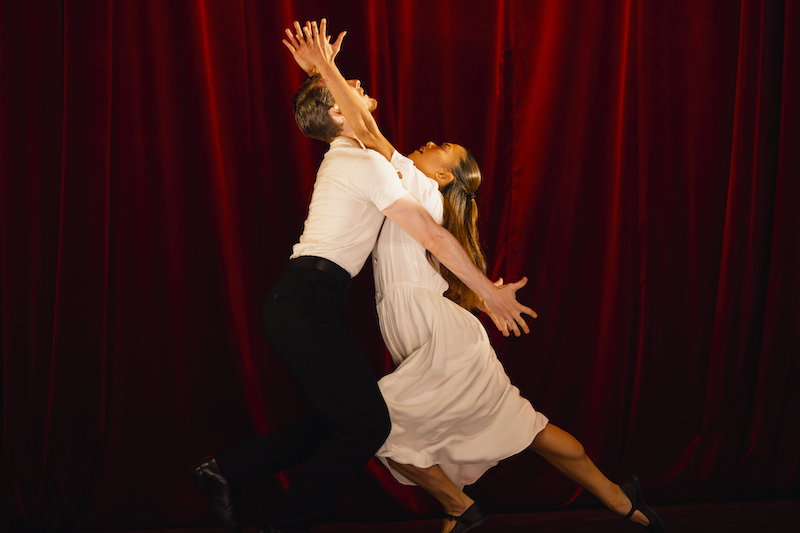
The first is the evening’s brand-new commission, yet for an evening that is about Rambert looking forward, it also leans on the company’s century-long heritage. In Crimson plays in front of a traditional red theatre curtain, with pianist Yonatan Daskal playing Bach and Bizet while seven dancers react in dance. And yet while the music is classical in nature, the choreography is not. Bobbi Jene Smith and Or Schreiber’s work initially feels like Gwen Verdon has been let loose in an acid factory, delightfully and whimsically eccentric.
As the music progresses and Daskal shifts toward more electronic work (including his own compositions), the dancers couple and recouple. Elements of homoerotic charge are never very far away in contemporary dance, but they are made obvious here: when a jealous man moves to break up a couple dancing in hold, it is the woman of that couple who finds herself thrust out. Elsewhere, we see the romantic charge of both solo work and pas de deux sequences. As a new commission (albeit based on 2022’s Fugue in Crimson), it’s a statement that Rambert’s future is very much respectful of its past.
That is followed by Hope(e)storm, a fun and lively 2025 work created in collaboration with choreography trio (LA)HORDE that takes the classic Lindy Hop and, by deconstructing it, finds darker tones beneath what is traditionally a lively and enthusiastic dance of joy.
The impact of the piece’s opening is accentuated by a similarly deconstructed musical score, using samples from Elvis Presley’s Jailhouse Rock over a largely percussive track free of much in the way of melody. The synchrony of the company’s dancers is hypnotic, and as the aggression of the opening gives way to more modern, rave-style beats, the joy of the original dance returns. It’s a pulsating, heady concoction that celebrates the unity that great dance can inspire.
The final of the evening’s three pieces is the longest and most diverse. 2025’s Gallery of Consequence is set in an airport departure lounge, using the criss-crossing lives of staff and passengers to bring together many different styles of movement and purpose.
Emma Evelein’s choreography opens with several dancers walking through the concourse in a mechanical, quasi-robotic style. These seem to be the perpetual business travellers, the ones for whom this is just another flight in a long list. But we also see looser dances, especially from a trio of gossiping ground crew, along with flashes of darkness. The departures board that illuminates the back of the stage, ever changing with flights to London, New York and many others, occasionally flashes up ALONE, SCARED, ISOLATED.
Such thoughts intrude on some of the more contemplative sequences, from witnessing individual passengers’ struggles to some more intense interpersonal relationships. All are executed excellently, the seamless transition between all sequences maintaining momentum throughout.
The piece’s large scale justifies its place as the concluding piece of the trio on display here, even though it is In Crimson that will remain in the memory the longest. As a collective trilogy, though, they fulfil Rambert’s centenary purpose: to celebrate 100 years of contemporary dance by acknowledging the past, even as the company dances defiantly, proudly, exuberantly into the next hundred.
Runs until 13 June 2026
