

Writer: James Graham
Director: Jess Staufenberg
When James Graham’s Ink premiered at the Almeida Theatre in 2017, the concept of the tabloid newspaper was already in decline. Both Rupert Murdoch’s News International and competitor Mirror Group Newspapers had been hit by phone hacking scandals for years, culminating in the closure of the News of the World in 2011.
With both reputations and circulations in decline, Graham used his knack for dissecting the past to look at the rise of the very tabloid newspaper industry that had been brought to its knees. The focus in Ink is on the creation of The Sun, at least in the paper’s current form.
Graham’s story starts in 1969 with Rupert Murdoch (Zane Fleming), a go-getting Australian tycoon who has just purchased The News of the World and is looking for a stablemate for the daily. He purchases The Sun, then a money-losing, Labour-supporting broadsheet. As editor, he installs Larry Lamb (Christopher Lloyd James), who takes on the task of creating a different style of newspaper.
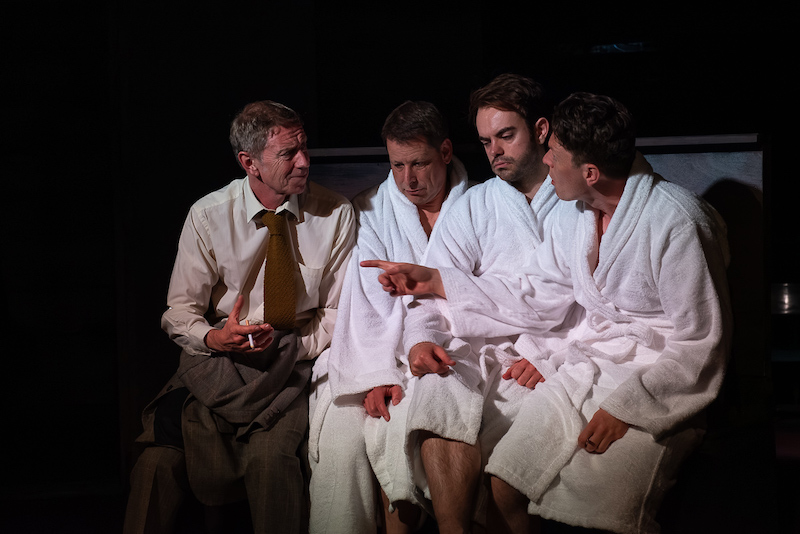
Much of the first act of Graham’s sprawling epic follows the structure of a heist movie, with Lamb gradually pulling a team together. These sequences make some of the best of this production, especially when Lloyd James recruits Jonathan Buckingham’s Brian in a steam room to be news editor, and Harry Apps’s nervy-but-principled Bernard Shrimsley as deputy.
But once the collective team has been assembled, the large-ensemble scenes of Lamb and his colleagues working out how to create a brand-new newspaper in a few weeks often struggle to maintain a sense of dynamism. At running just short of three hours, Ink often feels like it is constantly pausing for breath, gaining momentum that then dissipates as quickly as it appears.
That said, the potted history is fun, from the portrayal of the highly demarcated, union-led world of the newspaper shop floor to some of The Sun’s initial teething troubles (a typeface purchasing error meant that front page headlines could contain no more than three letter ‘E’s). Some of Lamb and Murdoch’s other tactics for saving money – aiming for members of the public to contribute and become content creators as well as consumers – feel even more presciently directed towards the social media trends that would eventually see the tabloids’ monopoly on public attention disappear.
Before that, though, the play’s second act sees Lamb’s attempts to fulfil his boss’s wishes of beating the Daily Mirror’s circulation take ever darker turns. The kidnapping of Muriel McKay, a newspaper executive’s wife who was mistaken for Murdoch’s wife Anna, is covered in ever more lurid detail, heralding the age of journalism where intrusive prurience and the public interest would forever be blurred. Billie Straughn also impresses as Stephanie Rahn, the glamour model who is persuaded to pose for the paper’s first topless photo shoot in what would eventually become the regular, controversial Page 3 feature.
Tower Theatre’s production preserves the ambiguity of Graham’s approach to his portrayal of The Sun’s foundation. It may have created a new type of newspaper, a template that many papers have followed in the years since. There is a sense that, while the approach to creating a popular, fun daily read had its benefits, the race for high circulation encouraged an amorality that seeded the attitudes that ultimately secured the downfall of Murdoch’s other great title, The News of the World.
In the years since Ink’s original production, the tabloids’ grip on the public consciousness has dipped ever further. What, at the time, was a look at the creation of a new media genre feels less relevant and more dated now that tabloids no longer lead the public conversation as they did in the 1970s, or indeed were still doing into the 2010s.
As a result, the world of Ink is becoming a relic of history. And while Tower Theatre’s production struggles with pace and some performances, it does at least manage to illustrate why that may not be a wholly bad thing.
Runs until 13 June 2026
