

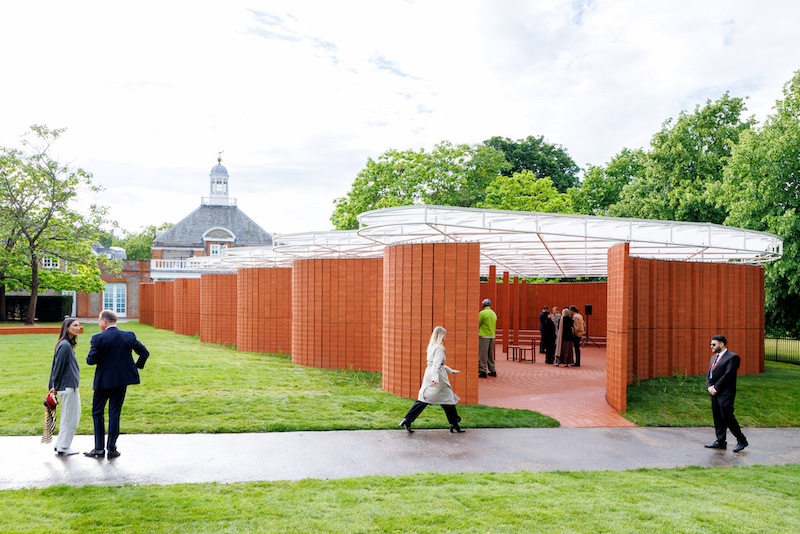
Designer: LANZA atelier
LANZA atelier, founded by Isabel Abascal and Alessandro Arienzo, design this year’s Serpentine Pavilion, a prestigious and ongoing summer project that invites massive names in art and design from around the world to contribute a temporary architectural space just outside the Serpentine South Gallery. As well as hosting curator-led tours of the pavilion over the course of the summer, this year’s iteration, titled a serpentine, will provide a space for music, poetry, performance, and dance nights.
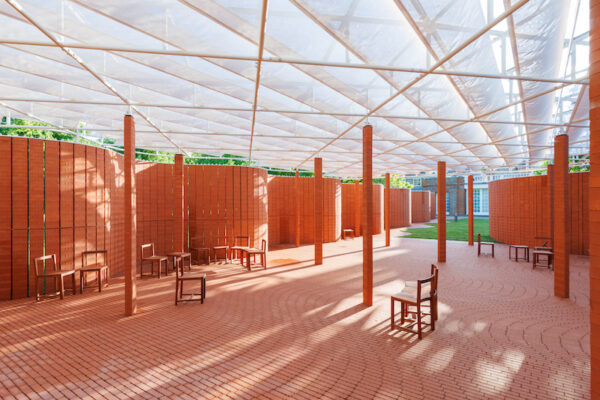
LANZA atelier’s design nods towards sustainability, with single-brick-thick walls that limit unnecessary resource use. Its design is respectful of the changeable British summertime, with a roof that lets in sunlight and a gentle breeze but keeps the rain at bay. The roof consists of diagonally positioned fabric shades alongside a squared metal frame, which generate visual interest above through trapezoids of varying size while allowing beams of diagonal light to play off the vertical lines of the brick walls.
However, this year’s pavilion appears too British and too respectful of heritage in its ethos. Previous years’ iterations have been controversial, but they have always generated interest and reflected the artistic ethos of their designers’ cultural origins. In lieu of any inspiration from LANZA atelier’s home of Mexico City, we have a design that only dares to lightly play on the English walled garden.
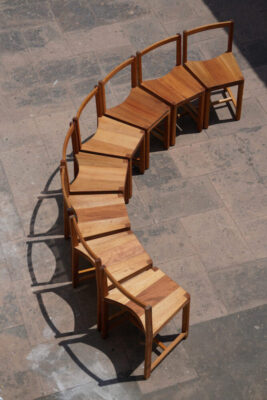
LANZA atelier’s furniture design within the space mirrors the colour and curvilinear form of a serpentine, but the choice of sapele wood fails to speak either to the British heritage of the overall design, nor does it adequately challenge the roots of that design. Sapele wood typically comes from tropical rainforests in countries that the British colonised. And yet sapele wood appears chosen for its aesthetic role, with no expression of its political history. In comparison to the history of the Serpentine Pavilion, a serpentine appears to lack any aspect of aesthetic or political challenge to its location.
For a British audience, a serpentine is perhaps too reserved, too familiar from ground level. And yet both the small brick serpent-like bench and the anguiform shape of the entire pavilion read fantastically well from the air. It feels that the design is much more suited to drone shots than a pedestrian-level experience. The one exception to this is the main curving wall, which creates moments of hiding and revealing when one stands at an angle alongside it.
a serpentine is therefore ideally suited to performance and dance, with moments of play thanks to the curving wall and single brick columns, which break up visual lines gently. Equally, the unmortared space between bricks below and beside performers will allow inventive lines of vision to the world below and outside. The relaxed space between the top of the wall and the roof, and the offset placement between the ends of the roof and the wall, create openness, freeness, and a friendly entrance and exit to the space. Indeed, the more time one spends in the pavilion, the more playful it feels: Particularly the arrangement of the brick footpath alongside the curving wall, which expands and contracts ahead of you to create a space that aligns with the natural movement of the trees surrounding the pavilion.
This year’s contribution to the history of the Serpentine Pavilion may be muted in its power, but it is friendly, welcoming, sensitive to its surroundings, and will serve its purpose as a performance and gathering space with comfort and care.
Runs until 25 October 2026
The Reviews Hub Star Rating
-
6
