

Book, Music and Lyrics: Jordan Luke Gage
Director: Paul Foster
It is rare for any historically accurate queer love story to end well. In Redcliffe, based on the real-life tale of two queer men in 18th-century Bristol who were accused of “the detestable crime of buggery,” many events have been tweaked to create a palatable structure. But it’s no spoiler to suggest that the men’s story has a grim conclusion.
Writer-performer Jordan Luke Gage has created this full-length musical around the case of William Critchard, a footman who has been in service to a wealthy household and returns to his family in Redcliffe, Bristol, for Christmas. While having a quiet drink in the local inn, William (Gage) meets sailor Richard Arnold (Daniel Krikler) and the two men hit it off.
The couple’s tentative romance takes somewhat of a backseat, though, as Gage fleshes out the society in which William lives. A lot of that work is carried by Rebecca Lock as his mother, a larger-than-life bundle of good humour and allegedly bad singing. Lock’s ebullience dominates Act I, the sense of warmth radiating out into a community that includes Jess Douglas Welsh as William’s teenage sister and Joseph Peacock as her charmingly bumbling suitor.
Gage’s music starts with an a cappella introduction, but soon falls into a more modern folk-rock vibe. Some of the lyrical rhyming betrays the actor’s naiveté when it comes to songwriting, making this musical’s place as the output of a first-time writer more obvious than one would hope.
There are some nice touches, too. When the fated couple meet, their bonding over knowledge in the comic duet A Million Things I Know reveals much about the pair’s differences and similarities in wily, amusing ways – Krikler’s Richard may be more worldly wise than William, but the younger man refuses to be patronised or treated as anything other than an equal.
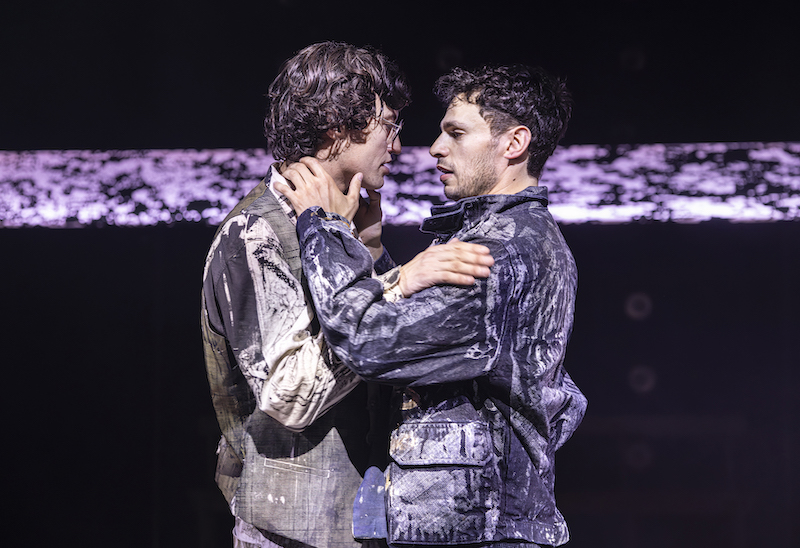
Andrew Exeter’s wooden thrust-stage set design provides a more effective backdrop for the romance than Martin Hanly’s costume designs, which take modern clothing cuts and cover them with distressed prints to simulate age. Some of these work, but more do not, especially Melissa Jacques’s judge’s gown, which looks like someone had an unfortunate encounter with a can of Dulux.
The general brightness of Act I is harder to find in the second act, once a romantic tryst between William and Richard is witnessed, and the community hardens. Here, too, though, the men at the heart of the story are often sidelined; Richard is at sea for much of it, so the homophobic opprobrium falls mainly on the shoulders of Gage’s William. Even then, his imprisonment means that focus returns once more to Lock’s Mother. Shorn of much of the good humour that characterised her role in the first half, Lock shows her range with a sensitive portrayal of a mother who is outraged and offended by her son’s (supposedly sinful) actions, but who rises above to support the child she loves.
The destination to which the musical inexorably draws may be known, but the route is compelling, however heavily romanticised it may be. Not much is documented about the two men, but it is known that before their executions, Richard kissed William tenderly on the hand. That one action, recreated in a blaze of light, is enough to anchor Gage’s sense of loving romance in the realm of reality.
Redcliffe does not necessarily need its coda, in which actors break character to remind us that there are still 12 countries in which gay relationships are punishable by death. However unnecessary for the show, it is a valuable lesson to remember and encourages us, as Gage has done, to celebrate the stories of LGBTQ+ love and defiance that would otherwise be lost to history.
Runs until 4 July 2026
