

Writer: William Shakespeare
Director: Mark Dornford-May
Established less than two years ago, theatre company Ensemble ‘84 has achieved so much in a short period of time and in the most unlikely of places. Following winning three North East Culture Awards in 2025, funding from Arts Council England and Durham County Council has allowed them to convert a Methodist church into The Playhouse: their own performance space in the heart of Horden – one of the many pit villages that dot the North East of England. Like most of these mining communities, Horden has struggled to recover from the closure of the pits in the 1980s but thanks to a dedicated band of passionate people, Horden now has its own theatre that hosts the UK’s only resident company of paid actors. The theatre’s launch was attended by Sir Ian McKellen who was very vocal in his support of this venture and his hopes that other villages, towns and cities will want to emulate it.
Ensemble ‘84’s first production in their new home is as apt as it is challenging: what many consider the greatest work of the greatest ever writer, Hamlet comes with a lot of expectations. The First Quarto (or Hamlet Q1) is a shortened and slightly simplified version of the recognised text, the source of which scholars have been debating for years. Whether it’s an early version of the play or a “pirated” version written down from memory by an actor of the time, it is still a challenging piece that suits this relatively small company very well thanks to its reduced character list and quicker pace.
The production itself is superb, offering a very raw, primal staging with a striking urgency partly thanks to the simplicity of the set and lighting, and the cast providing all of the music and sound effects live. The set spills into the rest of the space with scaffolding both providing a multi-level performance area and housing the audience’s seats. This and the fact that the actual playing area is surrounded on three sides by the audience, means that one is placed right in the middle of the action wherever you are seated.
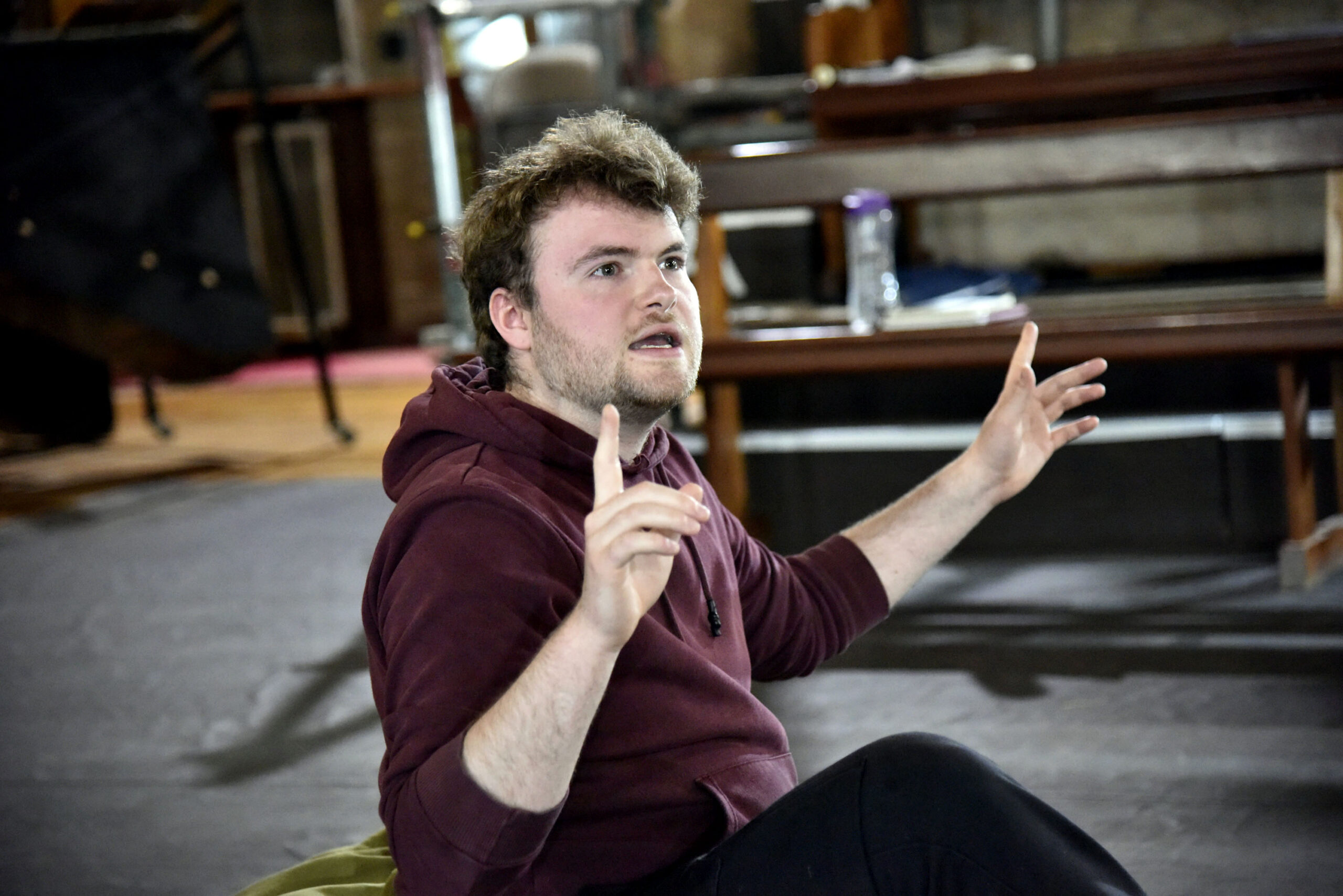
Mark Dornford-May’s direction is creative and impressive in its simplicity, allowing the actors to do their thing but also adding spectacular flourishes when required. The moments of physicality are particularly striking, including Hamlet’s “get thee to a nunnery” scene with Ofelia (here extremely disturbing in its intensity) and the climactic sword fight which is nail-biting, edge-of-your-seat exciting. This obvious creative flair brings out the best from the cast which is made up entirely of people who live in the surrounding area. Joseph Hammal as Hamlet makes one totally believe in his spiraling sanity, toggling between jovial and cruel, loving and violent, gentle and vicious with apparent ease – this is an excellent central performance that could easily stand alongside his more well-known counterparts. Originally from South Africa, Thandolwethu Mzembe makes a very powerful and commanding Claudius, as well a genuinely disturbing ghost of King Hamlet, delivering all his lines in his native language which is surprisingly effective. Willow Pearson beautifully brings the tragic Ofelia to life, Keith Irons makes the perfect foil for Hamlet’s taunts as Corambis (aka Polonius) and gets big laughs with his Gravedigger, and Brodie Jobson is a very intense and commanding Leartes. This entire production and all the performances would not look out of place at the RSC or National Theatre.
When visiting The Playhouse the week before the premiere of this play, McKellen enthusiastically described the upcoming performance as being “one of the most important theatre events in the United Kingdom, certainly this year”. As well as not wanting to contradict the great Sir Ian, after seeing this version of Shakespeare’s masterpiece, it hard to argue with his sentiment. This is a first-rate production that aims to and succeeds in making theatre accessible to the people. The Bard would be so proud.
Runs until 6th June 2026
The Reviews Hub Score
-
10
