

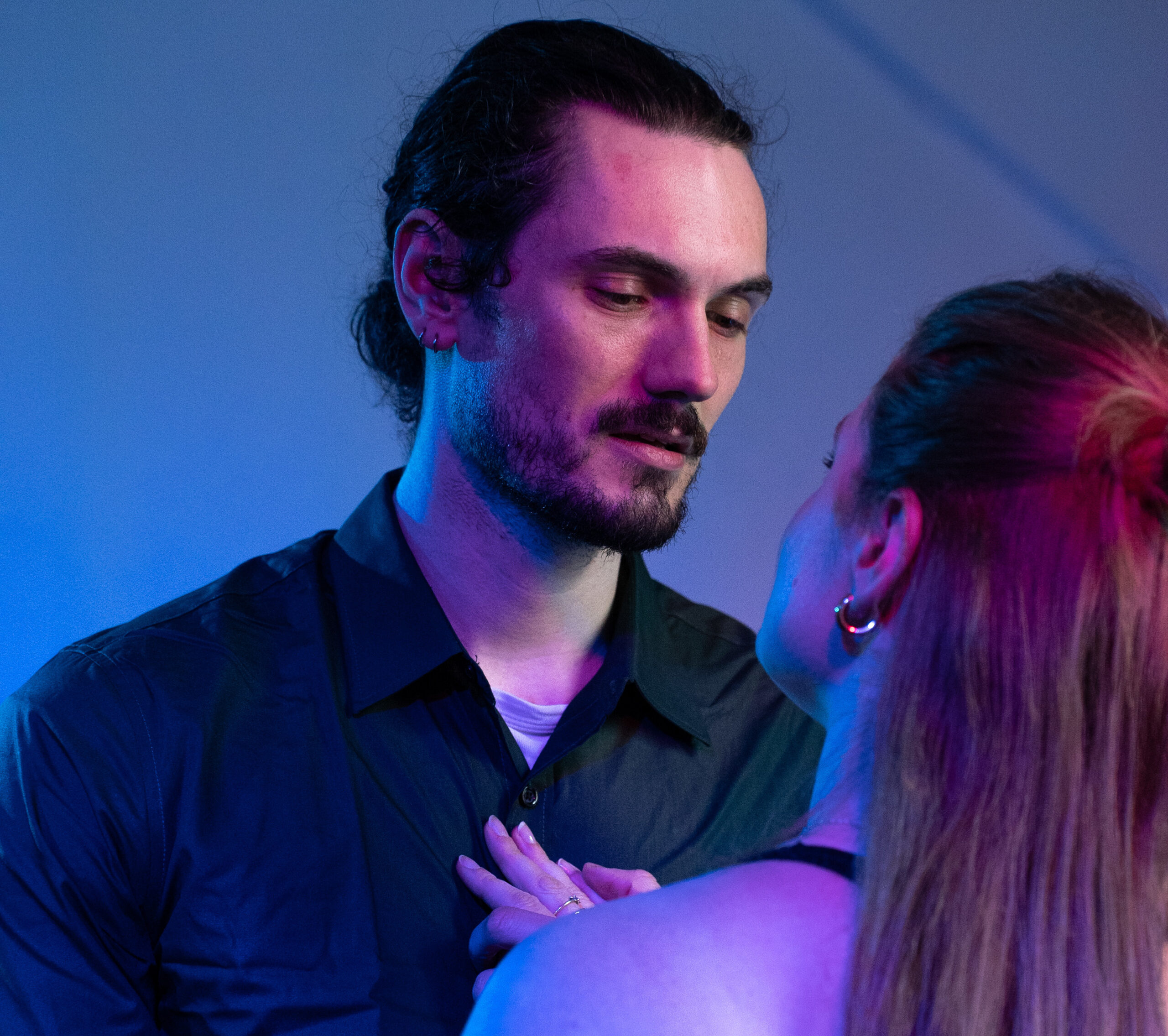
Depression and mania combine in Chemistry, a revival of Jacob Marx Rice’s problematic play about love, drugs, and mental health.
Kathryn Bates and Rowland Stirling – East Coast accents impeccable throughout – play Steph and Jamie, two young Americans who meet at a psychiatrist’s office. Steph’s a sassy depressive, who’s seen it all before; Jamie is the hyper-intelligent “unicorn” (he has a rare form of bipolar disorder) naif, welcomed into the world of professional mental health care with cynicism, jargon, and Steph asking him out on a date.
This two-hander is beautifully staged, and the love story that unfolds is believable and – at first – sweet. Crates sweep together to form a bed for those early, glorious moments of shared intimacy. Steph’s a Brown university drop-out now working in a bar; Jamie has a very specific ambition to be Secretary of State, and to this end is working in politics in Washington. This characterisation partly explains the Aaron Sorkin-esque dialogue, in which the two exchange sharp but faintly unbelievable zingers with each other in a manner familiar with anyone who has seen Sorkin’s Democrat Fantasia The West Wing.
The problems – both in, and with, the play – begin as the characters fall in love, and their conditions are foregrounded. Steph warns Jamie that her self-destructive traits equal inevitable relationship distruction. Jamie, meanwhile, comes off his bipolar meds and… thrives.
The ease in which Jamie gives up his medication, contrasted with Steph’s “doomed whatever she does” descent into depressive inertia, makes sense dramaturgically but is at best cringe as a plot device. With chronic depression treated as essentially incurable, and unipolar mania as a kind of superpower that lets you do super-serious jobs, it’s hard to take the play seriously when its treatment of mental health conditions is so inherently unserious.
Still, the performers do their best with the material given to them. Steph’s gradual withdrawal from the world – despite Jamie’s hyper-puppy-dog attempts to keep her engaged – is well played, the character’s inability to get out of bed and hope for an act of God to get her out of her miserable stasis familiar to anyone who has experienced clinical depression.
There are some aspects of Jamie’s actions that made this audience member uncomfortable. His snootiness at her low-status job working in a bar – played as a big dramatic moment, as he says the unsayable – is one of a few red flags the character displays. There’s a physicality to Jamie, who pulls Steph close in a way the character, I’m sure, feels is reassuring, but doesn’t feel so from where I’m sitting.
In the most moving scene, Steph stands on a box – a foreshadowing of suicide – and gazes helplessly at the hundreds of smashed glasses around her. As the play unfolds, Jamie spends more time off stage, offering distant reassurance by phone, and appearing increasingly manic and distracted by his increasingly successful professional career.
Jamie is cynical about medication, fearing the chemical balancing will impact his creativity and genius. Steph believes, though it seems to be doing little to help her. These characters seem to have no friends, or anything in the kind of a wider support network, professional or otherwise.
Fighting for air, implicitly, in this play, is a savage denoucment of late-stage capitalism, of isolation, atomisation, and of loneliness in a world that has forgotten everything bar the profit motive. Though their chemistry is convincing as a couple, Jamie and Steph’s story is one that seems confusingly blind to wider truths.
Reviewed on 18th May.
