

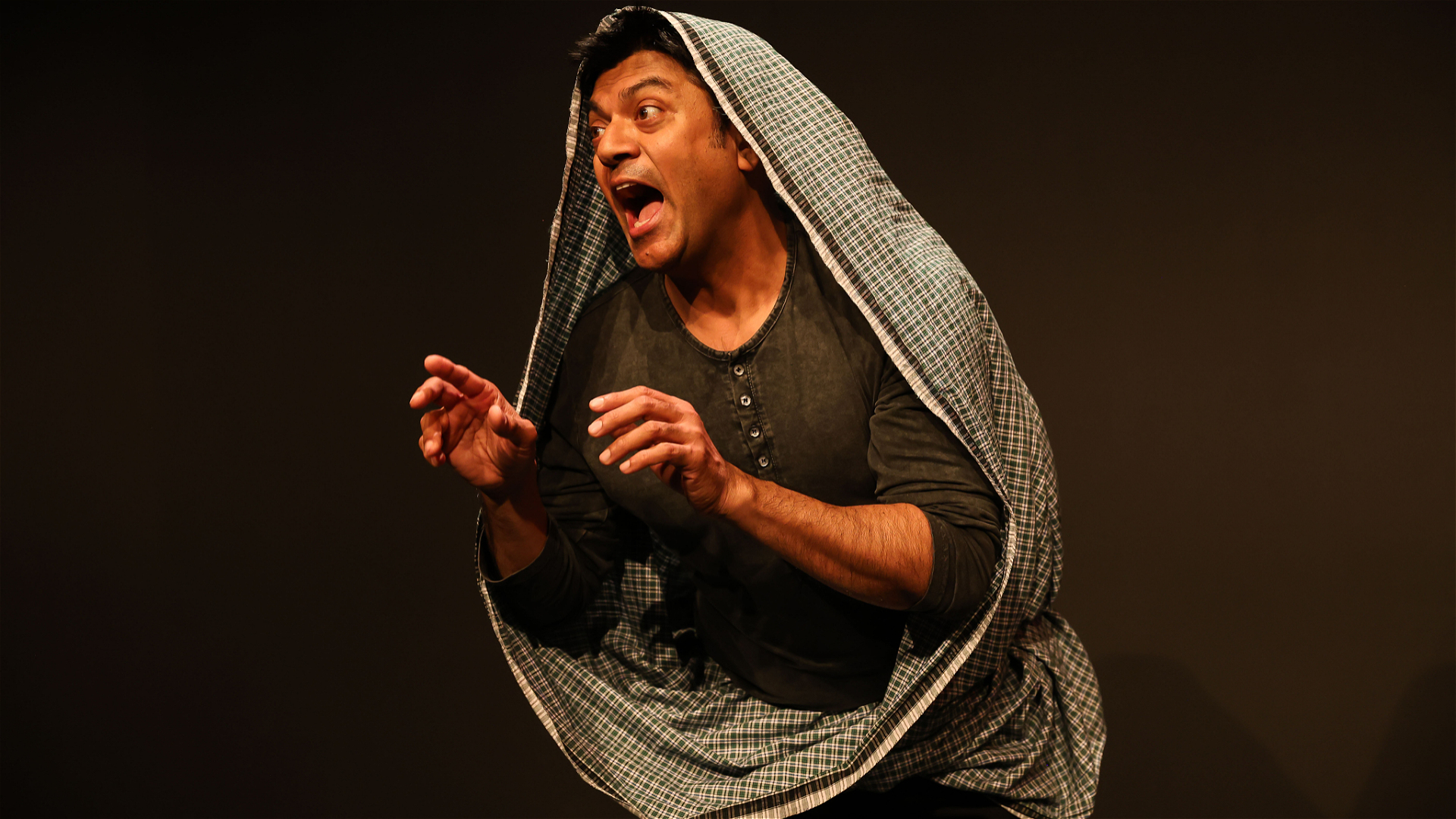
There’s an intentionally awkward moment towards the end of this one-man storytelling hour, in which the audience is made to hold up some Union Jack bunting. As our performer, playing a migrant from Bangladesh, looks back out at us, there’s a frisson in the room. After all, we all know what this flag represents. Don’t we?
Flight: one man’s journey is about memory, home, and belonging, directed by Jacquie Crage and written by Martin Lytton. The character, Maneek, is played by Naz Sheikh, in a compellingly committed performance, as he leaps and glides across the stage, plays instruments, shakes bells, waves pieces of colourful fabric, and gets plenty of use out of a stepladder, which at one stage stands in for a coconut tree.
The play tiptoes carefully through shards of reminiscence and recollection – tales, scenes, and memories by turns vivid and cloudy. First we see a small child, plagued by dreams of tigers and reassured by songs reminding him to be the crafty jackal, and to lure that most dangerous of creatures into a cage.
But we’re all trapped, in some way or other, and Maneek, son of the local policeman, is a boy apart from the others in the village, with whom he desperately wishes to swim and play and prove his worth.
Some of these early scenes are the best in the whole show, as Sheikh expertly portrays the confusion and luminous colour of childhood memory. Women sing, market traders shout out their wares, and Maneek tries to establish who he is and who he wants to be.
Also engagingly played are scenes of Maneek’s first experiences of England, working in a restaurant, and trying to figure out what “minging” means.
Other vignettes are less successful. The character spends some time in urban slums, juxtaposed starkly with idyllic village life, but this section feels vague and ephemeral; so, too, does Maneek’s courting of the love of his life, despite the bittersweet memories of ice cream, meaningful glances, and empty pockets.
Despite some excellent moments, the narrative never quite comes into focus, and the finale, though thought-provoking, doesn’t feel fully earned. Still, this show comes recommended: it is the diaspora experience neatly distilled into a tight 55 minutes, with vivid characters, excellent, unrestrained performance, and a sense of intangible yearning.
Reviewed on 15th May.
