

Book and Lyrics: Jishik Kim
Music: Seungyeon Kwon
Director: Daljung Kim
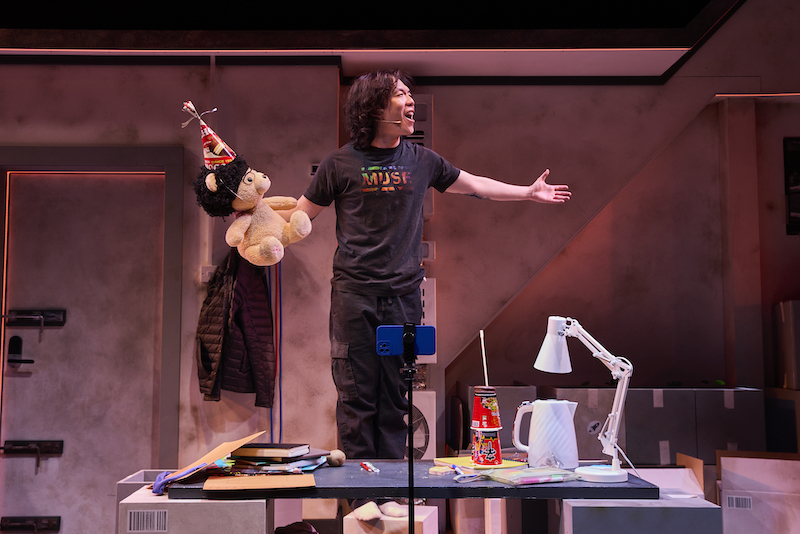
The only (unnamed) character in the South Korean musical The Last Man is a film nut with many a movie reference at the ready for any situation. It is perhaps a little on the nose, then, for the only film posters adorning the Seoul basement flat that forms Shankho Chaudhuri’s set to be those from zombie movies.
For an impending zombie apocalypse is the reason why The Survivor (played by Lex Lee on press night, in a role he alternates with Nabi Brown) has barricaded himself inside. A mysterious virus is sweeping through the city, the government authorities aren’t doing enough to arrest its spread, and complete isolation is the only way he will survive.
One can’t help but feel triggered by memories of 2020 and the first days of the COVID-19 lockdown during the musical’s first moments. There’s the sense of stockpiling, of enforced acts of cutting oneself off from the world, that once seemed outlandish but now are personal memories.
For a one-actor musical, the real challenge is who this forced recluse will be talking to for the musical’s two hours. Here, that’s resolved by setting up a mobile phone on a trip and delivering vlog messages, stutteringly played out on small screens embedded into the set. Lee is personable and charming here, as matter-of-fact as one can be, as he waits out the crisis.
The character’s film knowledge acts both to gallop through zombie lore – from the shuffling undead corpses of George Romero’s Night of the Living Dead to the athletic sprinters of World War Z – and to undercut some of the musical’s similarities to other tales. As the Survivor cultivates some potatoes to boost his food rations, any audience thoughts of a Matt Damon film in which he did something similar are interrupted by the Survivor confirming that, yes, it’s a similar plot line to The Martian. And when a thunderstorm threatens to flood the flat, the character brings up the resemblance to Parasite.
Such self-referential nods are sparse, with most of the Survivor’s monologue talking about how he intends to survive. There are reminiscences, too: an alternate outlet for the character’s monologuing is an old stuffed toy, with whom Lee share memories of his childhood.
Seungyeon Kwon’s rock-and-violin score (with arrangements by Gabrial Chernick) allows for a mix of anger, pent-up excitement and quieter contemplation, with Lee providing the requisite light and shade to deliver them well.
The main problem is that, like the Survivor, there often seems to be nowhere for the music or the story to go. Perhaps inevitably, this one-room, one-actor musical often feels stuck, particularly in Act I.
After the interval, after a series of setbacks with power and flooding break the quiet monotony of the Survivor’s lockdown, there is more to play with emotionally, musically and dramatically. As Lee’s character begins to struggle with his mental health, and the prospect of other survivors begins to trickle through, the play gains some structure and propulsion that were lacking in the first act.
The final moments of the musical pull a rug out from under, leading one to question everything that has gone before. That’s a difficult task for any story to pull off without risking that the audience feels betrayed by being misled. The Last Man’s version of a big twist doesn’t really come off as well as the production hopes, even though the seeds of its climax have been planted throughout the story.
One is left wondering how much of the Survivor’s year was rooted in the real world (or as close to it as a vision of a zombie-infested Seoul could ever be) and how much has been told to us by the ultimate unreliable narrator. And even though the musical ends in a hopeful, partially redemptive note, that lingering whiff of betrayal lingers.
Runs until 13 June 2026
