

Writer: Andrea Levy
Adapter: Helen Edmundson
Director: Matthew Xia
Small Island was written over two decades ago as a reminder of the hostility the Windrush generation encountered when they arrived in a country they regarded as their own. Sadly, it has become something more urgent than that. Matthew Xia’s production – a regional premiere, the first time Helen Edmundson’s adaptation has been seen outside London – makes no attempt to update or reframe Andrea Levy’s story for the present time. It doesn’t need to – the accusations of benefit-seeking, the instinct to protect women and children from newcomers, the casual, corrosive sense of superiority, need no updating. Xia puts it plainly in the programme notes: “It’s a story about people, not headlines.” That directorial decision is exactly what makes it land so hard.
There is a personal dimension to Xia’s investment in the material too. His father travelled from Jamaica to London in the early 1970s, and he is candid about what that means: “It’s literally why I’m here – a part of my personal history.” The background shows in the production’s refusal to treat the story as historical artefact. It is also the first time Edmundson’s adaptation has toured to cities with their own deep connections to this history – Leeds, Birmingham and Nottingham each have communities with Windrush-era roots, and communities from other backgrounds who will recognise the experience of migration as present tense rather than past.
The original National Theatre production had the Olivier’s vast resources behind it. This touring production is necessarily smaller in scale, and the intimacy that results is entirely beneficial. Xia describes his intention as “sensory immersion,” and he achieves it. The effect is of being drawn into events rather than observing them, making it impossible to look away. Edmundson’s script uses humour as a counterpoint throughout, but it doesn’t soften the blows. The racial slurs land hard and draw a sharp reaction from the Nottingham audience.
Simon Kenny’s set is well conceived, and Ciarán Cunningham’s lighting design supports it effectively. A front-of-stage screen carrying contemporary film footage handles the shifts in time and location well. The open brightness of Jamaica in Act One – vivid colour, a sense of space and possibility – gives way in Act Two to the grey claustrophobia of post-war London. Hurricanes become drizzle. It is a simple but effective piece of visual storytelling.
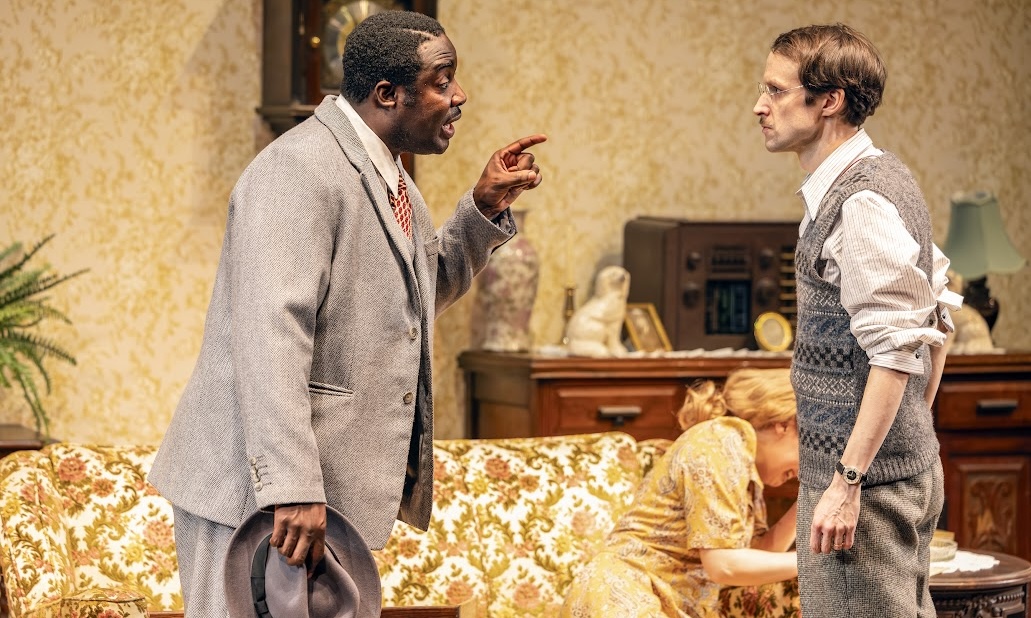
The cast is strong across the board. Bronté Barbé’s Queenie is warm, funny and grounded – open and welcoming in a way that makes her the story’s moral centre, the near-sole haven from the racial hostility that surrounds the new arrivals. Anna Crichlow’s Hortense is her counterpoint: rigid, disciplined, aspirational in a way that has been shaped by the very colonial hierarchies the story sets out to challenge. Daniel Ward brings confidence and easy charm to Gilbert, a man forced to diminish himself in order to avoid antagonising those around him – the gap between who he is and how he must present himself is an integral part of the play. Mark Arends is suitably contained as Bernard, his racism never far beneath the surface. Rhys Stephenson, making his professional theatre debut, brings a natural ease to Michael – a small role, but well-observed.
The production’s most quietly effective performance comes from Paul Hawkyard as Arthur, Bernard’s father. Shell-shocked into near-muteness, shambling and twitching with constant involuntary tics, it is a masterclass in physical characterisation – a whole life’s damage rendered in a few scenes without a word of explanation.
Costume, too, has a part in telling the story. The Jamaican arrivals are dressed with care and pride – aspirational, considered – and yet find themselves living in a cramped and shabby single room. Queenie, by contrast, wears lived-in, practical clothes but occupies a decent space. The visual gap between expectation and reality says much that the script doesn’t need to spell out.
The climax arrives in Gilbert’s searing speech to Bernard – a precise, devastating account of what whiteness actually confers, and what it does not. Bernard’s response offers a flicker of hope. “I’m sorry,” he says – and then doubles down. It’s a most telling moment in a very powerful evening. History tells us things do get better. Small Island makes you feel how long and difficult that process is.
Runs until 16 May 2026
The Reviews Hub Star Rating
-
8
