

Writer: Virginia Woolf, adapted by Flora Wilson Brown
Director: Júlia Leval
Virginia Woolf described her 1931 experimental novel, The Waves, as a play poem. Comprising six interweaving soliloquies that focus on inner lives and personal identities, it’s a text that prioritises thoughts over action. It’s not an easy read in the way that James Joyce’s Ulysses is no breeze, but if you’ve ever tried and failed, then you need to see it performed.
Way before Our Friends in the North, Friends or Sex in the City, Woolf recognised how friends could be closer than family and more reliable than blood ties. Played out in her own life as part of the Bloomsbury Group, The Waves taps into a social phenomenon that became more important as communities became more fractured. Woolf was ahead of her time.
The new adaptation by Flora Wilson Brown at the Jermyn Street Theatre makes the obtuse, convoluted and dizzying text sparkle and shine. The story of six lifelong friends spans decades and starts in childhood. The live performance of this poetic prose, cut up and distributed across the characters, never feels overwrought and is owned by an accomplished, self-assured cast.
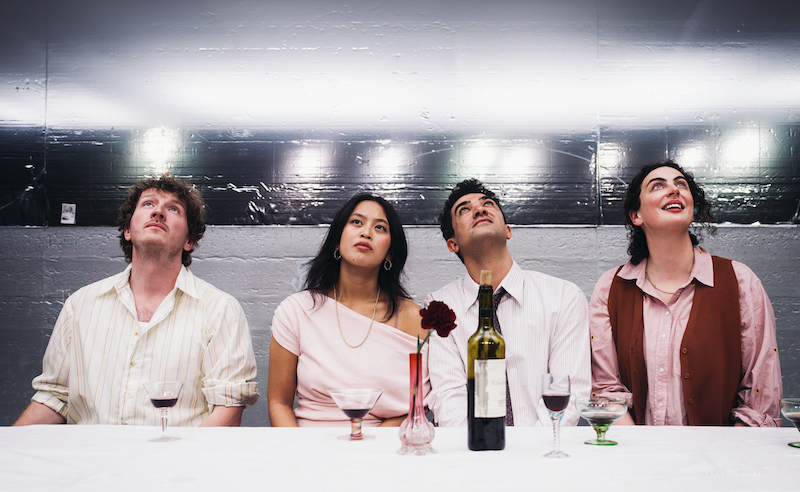
Although having an ensemble of six on a relatively small stage goes against contemporary mores—it’s not only more expensive but can confuse audiences—there is clarity throughout. Cleverly choreographed scenes, which see some characters recede and others take the verbal baton, allow audiences to navigate their way around the cast. The occasional tableau vivant, combined with witty T-shirts that announce each character’s name, offers clean, modern direction from Júlia Leval.
The distinctly different personalities and mental/emotional states of each character soon become clear. Archie Backhouse is Louis, the Ozzie “alien” with many fantasy aliases, while Tom Varey brings an Irish lilt to steady Bernard. Breffni Holahan is Susan, the crazy-eyed, land-girl, while Timothée Chalamet lookalike, Pedro Leandro, is queer poet Neville. Syakira Moeladi mischievously performs good time girl Ginny, she likes red lipstick and sleeping around, while sensitive Rhoda is plagued by doubt and uncertainty; Ria Zmitrowicz gives pure vulnerability.
The endearing opening scene with the cast as children sees the characters at their most free. Their imaginations go wild in a reverie of games and stories, bizarre declarations and sweet friendships. Emotions are at their most powerful, and here they are unaware of the expectations before them: education, professional lives, relationships or families. Boarding school is an altogether different experience: the trauma of separation, a new pecking order, a more brutal social setting, the discovery of masturbation, and the arrival of Percival, a dreamboat who will break all their hearts.
From the open expansiveness of childhood when the world is vast and choices unlimited to the lived reality of a contracting adulthood where sacrifices are made, paths chosen and loves lost, The Waves seems to encompass all of life in 95 minutes. The sound of waves bookends the narrative as an audio, metaphorical representation of time passing and the inevitability of life’s passage. The light always returns after an eclipse, and despite everything, the closing words give hope and remain true: “How incredible it is to be alive.” The Waves is a delight from start to finish.
Runs until 23 May 2026
