

Writer: John le Carré
Adaptor: David Eldridge
Director: Jeremy Herrin
Published in 1963, a year after the Berlin Wall divided Germany and the world into two halves, and also a year after Sean Connery first starred as James Bond, The Spy Who Came in From the Cold was the gritty, realistic counterpart to Ian Fleming’s glossy version of life in the secret service.
Writing from first hand experience, John Le Carré created a work that was fiction drawn from fact, depicting Special Agents and their handlers as actors moving in shadows, constantly playing roles that were anything other than glamorous and unable to seek public acknowledgment, let alone praise, for their performance. The claustrophobic and manipulative nature of this world is superbly evoked in David Eldridge’s adaptation of the book.
The story centres around Alec Leamas, played by Ralf Little, a spy working in Berlin, distraught at the death of Karl Riemeck, his agent in the East of the city who was kept there for too long by the Circus – the name given to the fictitious British Intelligence Agency in much of Le Carré’s writing. Given the opportunity to leave Berlin and come in from the cold, Leamas instead accepts a different offer, a chance to bring down Mundt, the German Counter-intelligence officer responsible for Riemeck’s death.
Showing the elaborate and painstaking nature of these operations, the task will take several months, if not years, to achieve and will require Leamas to play out a series of roles that will cast him as an out of work alcoholic resentful at his treatment by the service in order for him to be a convincing participant and witness when he returns to Europe to recast Mundt as a double agent in the eyes of his own handlers.
Divided into neat halves, the prosaic nature of Act 1, set largely in England, can at times feel like the story is spending too long meandering down alleyways that are merely delaying the start of Act 2 where the real counter-intelligence stuff can begin. However, the small details revealed and developed all count for something as seeds are skillfully sown so that they can come back together in a series of twists that show Le Carré and Eldridge don’t need to withhold information in order to create surprise endings.
Little brings a detached, unemotional coldness to the role of Leamas, perfectly capturing the sense of resentment at being an outsider in the organisation by virtue of upbringing, and an outsider in the wider world by virtue of his job. However, the detachment spills over into the scenes he shares with Liz, the communist party member he meets at the library where he is sent to work. As Liz, Gráinne Dromgoole, combines feminist values with a rigorous adherence to the principals of the party, creating a character who is both liberated and oppressed. Individually excellent in their characterisations, it nevertheless make their relationship seem closer to the functional relationship of Winston and Julia in 1984 than to one where there is any close bond or real love.
Peter Losasso’s portrayal of Mundt, and Eddie Toll’s portrayal of Fiedler, the agent who wishes to bring him down, both skilfully avoid the danger of becoming parodic caricatures of foreign agents. Losasso gives Mundt an arrogance and ruthlessness that suggest he would not be one for long speeches before dispatching his victims, and Toll makes Fiedler appear as if this would be something he would do simply to display his intellect and rigour.
Driving the plot, as far as the British Intelligence Agency is concerned, Nicholas Murchie captures the essence of Control, coming across as Q but without the enigmatic name or charisma, and with a moral compass that values causes more than people. Tony Turner brings out the more nuanced nature of Smiley, a background figure here who is both institutionalised in the service while also being seen by others as closer to an Oxford don than a spy.
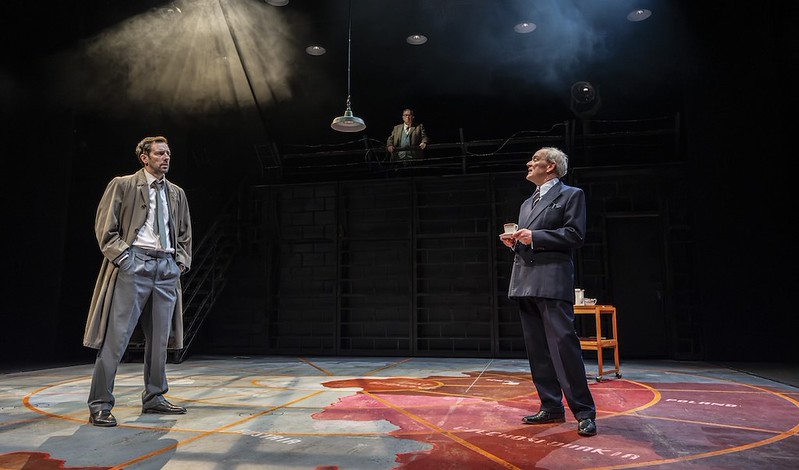
The stark minimal stage set suits a script that focuses on dialogue and tradition rather than action and adventure. Lucy Cullingford’s movement direction enables the story and settings to come to life in the absence of visual clues, and one of the strengths of Jeremy Herrin’s direction is that the early blocks of exposition, where histories and allegiances are revealed, seem like perfectly normal formal conversation in a world where protagonists will seldom know each other let alone be friends.
Overall, it is a strong production that takes a deliberately slow paced story and turns it into something that always manages to provide sufficient intrigue and twists to hold audiences attention until the curtain comes down.
Runs until 25 April | Image: Johan Persson
