

Book: Tina Fey
Music: Jeff Richmond
Lyrics: Nell Benjamin
Director: Casey Nicholaw
Few modern comedies embed themselves in popular culture as indelibly as Mean Girls. Written by Tina Fey, the film distils the social brutality of adolescence into something both savagely funny and sharply observed. Its transition to the stage as Mean Girls The Musical is not merely an act of adaptation, but expansion, retaining its bite while embracing the heightened theatricality of musical storytelling. The current UK tour demonstrates just how effectively that transformation translates to the stage.
Mean Girls follows Cady Heron (Emily Lane), a teenager who enters the unfamiliar world of an American high school after a very different upbringing. As she navigates its social landscape, she encounters a tightly controlled hierarchy led by an elite group known as “The Plastics.” What begins as a simple attempt to fit in quickly evolves into something far more complex, as friendships, identity, and status become increasingly intertwined. The story explores the pressures of belonging and the consequences of trying to reshape oneself to meet the expectations of others, all with sharp humour and a distinctly contemporary edge.
This production is driven by the exceptional strength of its ensemble. They are not simply cohesive; they are instinctive, intuitive, and visibly having the time of their lives on stage. As a collective, they function as a single, finely calibrated organism, each performer a consummate triple threat, delivering vocals, choreography, and character with precision and assurance. That shared energy is not incidental; it is foundational to the show’s success.
At its centre, Vivian Panka’s Regina George is a performance of real authority. Vocally formidable, she commands the score with clarity and power, while her dramatic control distinguishes the performance. Her Regina is cool, dangerous, and utterly compelling, precisely judged and consistently magnetic. What works well is the shift between direct malice and intimidation and the comedic moments we see with her onstage mum (Faye Tozer). Tozer, best known for her work with the band Steps, delivers a performance of real substance across multiple roles. She demonstrates impressive versatility, bringing clear, distinct characterisation to each part and revealing a depth of acting talent that extends well beyond her pop credentials.
The production’s sense of propulsion stems in no small part from Casey Nicholaw, who serves as both director and choreographer. This dual creative authorship results in staging of remarkable cohesion and momentum. The action is relentlessly dynamic: transitions happen in the blink of an eye, routines are high-level aerobic set pieces executed with precision, and the ensemble sustains an extraordinary level of energy throughout.
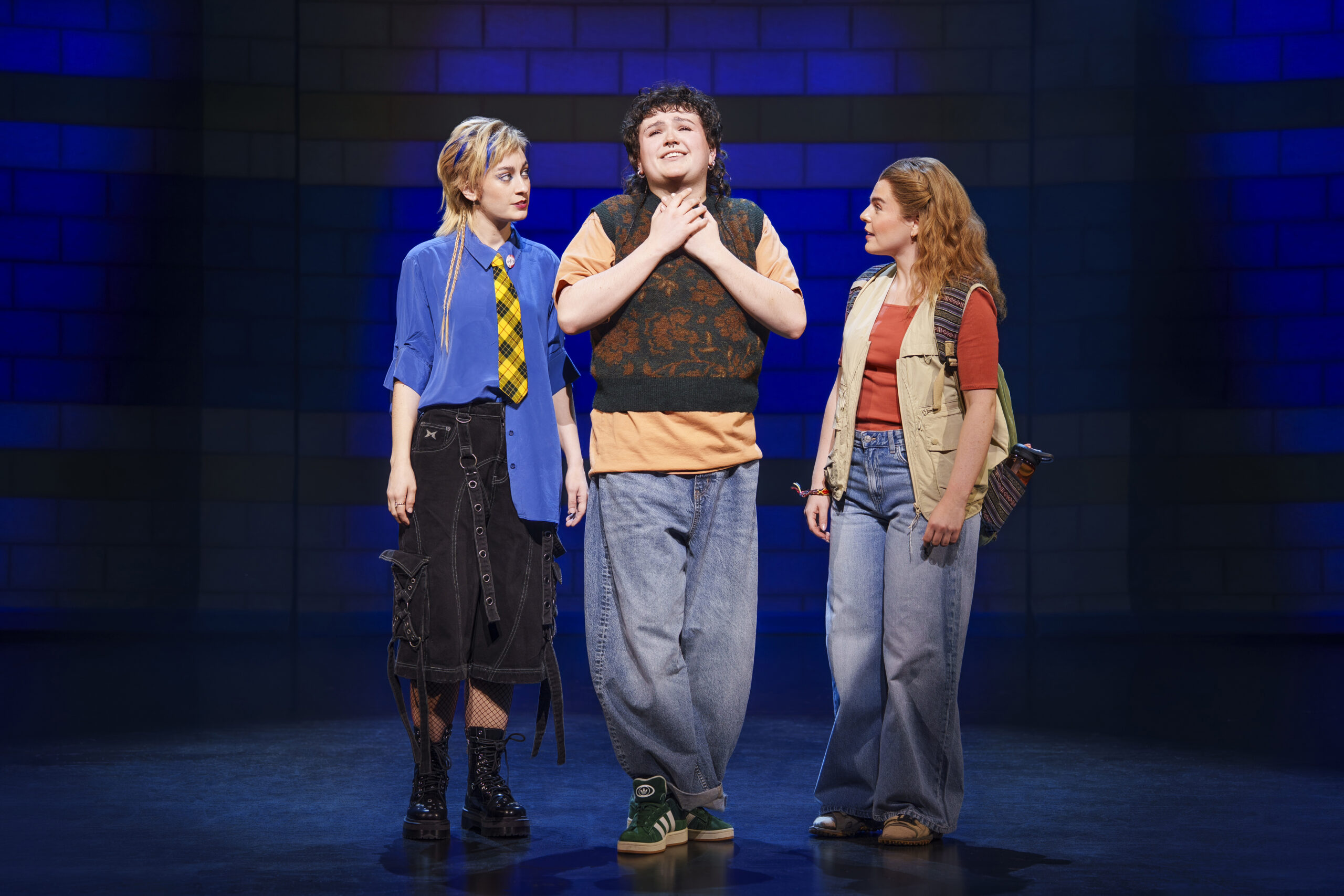
The production’s visual identity is anchored by the work of Scott Pask, whose design centres on the school canteen—the epicentre of the show’s social hierarchy. It is here that status is negotiated and power displayed. Around this, a series of mobile and highly adaptable set pieces, beds, desks, and doors slide effortlessly in and out of the action. These elements are fully integrated into the choreography, resulting in razor-sharp transitions that maintain the production’s relentless pace.
Pask’s design is further enriched by imaginative masking and flown elements, including the striking African landscape, which appears and disappears with theatrical precision, expanding the visual scope without disrupting the flow.
Complementing this is the dynamic lighting design by Kenneth Posner, which plays a crucial role in shaping the production’s tonal shifts. Posner contrasts the drab, mundane fluorescence of the school environment with the bold, punchy dynamism of the musical numbers, allowing the show to pivot seamlessly between realism and heightened theatricality. Nowhere is this more effective than in the climactic World Burn, where Regina is held in stark backlight as a single LED strip mimics the motion of a photocopier scanner, an image of striking precision and theatrical intelligence.
It is worth noting, however, that while the cast is undoubtedly exceptional, the sound design does not always serve them as well as it should. Microphone levels are frequently pushed too hard, and at times, vocals, particularly on sustained power notes, become obscured or distorted. It is a technical shortcoming that slightly undermines what is otherwise an extraordinarily polished production.
That caveat aside, this remains an excellent show. Slick, intelligent, and executed with precision, Mean Girls delivers on every level. Fans of both the original film and its stage adaptation will find much to admire.
Runs until 18 April 2026 and on tour
The Reviews Hub Star Rating
-
8
