

Creators: Silvia Calderoni and Ilenia Caleo
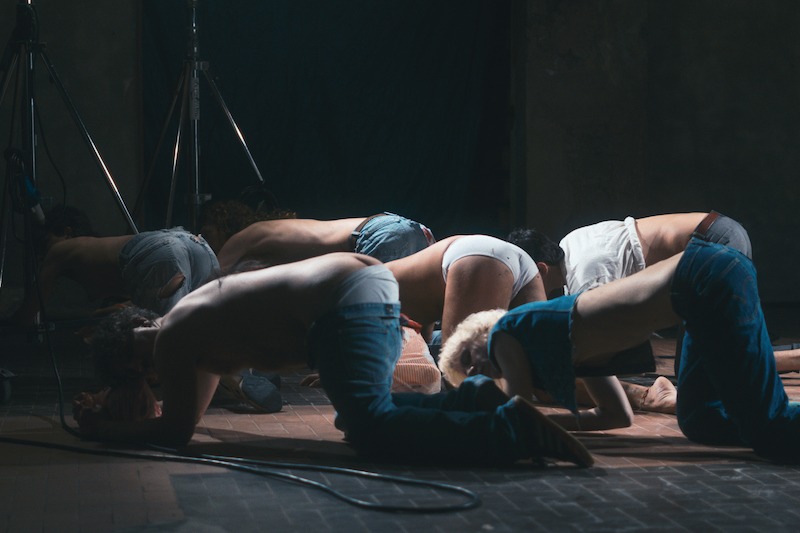
Large portions of Italian artists Silvia Calderoni and Ilenia Caleo’s hour-long performance work, The Present is Not Enough, consist of a group of queer people sitting or lying together in various states of undress. The clothes are dominated by denim, which, together with some of the male-presenting performers’ moustaches, lends a 1970s air to a tableau that also reminds one of Manet’s Le Déjeuner sur l’Herbe.
But the way in which the group sit, surveying its surroundings and locking eyes with audience members – not unkindly, sometimes flirtatiously, with a hint of mystery – also suggests a pride of lions, especially when Caleo plays an audio of cats loudly purring. There is a languor to these stretches that dares the audience to look away, to stare more closely, or to examine why they might want to do either. There is a charge to the performers’ stillness, each reclining posing a quiet assertion of presence, of the right to simply be seen.
Rolls of corrugated card are unwound and stood on end, sometimes suggesting windbreakers protecting performers sunbathing under the stage’s large, wheeled spotlights. At other times, the rolls are reconfigured into urinals where the performers cruise one another. The soundscape, the cat purrs sometimes giving way to sounds of distant highways or slow electronica, also features audio recollections from artist and AIDS activist David Wojnarowicz. These bursts of speech are as unfocused as any excerpt from a diary is wont to be, but one particularly powerful extract talks of the anger that one can feel upon experiencing a new song or other work, and recollecting all the people who are no longer around to hear it.
Throughout, the performers dress and undress seemingly at will. At times, the flashes of nudity seem to come with a childlike innocence and at others, prompt suggestive glances. That combination adds a frank, matter-of-factness to bodies, specifically queer bodies, that is by turns amusing, honest, refreshing and, just occasionally, provocative. It also gestures towards a history that the Wojnarowicz recordings make explicit: the queer body as a site of political contest, of grief, of joy reclaimed. Calderoni and Caleo never underline this too heavily, but the juxtaposition of bare skin and that weathered voice from a decade of loss gives the work a cumulative emotional weight.
Latter stages of the hour see the construction of a couple of walls from large, black polystyrene slabs. Some audience members can view the dancing, while for most, only slivers remain. The vibrations as the participants jump up and down reverberate through the chamber, placing the majority of viewers at once part of events and kept separate from them. For a piece concerned with visibility and its limits, it underlines the overall thesis: who gets to watch and who is shut out.
Runs until 27 March 2026
