

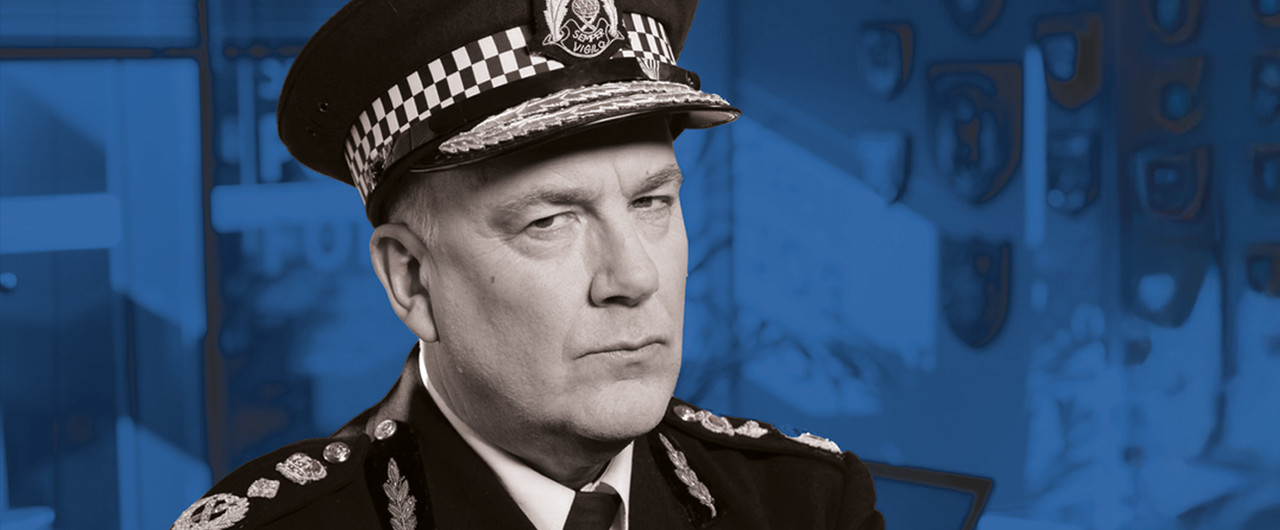
When Police Chief Commissioner Cameron Miekelson debuted in BBC Scotland blue light mockumentary Scot Squad more than a decade ago, few could have predicted that the gaffe-prone gaffer would prove so enduringly popular and adaptable, indeed that he’d go on to become Caledonia’s closest equivalent to Alan Partridge.
As with Steve Coogan’s creation, The Chief, or the more self-aggrandising “The Miek” as the blowhard occasionally styles himself, is something of a dinosaur, making superficial show of adapting to the modern world, with his true feelings and allegiances never far from the surface.
Yet as things change, so they remain the same. His opening remarks are admirably topical, the setups lifted straight from the news, as he takes gratuitous pops at the fire service, then quips about sectarian tensions. Though of course, you’re never too long from a devastating fire in Glasgow City Centre, violent clashes at the Old Firm derby or Donald Trump returning like the proverbial bad cent.
Even digging up and reviving one of The Chief’s best known television moments, in which he exhumes a childrens’ time capsule to find it chock full of memorabilia from now disgraced showbiz figures, is a classic routine that Docherty can smoothly update by adding whichever celebrity paedophiles and abusers have been exposed since it aired.
Ostensibly, this show is dedicated to promoting the paperback release of Miekelson’s bullishly titled memoir, No Apologies. And while no-one might mistake him for a canny political operator, his textbook description of a passive-aggressive, non-apology apology is shrewdly on-point. He has, at least, had the experience of making plenty of them.
Essentially, The Chief embodies a clash of old school policing with more PC attitudes, if you can forgive the pun. He hankers after a time when you could call a “bam” a “bam” and no-one would admonish you for it, when sexism kept the police force straightforwardly masculine and one didn’t have to mind one’s ps and qs quite so much.
Inevitably, he struggles with the tiptoeing around progressive standards and transgresses so many of the new guidelines, even as he invents so many outrageous slogans for his own policing vision. He’s also spectacularly indiscreet, particularly about First Ministers past and present and The Royal Family. Yet even his backslapping, golf club clubbability and desire to be seen as part of society’s elite, draws a line at former Prince Andrew, another alleged celeb deviant that he finds himself scrambling to disassociate from.
In concert with Miekelson’s recent sitcom, the memoir affords an opportunity to flesh out his backstory, including his tricky relationship with his climate activist daughter, her daddy issues exacerbated by the impeccable middle-class upbringing he’s given her.
There’s biographical cementing of The Chief’s own childhood and prescribed career path as well, as he remains oblivious to the privileges he’s benefited from his entire, vainglorious life, the lack of awareness conveyed in self-damning, amusingly unwitting testimony.
If one were cynical, you might wonder if the lecturely style of the presentation, complete with lectern, affords Docherty the chance to steal a glance at his script every now and then.
Yet he so inhabits and lives the character, wheeling about with theatrical flourishes and grandstanding with buffoonish pomposity, that you surmise he knows The Chief’s response to any possible situation anyway. The material is generally tight, notwithstanding the occasional thematic re-tread and over-indulgence of his boorishness. But it’s Docherty’s little nods and winks, poking through Miekelson’s posturing that really sells it.
A puffed up vanity project and sustained exercise in him having the last laugh, readings from the book allows for some pastiches of other literary styles, with his days on the beat rendered in sub-Irvine Welsh prose as he unsettles Leith junkies with his handsomeness. His initial dalliance with his now estranged wife glistens with the sweaty, febrile pawings of a terrible bonkbuster.
These more outlandish passages also lay the groundwork for the most leftfield aspects of The Chief’s personality, such as a belief in his coppering superpower to read minds and identify the offences of any miscreant. Of course, there then follows some lovely bits of business where he moves along the front row and condemns all he finds, blurting out accusations willy-nilly like a witchfinder possessed by the spirit of Derek Acorah.
Elsewhere, delivering a typically patronising dismissal of the criminal underclasses, attributing an incomprehensible dialect to “radges”, he hammers home his point by channelling Freddie Mercury at Live Aid. In the real world, this would seem insane behaviour. But so untouchable and so gifted a motivator does Miekelson imagine himself to be that it doesn’t feel especially out of character.
There are some missteps. The AI material that inexplicably bridges the interval, teasing the second half, feels underwritten and a disappointing resumption. And he hasn’t yet had the chance to accumulate quite as much comedy from John Swinney as he has from Nicola Sturgeon, the former being a much greyer personality.
Still, Miekelson is so rounded and versatile a character, with, you might imagine, so many quirks and flaws yet to be revealed, that there feels plenty of life left in him. At the same time, Docherty’s career as a performer has been so powerfully revived by his alter ego that, nearly twelve years in, he still brings so much vitality to The Chief that they seem inextricably bound together.
Tours until 30 May 2026 | Image: Contributed
The Reviews Hub Star Rating
Blowhard top coppering
