

Writer: Minjeong Kim
Director: Anna Udras
The term “Comfort Woman” is a grotesquely deceptive euphemism to obscure a systematised process of kidnapping, enforced slavery, and methodical rape perpetrated by Japanese military forces against around 200,000 mostly Korean and Chinese women from the late 1930s until the end of the war. The titular protagonist of writer and performer Minjeong Kim’s minimalist, intensely physical single-hander is a 13-year-old Korean girl named Minja. Japanese military officials specifically sought to abduct young girls from occupied rural areas, believing they were less likely to carry diseases than urban women.
Minja enjoys an idealised childhood in a small village, playing hopscotch, skipping stones into the river, and waiting for the boy she adores to walk her home. A neighbouring farmer and former family friend entices her and a host of other village girls into a truck, promising easy money for delivering flyers in the next village. Instead, the group finds itself sent directly to a military base, where they are divided into groups, assigned damp, mouldy rooms, given Japanese names, and ‘inspected’ by military medics. Minja, who recounts her tale from a late-life perspective, says, “If I could go back to that moment, I would tell myself, run”.
The Comfort Woman tracks Minja’s experiences over eight horrifying years. Japanese soldiers, whose slang for the women translates as ‘public toilet’, place a tick on a board outside each woman’s room after every rape. At the end of each week, there are dozens of such marks. Pregnant women are forced into abortions or shot. The fact that the terrified young Minja is yet to have her first period is held by other girls as something approaching luck.
With a friend, she attempts suicide by drinking medical alcohol, but survives to be sent straight back to work. Even liberation at the hands of American soldiers is a double-edged sword. Returning home, she finds all the men missing and must face up to the shame of telling her mother what happened.
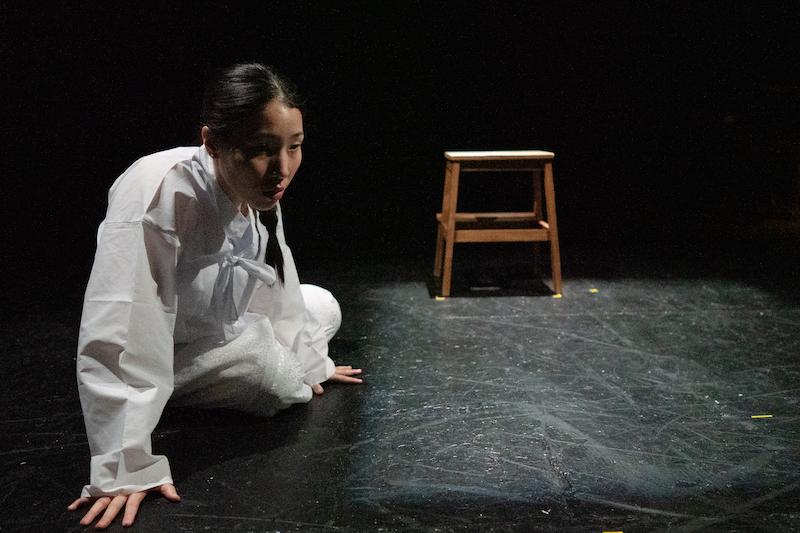
Kim wears a traditional white Korean Hanbok dress, a cultural symbol of innocence and purity, though here it serves more as a ghostly funeral shroud for the life and virtue the girl loses. There are few props and the dialogue is pared back, leaving mime, Ji Eun Jung’s haunting Korean harp music, and brilliantly executed physical theatre as the primary tools for storytelling. There are nods here to elements of Korean folk theatre, though the result is raw, deeply unsettling emotional realism rather than the stylised satire associated with traditional mask-play.
The Comfort Woman is not an easy watch: if you are prone to tears, come prepared. But Kim affords her protagonist immense, heartwarming dignity. Stories of survival against the odds are rarely as affecting as this.
Runs until 7 March 2026
