

Writer: Andrew Bovell
Director: Rosanna Preston
Ambitious and sweeping, this thoughtful, witty and emotional drama examines every aspect of family relationships via six representative characters: aspirational working-class mum and dad Fran and Bob and their four children Pip, Mark, Ben and Rosie, all at pivotal moments in their lives.
In the space of 90 minutes, it lays bare working-class parental sacrifice for the betterment of offspring, dashed hopes, marital discontent, favouritism, well-meaning but overbearing intervention, sibling rivalry, neglect, abuse, inter-generational bewilderment and the inadequacies of unconditional love.
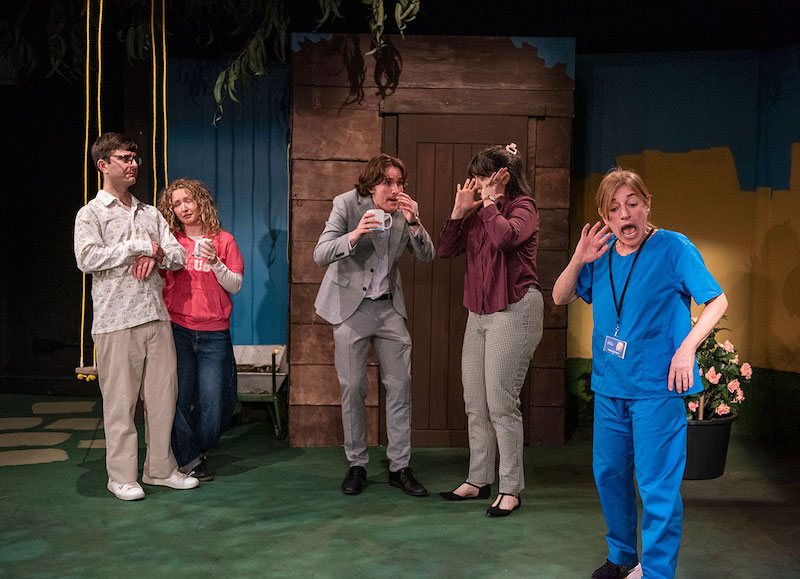
Writer Andrew Bovell is Australian, so the play was originally set in Adelaide, the sedate Victorian ‘City of Churches’, with its Mediterranean climate and melting pot population. Built within a square grid system, the city’s a useful Petri dish for social research, which seems relevant to the play’s intentions. Adelaide’s outdoor lifestyle gives rise to the scenery among which all the action happens: a homely, ramshackle backyard filled with childish paraphernalia, rendered here with cheerful broad-brush colour. “This garden is the world”, says Pip: it’s the venue for the family’s significant events, good and horrendous.
Regulars from the Tower Theatre team rise ably to the challenge of staging this intense, fast-paced show. They speak in their native UK accents, slightly dissonant in the ‘sunny side up’ setting, but this emphasises the fact that anywhere, no matter how idyllic, can become contemptibly familiar, with greener fields constantly calling.
Matriarch Fran, a frazzled nurse, is played hard, fierce and Northern by Sue Brodie, voice husky from incessant smokes. She perpetually grills and snaps at her four kids: “It’s a mother’s job to make her children cry so that they can withstand pain.” But the needling is on a sliding scale from outright anomie (eldest daughter Pip: “She’s me, but stronger.”) to joshing fondness (youngest Ben: “He’s my son: I’ll wash his shirts if I want to.”). Brodie navigates the high-speed dialogue with ease as the interrogations escalate, excuses are swatted away, and real reasons are nailed before anyone has time to reply. There’s genuine depth of feeling to her heartfelt homilies, pleading nags and reflections on life’s shortcomings, as well as occasional outbursts of loving appreciation as she remembers that although her kids are all grown up, they still look to her for support.
John McSpadyen is equally impressive as her husband, well-meaning, lumbering Bob, Scottish in full spate. Although he towers above shrewish Fran, he’s convincingly cowed, pottering around the backyard and dwelling mournfully on freedom wasted during his 30-year stint on a car factory floor, then, moreover, its premature end in redundancy and loss of meaning. “Who’d have thought the days would’ve turned out to be so long?” His life’s reduced to offering the kids lifts, most turned down, and bickering over household chores, his only solace tending the roses in the garden, each planted in honour of a family member. The performance really shines when he’s angrily standing up for his working-class family values and defending the children against the worst of Fran’s spite.
Madison Leach shines as youngest daughter Rosie, sweet, earnest, optimistic and kind. Her opening monologue about a passionate Euro-backpacking holiday fling gone heinously wrong is heartrendingly convincing. She adds warmth to every scene as she desperately tries to glue her rapidly distancing family back together with hugs. It’s her job to compare the things she knows to be true at the beginning and end of the piece, and her journey to bitter realisation rings true.
Eldest sister Pip is played by Rachel Bothamley with a mix of career woman steeliness, accusatory introspection, and wine glass-wielding sexiness. She’s the one most like Mum Fran, and has to carry the lion’s share of expectation and disappointment. Strident and defiant, she meets her mother’s career standards, but annihilates her respect by threatening to leave both husband and kids for an educational speaker she met on a works outing.
The two brothers, Mark and Ben, prove even more vexing to their troubled, eternally sacrificing parents. In a beautifully measured performance, David Lindley-Pilley as Mark displays all the quiet, kind, soft-voiced shyness that makes him such a male outlier, sparking suspicions in Fran’s relentlessly querying mind. Mark’s revelatory monologue dwells on rising above parental expectation in order to escape and grow: “My father’s grief is a price I am prepared to pay.” He warns Rosie against loving her siblings and parents too much: “We’re effed up, like most families.”
Brother Ben is, by contrast, loud and over-confident, brandishing the keys to a new European car that immediately triggers paternal concern: “Did you get finance for it? “I earn good money: spending isn’t a crime.” Fran defends her baby Ben to the hilt, but it soon becomes clear that his implied success stems from suspect sources. Bailey Finch deftly manages the swift switch from braggadocio to whining desperation, although the performance might benefit from more flash git unpleasantness in his first instance to accentuate the change.
Andrew Bovell has given this comprehensively dysfunctional family the surname Price, and it’s apt: all its members are paying heavily for their questionable and aberrant behaviours, the details of which emerge gradually, leading to shocking outcomes and a final catastrophe.
Written almost 10 years ago, the play is creaking slightly – it’s surprising how some of the issues raised, especially around gender, have lost their outrageous lustre – but its commentary around universal and timeless familial themes still has the capacity to resonate deeply and provoke tears. This honest and capable iteration is very much worthy of attention.
Runs until 31 January 2026
