

Writer: David Eldridge
Director: Rachel O’Riordan
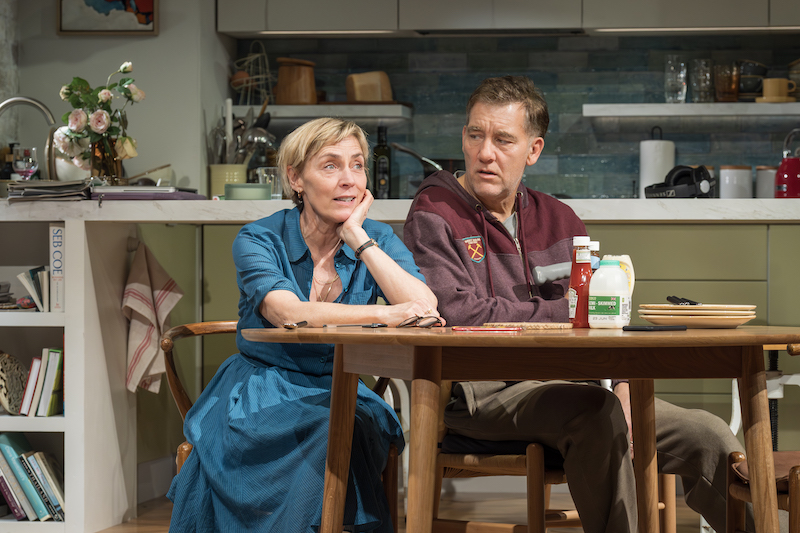
Completing David Eldridge’s trilogy of plays exploring heterosexual relationships is End, starring Clive Owen and Saskia Reeves as Alfie and Julie, two veterans of the 80s/90s Rave scene, and now both approaching their 60th birthdays. It’s unlikely that Alfie, once a famous House music DJ, will live long enough to reach this milestone, as he’s got cancer, and the play begins with him telling Julie, his partner, that he will refuse any further treatment.
Played in real time early one morning in their house in North London – Sally Ferguson’s lights stream bright sunshine through the window – End is incredibly sad as Alfie and Julie come to terms with mortality. Of course, Julie wants to change his mind or consider alternative treatment abroad. He, too, has looked at Laetrile treatment online, but isn’t convinced of its success. It would cost £50,000, the money they have saved for a rainy day. However, the size of their house would suggest that the pair isn’t short of a bob or two.
He’s spent half the previous night selecting club bangers to play at his funeral, although he later proclaims that he doesn’t want a funeral. And nor does he want his family at his bedside in the hospice where he inevitably will end up. He remembers visiting his dying father. Each time he said goodbye, he thought it would be the last time he saw him, and the next time, when he saw that his father was still clinging on, Alfie would be overjoyed for a few seconds before being overcome with the realisation that this might be the last time he saw his father alive.
Julie tells Alfie that he’s being selfish, not thinking of her feelings, or those of their adult daughter Annabelle. And yet, she knows too that it’s Alfie’s choice to make. These are familiar conversations in plays about death, but Owen and Reeves, at the top of their game, make the battle for a good death heartbreakingly poignant and fragile. Owen, especially, is expert in giving his character a sense of eleventh-hour agency when the world is closing down to a series of lasts; the last time he has sex with Julie, the last time West Ham played at Upton Park before the football team took the Olympic Stadium as its home. Julie’s as nostalgic for the London Games as Alfie is for the old Rave scene.
In comparison, Reeves’ Julie appears a little cold, especially when she declares that she wants to write a book about his death, a different kind of book from her successful crime novels. Of course, writing about her relationship with Alfie could be part of her mourning process, but she never says that she “needs” to write it all down, merely that she “wants” to. But when Alfie goes into the garden, Reeves quietly reveals how much his impending death is destroying Julie. Her muffled scream is truly devastating to watch.
Gary McCann’s intricately detailed set – an open kitchen with a working cooker; a living room with shelves stacked neatly with records and CDs; a staircase; a glimpse of a front door surrounded by stained glass windows -is a wonder to behold. But it is also unnecessary. Death is the great leveller, not just something that happens to the comfortable middle-class, although both actors’ accents hint that their characters were once more traditionally working-class. Just a black box with a sofa would have been enough to showcase the talents of Owen and Reeves. And End would be just as moving.
Runs until 17 January 2026
