

Writer: William Shakespeare
Director: Steffan Donnelly
For never was a story of more woe than those who chose to miss this production of Juliet and her Romeo.
Theatr Cymru and Steffan Donnelly’s production takes the original Shakespeare and the Welsh translation of the play by J.T. Jones, and creates a version which blends Welsh and English dialogue. This production has actors speaking both languages, but for those who do not speak Welsh, there is an app that can be downloaded prior to the start of the show. As the actors speak their lines in Welsh, the app does a live translation to guide the listeners. Those using the app will have to keep looking at their devices and may miss the actors’ expressions and movements. These attributes are masterfully done and help the non-Welsh speakers who opt out of using the app to still follow the emotional narrative of the story.
This production jumps straight into the building tension. The first lines are barely spoken before there is a contest between the actors over which language will be spoken to fully open the play. The Capulets prefer English, while the Montagues prefer Welsh. This divide in the usage and preference in language perfectly sets the rising hostility between the Capulets and Montagues.
Yet, the issue is that this tension between the usage of the two languages does not follow through in this production. The opening scene heavily alludes to the fact that there is not only a divide between families, but also in language. However, nearly all the characters can speak or at least understand Welsh. This production’s use of Welsh is meant to resemble how people in Wales, regardless of whether they speak the language, can still understand and interact with those who speak it.
The interaction between the two languages is beautifully done, but is rarely done enough. Most scenes focus on one language, perhaps with the occasional other language spoken a few times. The use of the two languages to heighten tensions is, therefore, sadly underwhelming. The tension is built on the original plot, while the two spoken languages add little to later tensions in future scenes.
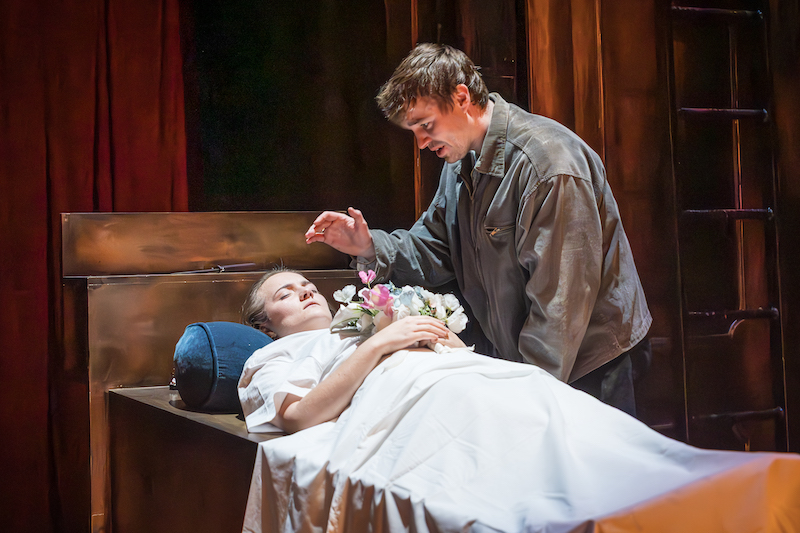
This production has a strong cast of actors. Easily able to step into each role, this cast embodies their character(s) with movements, prose, and facial expressions. Romeo (Steffan Cennydd) and Juliet (Isabella Colby Browne) lean heavily into the original characters’ ages. This is refreshing and works perfectly as Browne’s free-spirited Juliet matches with Cennydd’s Romeo, and with all their teenage angst quickly changing to suit their mood. From heartbreak over the death of Tybalt (Scott Gutteridge), to a giggling mess when they next meet to consummate their marriage, these two actors do a fabulous job reminding everyone that Romeo and Juliet are not adults. Interestingly, their emotional demands lead to the Nurse (Llinor ap Gwynedd) and Ffrier Lorens (Eiry Thomas) sometimes acting as surrogate mothers to small children throwing a temper tantrum. At times, Ffrier Lorens’ actions seem more in line with soothing the lovers to stop their dramatics than aiding them with their familial conflicts.
The narrative of the story is beautifully done. Occasionally, Donnelly opts to split the scene so some actors will be towards the front of the stage, while others hang back in the alcoves. This adds dimension to the scenes. This narrative emphasises the current tensions and allows characters not currently speaking to display their emotions. No other scene captures this better than when the heartbroken Romeo sits in the alcove, as the happily newlywed Juliet discovers her cousin has been killed by her new husband. Then the two switch, and Juliet sits in the alcove, as Romeo processes his emotions to Ffrier Lorens.
Welsh folk music and traditions play a strong backdrop to pivotal moments on stage. From Romeo and Juliet’s first meeting during the party, to their wedding, to Juliet’s fake death, this production highlights the importance of Welsh culture through Shakespearean storytelling.
This Romeo A Juliet has two love stories. The first is between Romeo and Juliet. The second, and much stronger, is this production’s love for the Welsh: their traditions, folk music, and language.
Runs until 8 November 2025 and continues to tour
