

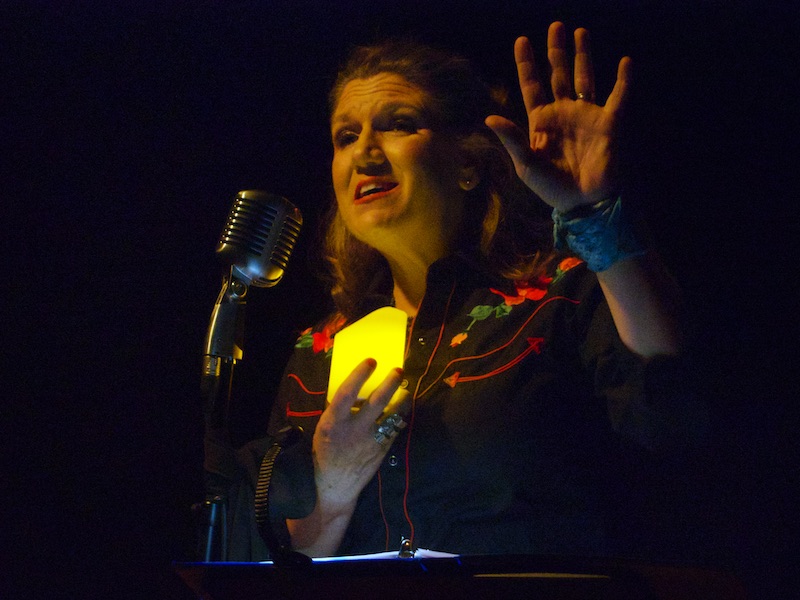
Writer: Stacie Burrows
Songs: Stacie Burrows and Sam Small
Director: Katierose Donohue Enriquez
The great writer and humorist Mark Twain is widely believed to have said that history does not repeat itself, but it rhymes. The attribution is probably false – the closest in Twain’s writings is a much longer phrase about how the kaleidoscopic view of the present is constructed out of the broken fragments of the past. But while that’s a beautiful visual that has meaning of its own, even that paraphrased summary is a bit of a mouthful. “History doesn’t repeat, it rhymes” is punchy to the point, whether Twain ever said so or not.
Similarly punchy and to the point is Stacie Burrows’s No Good Drunk, an exploration of how alcoholism has spread its diseased shadow over successive generations of the men in her family tree. She starts with the grandfather she never knew, and whom her grandmother never discussed. Dissolute alcoholic Buck was thrown out by his wife from the family Texas home, after which he moved to El Paso and his own daughter, Burrows’s mother, never saw him again. The performer uses a multimedia show to reveal extracts and remnants of her grandmother’s archives, discovered after her death, including to-the-point messages to the El Paso coroner, letters from Buck to his daughter, and more.
Burrows, who had moved to LA, recounts her journey back to Texas to learn more about this relative she never knew. She discovers his acquisition of a second life, and indeed a second wife, in El Paso, and that his eventual death to cirrhosis led to him being buried under a headstone engraved with his widow’s name, next to her first husband.
Burrows’s mother’s first husband, just as violent and aggressive a drunk as her father had been before him, also comes into the spotlight, although his death (by suicide) looms larger and longer, especially in the legacy of her half-brother, whose own addiction struggles continue.
So many of Burrows’s stories of the “no-good drunks” in her family are so redolent with pain brought on by the disease of alcoholism that it feels blessed to have a narrator who is imbued with optimism. The tales are interspersed with country songs co-written with Sam Small that, as befits the genre, turn heartbreak into moments for reflection and for seeking hope in the darkest places. If the lyrical rhyming schemes sometimes show the strain, there remains a propulsive thread that demonstrates that Burrows got her determination and grit from the women who came before her.
This is no hour of wallowing. Indeed, there is nothing but love threaded throughout. Her mother’s second husband – whose vice was gambling rather than alcohol – formed one half of a loving marriage that lasted for over 50 years, and photos of their hands clasped together near the end of their lives show that, even with the arguments that come with marriage, true love endures.
A common thread with these past stories, though, is how they were covered up and not spoken of. If Burrows is not outwardly scolding of such arrangements, she is clear that part of her brother’s poor mental health is tied to how he discovered his father’s suicide. She is clearer that when it comes to her own son, who faces the same disease, she is going to be open and honest. In that vein, and with his permission, she talks about his ongoing fight and the relapses that are part of the road to recovery.
History can and does repeat, even when we try to prevent it. But if we lean in to the rhyme, acknowledge them head-on and even turn them into country tunes, No Good Drunk shows us that the following verse can be different from the one that came before.
Runs until 29 October 2025
